Château de Montaner
The Château de Montaner stands as a remarkable example of medieval military architecture in the region of Béarn, southwestern France. Situated on an elongated plateau overlooking the Adour valley, this hill castle commands strategic views that were vital for controlling the frontier between Béarn, Bigorre, and Armagnac during the turbulent High Medieval period. Originally established in the 11th century as a motte castle by the Viscounts of Montaner, it was extensively rebuilt in the late 14th century under the direction of the renowned architect Sicard de Lordat at the behest of Gaston Fébus, the powerful Count of Foix and Viscount of Béarn.
Historical context and construction
The castle's initial incarnation in the 11th century took the form of a motte-and-bailey structure, typical of early medieval fortifications designed for rapid defense. However, the original earthwork fortifications were superseded in the 1370s by a robust brick fortress commissioned by Gaston Fébus, who sought to fortify Béarn's borders amid ongoing regional rivalries and the wider conflicts of the Hundred Years’ War. Sicard de Lordat, notable for his innovative use of brick—a material chosen for its relative affordability and speed of construction—was responsible for designing the castle’s distinctive polygonal enceinte and imposing keep.
Construction began around 1375, with the involvement of the Béarnese cagots, a marginalized group skilled in carpentry and brickwork, who played a crucial role in building the wooden frameworks and producing bricks. Their work was rewarded with tax exemptions and rights to forest resources, reflecting the social and economic dynamics tied to castle construction in the late medieval period. By late 1379, the castle was operational, though work continued into 1380 to complete the fortifications.
Architectural features and layout
The polygonal enceinte
The castle is defined by its vast polygonal enceinte, approximately 68 meters in circumference, composed of twenty wall sections reinforced by buttresses. This defensive wall encloses an interior courtyard of about 5,000 square meters, a considerable space for a medieval fortress. The enceinte includes two primary gateways, one of which was protected by a barbican, a fortified outwork that enhanced the castle’s defensive capabilities. Earthworks and additional fortifications are especially prominent on the northern side, underscoring the strategic emphasis placed on this approach.
The keep (donjon)
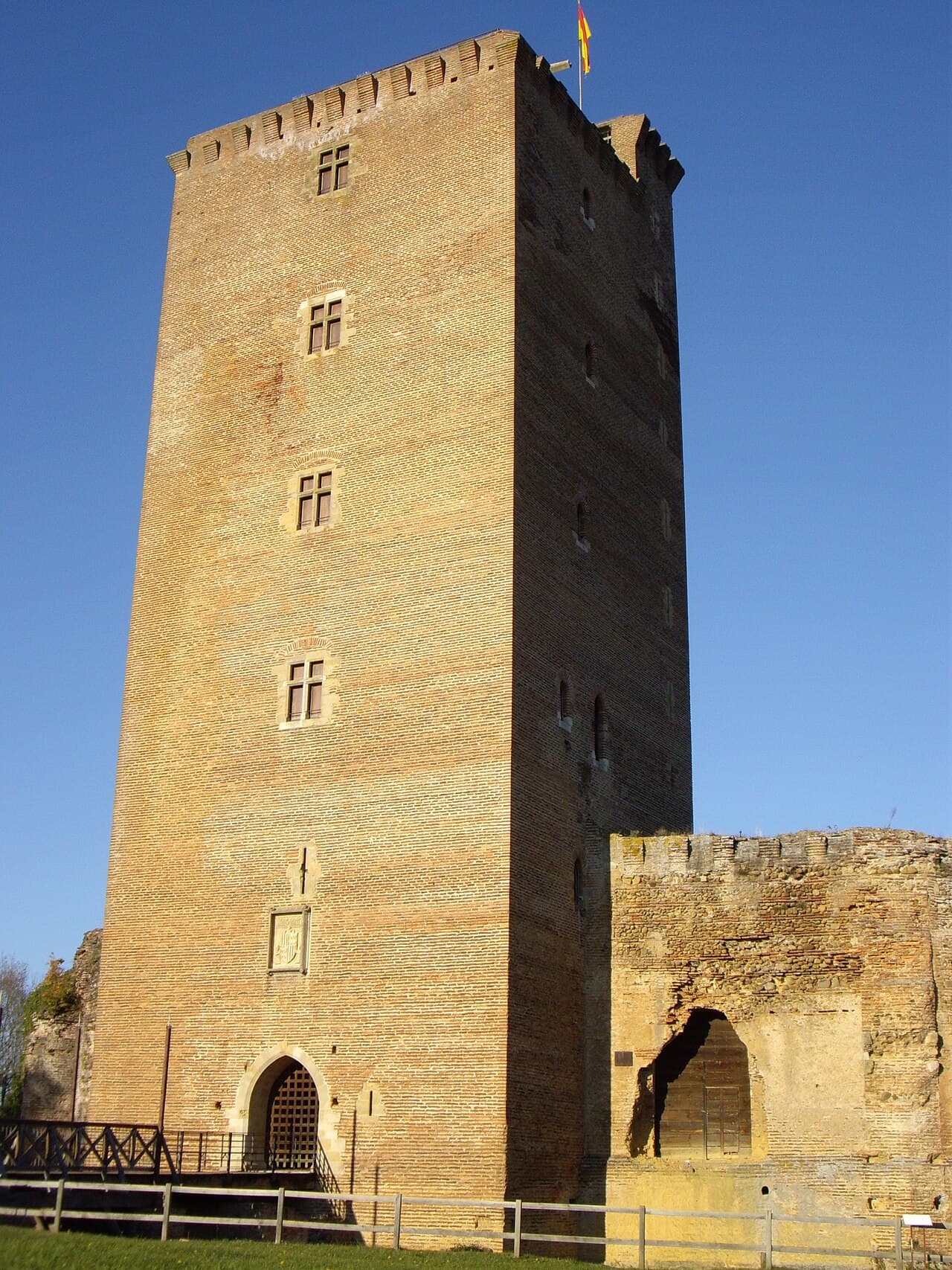
At the heart of the castle rises the imposing square keep, standing between 36 and 40 meters tall with five floors. This central tower served both as a last refuge in times of siege and as the main entrance, accessed via a swing bridge that could be raised to prevent enemy entry. The keep’s ground floor features a vaulted ceiling supporting the upper levels, which each contain twin windows allowing natural light to illuminate the interior chambers. Defensive features include narrow, cross-shaped arrow slits designed to enable archers to defend the castle while remaining protected.
Above the keep’s entrance is a prominently carved coat of arms divided into four quarters representing the historic regions of Foix and Béarn. This emblem is crowned with the Occitan inscription "Fébus mé fé" meaning "Fébus made me," a testament to Gaston Fébus’s patronage. The original carving was replaced by a replica in 1979 to preserve the emblem from weathering. Inside the keep, the coat of arms also appears near the fireplace on the first floor, emphasizing the symbolic importance of the fortress’s builder.
Interior buildings and courtyard
The castle’s interior courtyard housed various essential structures, including a great hall, kitchens, and residential lodgings. These buildings typically had two levels connected by an open gallery, reflecting the domestic architectural style of the medieval period. Notably, lavabos (basins for washing) and cupboards were integrated into the residential quarters, indicating a degree of comfort and functionality for inhabitants.
Archaeological excavations have revealed the presence of a windmill within the courtyard, suggesting additional practical facilities were once operational. A well centrally located in the courtyard provided a vital water supply during sieges, underscoring the castle’s design for prolonged defense.
Later history and preservation
Following the castle’s completion, its military significance fluctuated with the shifting political landscape. After 1425, the castle’s strategic importance waned due to the incorporation of Bigorre into Béarn-Foix and the subsequent union with the Kingdom of Navarre. However, during the 16th century and the Protestant Reformation, the castle regained prominence under Jeanne d’Albret, a key Protestant leader. It served as a watchpost monitoring Catholic royal forces amid religious conflicts.
In 1620, French royal troops stormed and largely destroyed the château in their efforts to reassert control over Béarn and restore Catholic dominance. The castle changed hands in 1627 when acquired by the Montesquiou-d’Artagnan family. Attempts to demolish the fortifications in 1641 were legally contested, preserving the main keep, which was later repurposed as a prison.
By the 19th century, the Château de Montaner had fallen into ruin, with parts dismantled for building materials. Public concern led to its designation as a historical monument in 1840. The Pyrénées-Atlantiques département acquired the site in 1854 and began restoration efforts, particularly from the mid-20th century onward. The association Pierres et Vestiges, later renamed Les Amis du Château de Montaner, played a significant role in preserving the site.
Today, the keep and curtain walls have been restored, including repairs to roofs and staircases. Other buildings remain primarily as foundations, but the courtyard has been cleared of overgrowth to maintain the site's integrity. The northern tower, barbican, and defensive earthworks have also been conserved. The adjacent former village site, with its own defensive walls, is protected as part of the monument historique classification, highlighting the extensive medieval complex that once thrived here.
Current use and cultural significance
Since the 19th century, the Château de Montaner has attracted visitors interested in medieval history and architecture. Managed by the Pyrénées-Atlantiques département until 2025, it remains a cultural landmark hosting numerous medieval-themed spectacles and exhibitions during the summer months. These events celebrate the castle’s rich heritage and provide immersive experiences that bring its history to life for modern audiences.
The castle’s unique use of brick, its impressive polygonal enceinte, and the towering keep make it a significant study subject for those interested in medieval fortifications and regional power dynamics in southwestern France. It stands as a testament to the architectural innovation and political complexities of the High Medieval period in Béarn.
Frequently asked questions (FAQ)
- How do I get to Château de Montaner?
- Château de Montaner is located in the picturesque village of Montaner, France. You can reach the castle by car, with parking available nearby, or by taking public transportation to the closest town and then a short taxi ride. The scenic drive through the French countryside adds to the charm of your visit.
- What is the historical significance of Château de Montaner?
- Château de Montaner was built in the 14th century and served as a fortress and a stronghold during the Hundred Years' War. It played a crucial role in the defense of the region against English invasions and is an excellent example of medieval military architecture. Its historical importance is recognized, making it a popular site for history enthusiasts.
- When was Château de Montaner built?
- Construction of Château de Montaner began in the early 14th century, specifically around 1300, and it was completed in the subsequent decades. The castle was strategically designed to serve as a military stronghold and has been well-preserved over the years. Its architecture reflects the defensive needs of the time.
- Can I take guided tours of Château de Montaner?
- Yes, guided tours of Château de Montaner are available, offering visitors in-depth insights into its history and architecture. These tours are conducted by knowledgeable guides who share fascinating stories and historical context. It's advisable to check the castle's official website for tour availability and scheduling.
- Why is Château de Montaner a popular tourist destination?
- Château de Montaner attracts visitors due to its stunning medieval architecture, rich history, and breathtaking views of the surrounding landscape. The castle's well-preserved structure allows guests to step back in time and experience the medieval era. Additionally, its location offers a tranquil escape from the hustle and bustle of larger cities.
- Is it possible to visit Château de Montaner year-round?
- Yes, Château de Montaner is open to visitors year-round, although opening hours may vary by season. It's best to check the official website for specific hours and any seasonal events that might enhance your visit. The castle's beautiful surroundings can be enjoyed in all seasons.
- What are the ticket prices for Château de Montaner?
- Ticket prices for Château de Montaner vary based on age and whether you choose a guided tour. Generally, adult tickets are reasonably priced, with discounts available for students and seniors. It’s recommended to purchase tickets in advance during peak tourist seasons to ensure availability.
- What are the opening hours of Château de Montaner?
- Château de Montaner typically opens from 10 AM to 6 PM during the summer months, while winter hours may vary. It's advisable to check the castle’s official website or contact them directly for the most accurate and up-to-date information regarding opening hours. Planning your visit according to these hours will help maximize your experience.
- What nearby attractions are there to explore?
- Visitors to Château de Montaner can explore several nearby attractions, including the charming village of Montaner and the stunning landscapes of the Pyrenees. The region is also known for its wineries, offering tours and tastings. Additionally, the historical towns of Pau and Tarbes are just a short drive away, providing more cultural experiences.
Photo gallery

Information
Website
Visit websiteSources & official resources
Verify the information above using these authoritative references.
Loading map...
Visitor reviews
No reviews yet. Been here? Write the first review and help other travelers!
Write the first reviewVisited this castle? Share your experience
Your review helps other travelers and adds first-hand knowledge to our encyclopedia.