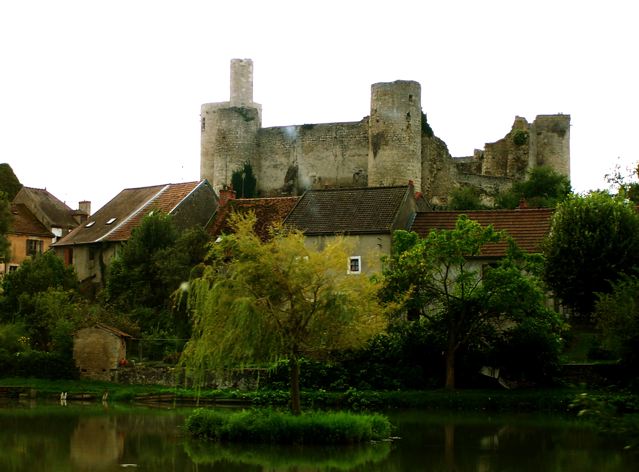
Château de Montaigu-le-Blin
The Château de Montaigu-le-Blin is a remarkable example of a medieval hill castle located in the village of Montaigu-le-Blin in France. Strategically positioned after the 13th century, it overlooks a vital route linking the Allier valley to the area surrounding Lapalisse. This location was crucial for controlling movement and trade between the valleys of the Allier and Besbre rivers within the historic Bourbonnais region.
Constructed initially as a defensive stronghold, the castle was under the control of the noble Chabannes family, who also held the nearby territory of Lapalisse. In the mid-15th century, Jacques de Chabannes, a prominent member of this lineage, initiated significant renovations that reflected the Renaissance architectural influences emerging at the time. These updates modernized the fortress, blending military functionality with the aesthetic and residential improvements characteristic of the period.
Historical significance and ownership
The castle's primary role throughout the medieval and Renaissance periods was to serve as a local stronghold overseeing the important corridor between the Allier and Besbre river valleys. Its strategic importance lay in monitoring and controlling access along this route, which was essential for regional security and commerce.
The Chabannes family maintained stewardship over the castle for several centuries, with Jacques de Chabannes' renovations marking a key moment in its architectural evolution. His work not only enhanced the defensive capabilities but also introduced Renaissance elements, such as the molded portal at the entrance, signifying a shift from purely military purposes to a more residential and representational function.
Architectural features and layout
Defensive structures
The castle's layout is centered around a central plan enclosed by formidable defensive walls. These walls are reinforced at the corners by a series of cylindrical towers, including two larger and three smaller towers, placed closely together to provide overlapping fields of fire and comprehensive defense coverage. This arrangement allowed defenders to effectively monitor and repel attackers from multiple angles.
Surrounding the main enclosure was a secondary lower wall, now largely in ruins, which would have added an extra layer of protection. Access to the fortress was originally controlled by a 14th-century drawbridge, spanning a defensive ditch or moat. This drawbridge was a critical security feature, enabling the inhabitants to control entry and exit during times of siege or attack.
Residential and entrance elements
Adjacent to the entrance, to the left of the drawbridge, stands the main residential building dating from the 14th century. This structure highlights the castle's dual role as both a military fortification and a noble residence. The entrance portal itself, crafted in the 15th century, is a fine example of Renaissance architectural style, featuring molded stonework that reflects the aesthetic sensibilities introduced by Jacques de Chabannes.
The donjon and central keep
At the heart of the castle enclosure once stood the donjon, or keep, a tall fortified tower that served as the last line of defense and the lord's stronghold. Although now in ruins, the donjon remains a powerful symbol of the castle's medieval origins and its historical role as a fortress designed to withstand prolonged sieges.
Preservation and modern history
By the 20th century, the Château de Montaigu-le-Blin had fallen into significant disrepair, with the threat of dismantling for its valuable limestone materials looming. In 1925, four local families united to acquire the castle, effectively preventing its destruction. This community-driven preservation effort was instrumental in saving the castle from ruin.
In recognition of its cultural and historical importance, the castle was officially designated a historic monument in 1926. This status has helped secure protection for the site, ensuring that the architectural heritage and historical legacy of the Château de Montaigu-le-Blin are preserved for future generations to study and appreciate.
Architectural style and construction period
The Château de Montaigu-le-Blin primarily exhibits characteristics of medieval military architecture with significant Renaissance influences introduced during the 15th century renovations. The original construction dates back to the 14th century, with later additions and modifications reflecting evolving defensive needs and aesthetic trends.
The castle's hilltop location classifies it as a hill castle, designed to maximize natural defensive advantages by leveraging elevated terrain. Its robust walls, cylindrical towers, and drawbridge are typical of fortifications built to withstand the military tactics of the late medieval period.
Visitor information and cultural significance
Today, the Château de Montaigu-le-Blin stands as a testament to the rich history of the Bourbonnais region and the architectural evolution from medieval fortress to Renaissance residence. Although parts of the castle are in ruins, the surviving structures offer valuable insights into the defensive strategies and noble lifestyles of the period.
The castle's preservation as a historic monument highlights its importance as a cultural landmark, attracting historians, architects, and visitors interested in medieval and Renaissance heritage. The site serves as an educational resource and a symbol of local identity and pride.
Frequently asked questions (FAQ)
- How do I get to Château de Montaigu-le-Blin?
- Château de Montaigu-le-Blin is located in the Auvergne region of France. You can reach it by car via the A71 motorway, and there are also local train services to nearby towns, from where you can take a taxi or bus to the castle.
- What is the historical significance of Château de Montaigu-le-Blin?
- Château de Montaigu-le-Blin dates back to the 15th century and is known for its unique blend of Gothic and Renaissance architecture. It played a significant role in the region's history, serving as a strategic fortress during various conflicts.
- When was Château de Montaigu-le-Blin built?
- Construction of Château de Montaigu-le-Blin began in the late 1400s and was completed in the early 1500s. The castle has undergone several renovations over the centuries, preserving its historical charm and architectural integrity.
- Can I visit Château de Montaigu-le-Blin year-round?
- Yes, Château de Montaigu-le-Blin is open to visitors throughout the year, although hours may vary by season. It is advisable to check the official website for the latest information on opening hours before planning your visit.
- Why is Château de Montaigu-le-Blin a popular tourist attraction?
- Château de Montaigu-le-Blin attracts visitors with its stunning architecture, rich history, and beautiful surrounding landscapes. Additionally, the castle often hosts cultural events and exhibitions, making it a vibrant part of the local community.
- Is it possible to take guided tours of the château?
- Yes, guided tours are available at Château de Montaigu-le-Blin, offering deeper insights into its history and architecture. Reservations are recommended, especially during peak tourist seasons, to ensure availability.
- What are the ticket prices for visiting Château de Montaigu-le-Blin?
- Ticket prices for Château de Montaigu-le-Blin vary depending on age and group size, with discounts often available for students and seniors. It's best to check the official website for the most current pricing information before your visit.
- What is the best time to visit Château de Montaigu-le-Blin?
- The best time to visit Château de Montaigu-le-Blin is during the spring and early autumn months when the weather is mild and the gardens are in full bloom. This is also when many cultural events and festivals take place, enhancing the visitor experience.
- Are there any nearby attractions to visit along with Château de Montaigu-le-Blin?
- Yes, there are several nearby attractions, including beautiful hiking trails and other historic sites in the Auvergne region. Visitors can also explore charming villages and local markets that showcase the region's culture and gastronomy.
Information
Loading map...
Visitor reviews
No reviews yet. Been here? Write the first review and help other travelers!
Write the first reviewVisited this castle? Share your experience
Your review helps other travelers and adds first-hand knowledge to our encyclopedia.