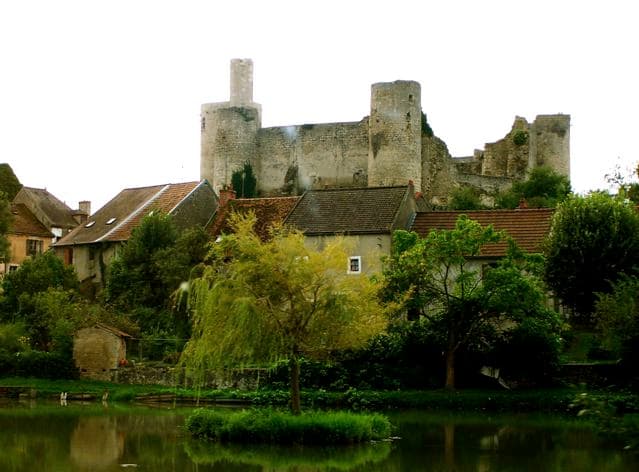
Château de Billy — France castle

Château de Billy

Château de Billy: medieval hill castle ruins in Allier, France
Billy, France
High Medieval (11th–13th c.)
Ruins

The Château de Billy stands as a significant example of medieval military architecture in the Allier département of France. Perched on a limestone promontory approximately 50 meters above the surrounding landscape, the castle commands sweeping views over the Allier River valley and the village of Billy. This strategic location underscores the castle's historical role as a defensive stronghold and administrative center within the region.

Constructed initially in the late 12th or early 13th century, the castle's origins coincide with the expansion of royal authority under King Philip II of France, particularly following his conquest of Auvergne around 1213. The early phase of the castle's development is closely linked to the Bourbon family, who acquired it in 1232 when Archambaud VIII of Bourbon purchased it from Hugues de Colombie. This acquisition integrated the château into the powerful Bourbon domain, which played a pivotal role in the political landscape of medieval France.

Historical significance and ownership

Throughout the High medieval and Late medieval periods, Château de Billy served as a key administrative hub, functioning as the seat of a royal bailiwick and later a châtellenie, a form of lordship linked to the emerging Duchy of Bourbon. The castle's strategic importance was heightened by its position amid the longstanding rivalries between the Bourbons and the Counts of Auvergne, who were aligned with English interests through the Dukes of Aquitaine.

By the early 16th century, Château de Billy had evolved beyond a mere fortress into a fortified town, reflecting its growing political and economic significance. It ranked second among the seventeen châtellenies in the Bourbonnais territory, overseeing a vast jurisdiction that included 62 parishes and several subordinate lordships. The castle reached a peak of influence during the administration of Pierre, the illegitimate son of Charles I, Duke of Bourbon, who governed the site from 1471 to 1488.

The confiscation of the estates of the Constable of Bourbon in 1527 marked a turning point, bringing Château de Billy under direct royal control. Despite this, the castle maintained its military relevance through the 16th century, notably during the French Wars of Religion. In 1576, it was besieged and temporarily occupied by forces loyal to the Protestant Prince de Condé and the German prince Johann Casimir. The siege inflicted significant damage to the fortifications, which were never fully restored.

Following the turbulent religious conflicts, the castle's role as an administrative center diminished. In 1596, King Henry IV pawned the château to creditors, including financier Sébastien Zamet. Subsequently, the property passed through various private owners until the French Revolution, during which time the castle was repurposed as a prison until 1790. The 19th century saw the fortress fall into neglect, with local inhabitants removing stones for building materials.

The local municipality purchased the ruins in 1963, initiating preservation efforts to maintain this historic monument.

Architectural features and layout

Château de Billy exemplifies the hill castle typology, utilizing its elevated position for defense and surveillance. The castle's layout is characterized by an ovoid upper courtyard (haute cour) enclosed by a polygonal curtain wall measuring roughly 50 meters east to west and 40 meters north to south. This wall is reinforced by six semi-circular towers strategically placed along the north, south, and west sides to provide overlapping fields of fire.

The main entrance is protected by a formidable châtelet gatehouse with twin towers, featuring a 14th-century pointed arch and a groove for a portcullis, a heavy wooden gate designed for enhanced security. This defensive gateway exemplifies the military architectural innovations of the period.

Dominating the eastern side of the enclosure is a tall cylindrical donjon or keep, primarily constructed in the 14th century and possibly heightened during that time. Attached to the donjon is a polygonal stair turret facilitating access to the upper levels. The castle also includes an octagonal watchtower known as "La Guette," added under the rule of Duke Louis II of Bourbon, which served as an observation post overseeing the surrounding countryside.

Beneath the upper courtyard lies the expansive outer bailey (basse-cour), an oval-shaped enclosure extending over 120 meters in length and nearly 100 meters across. The curtain walls here adapt to the uneven terrain with a combination of straight, curved, and irregular sections. Defensive features include archères en rame, narrow vertical arrow slits typical of 13th-century royal fortifications, allowing defenders to repel attackers effectively.

The outer bailey contains a captain's residence and a guardhouse built during the 15th century, reflecting the castle's evolving domestic and military functions. Archaeological excavations have revealed the foundations of various service buildings, including stables adjacent to the southern curtain wall and other structures along the northern wall.

A chapel once adjoined the southern tower of the châtelet, now in ruins but retaining traces of painted vaults that hint at its former decorative richness. In the late 16th century, one of the northern semi-circular towers was converted into a prison cell, a function it maintained until the French Revolution.

The castle's construction materials primarily include local limestone and sandstone, chosen for their availability and durability. The walls and towers exhibit robust masonry techniques characteristic of medieval fortifications in the region.

Preservation and cultural heritage

Recognized for its historical and architectural significance, Château de Billy has been protected as a monument historique since 1921, with the outer enceinte receiving similar status in 1929. The entire village of Billy was designated a heritage site in 1975, underscoring the castle's integral role within the local cultural landscape.

Partial restorations during the 20th century have focused on stabilizing the ruins to prevent further deterioration. Today, the site offers visitors a tangible connection to the medieval past through its well-preserved defensive walls, towers, and the imposing donjon.

Visitors can explore the castle ruins and the surrounding fortified town layout, gaining insight into the military, administrative, and residential functions that shaped the château's history. The panoramic views from the curtain walls and the southern walkway provide a striking perspective of the Allier valley and the village below.

Château de Billy remains a poignant symbol of the Bourbonnais heritage and medieval French fortification architecture, drawing scholars, history enthusiasts, and tourists alike.

Frequently asked questions (FAQ)

How do I get to Château de Billy?
Château de Billy is located in the charming village of Billy, France, easily accessible by car or public transportation. If you're driving, it's situated just off the main road connecting nearby towns. Public transport options include regional trains and buses that frequently stop near the castle.
What is the historical significance of Château de Billy?
Château de Billy dates back to the 15th century and has played a crucial role in French history, serving as a noble residence. Its architecture reflects the transition from medieval fortifications to Renaissance elegance, showcasing the evolution of French castle design. The castle has been a witness to various historical events, making it an important cultural landmark.
When was Château de Billy built?
Construction of Château de Billy began in the late 15th century, with significant renovations occurring in the following centuries. The castle's design incorporates elements from both the medieval and Renaissance periods, making it a unique architectural gem. Visitors can explore the various styles that have been preserved over the years.
Can I take guided tours of Château de Billy?
Yes, guided tours are available at Château de Billy, offering visitors a deeper insight into its history and architecture. Tours are conducted by knowledgeable guides who share fascinating stories and details about the castle. It's recommended to book in advance, especially during peak tourist seasons.
Why is Château de Billy considered an architectural gem?
Château de Billy is renowned for its stunning blend of medieval and Renaissance architectural styles, featuring intricate stonework and elegant design elements. The castle's layout includes impressive towers, beautiful gardens, and well-preserved interiors that reflect its noble heritage. This unique combination makes it a must-see for architecture enthusiasts.
Is it possible to host events at Château de Billy?
Yes, Château de Billy offers facilities for hosting various events, including weddings and corporate gatherings. The picturesque setting and historical ambiance provide a memorable backdrop for any occasion. Interested parties should contact the castle management for details on availability and services.
What are the opening hours for Château de Billy?
Château de Billy is typically open to visitors from 10 AM to 5 PM, but hours may vary based on the season and special events. It's advisable to check the official website or contact the castle directly for the most current information before planning your visit. Extended hours may be available during peak tourist months.
What are the ticket prices for visiting Château de Billy?
Ticket prices for Château de Billy generally range from €8 for adults to €4 for children aged 6-12. Children under 6 can enter for free. Discounts may be available for groups and seniors, so be sure to inquire when purchasing your tickets.
When is the best time to visit Château de Billy?
The best time to visit Château de Billy is during the spring and early autumn months when the weather is mild and the gardens are in full bloom. This period also sees fewer crowds compared to the peak summer months, allowing for a more enjoyable experience. Spring festivals and events may also enhance your visit.
What nearby attractions should I visit while at Château de Billy?
While visiting Château de Billy, consider exploring the nearby historic town of Billy, known for its charming streets and local cuisine. Additionally, the picturesque countryside offers beautiful hiking trails and scenic views. Other nearby attractions include local vineyards and other historical landmarks that showcase the region's rich heritage.

Photo gallery

Château de Billy
Click to view

Photo by DVernon at English Wikipedia•Public domain

1 photo • Click any image to view in full screen

Information

Hill Castle

Sources & official resources

Verify the information above using these authoritative references.

Loading map...

Visitor reviews

No reviews yet. Been here? Write the first review and help other travelers!

Write the first review

Visited this castle? Share your experience

Your review helps other travelers and adds first-hand knowledge to our encyclopedia.

Write a review

(5/5)

0/2000 characters

Your review will be visible after admin approval

Nearby castles

9.3 km

Château de Montaigu-le-Blin

, France

The Château de Montaigu-le-Blin is a remarkable example of a medieval hill castle located in the village of Montaigu-le-Blin in France. Strategically positioned after the 13th century, it overlooks a vital route linking the Allier valley to the area surrounding Lapalisse. This location was crucial for controlling movement and trade between the valleys of the Allier and Besbre rivers within the historic Bourbonnais region.Constructed initially as a defensive stronghold, the castle was under the control of the noble Chabannes family, who also held the nearby territory of Lapalisse. In the mid-15th century, Jacques de Chabannes, a prominent member of this lineage, initiated significant renovations that reflected the Renaissance architectural influences emerging at the time. These updates modernized the fortress, blending military functionality with the aesthetic and residential improvements characteristic of the period.Historical significance and ownershipThe castle's primary role throughout the medieval and Renaissance periods was to serve as a local stronghold overseeing the important corridor between the Allier and Besbre river valleys. Its strategic importance lay in monitoring and controlling access along this route, which was essential for regional security and commerce.The Chabannes family maintained stewardship over the castle for several centuries, with Jacques de Chabannes' renovations marking a key moment in its architectural evolution. His work not only enhanced the defensive capabilities but also introduced Renaissance elements, such as the molded portal at the entrance, signifying a shift from purely military purposes to a more residential and representational function.Architectural features and layoutDefensive structuresThe castle's layout is centered around a central plan enclosed by formidable defensive walls. These walls are reinforced at the corners by a series of cylindrical towers, including two larger and three smaller towers, placed closely together to provide overlapping fields of fire and comprehensive defense coverage. This arrangement allowed defenders to effectively monitor and repel attackers from multiple angles.Surrounding the main enclosure was a secondary lower wall, now largely in ruins, which would have added an extra layer of protection. Access to the fortress was originally controlled by a 14th-century drawbridge, spanning a defensive ditch or moat. This drawbridge was a critical security feature, enabling the inhabitants to control entry and exit during times of siege or attack.Residential and entrance elementsAdjacent to the entrance, to the left of the drawbridge, stands the main residential building dating from the 14th century. This structure highlights the castle's dual role as both a military fortification and a noble residence. The entrance portal itself, crafted in the 15th century, is a fine example of Renaissance architectural style, featuring molded stonework that reflects the aesthetic sensibilities introduced by Jacques de Chabannes.The donjon and central keepAt the heart of the castle enclosure once stood the donjon, or keep, a tall fortified tower that served as the last line of defense and the lord's stronghold. Although now in ruins, the donjon remains a powerful symbol of the castle's medieval origins and its historical role as a fortress designed to withstand prolonged sieges.Preservation and modern historyBy the 20th century, the Château de Montaigu-le-Blin had fallen into significant disrepair, with the threat of dismantling for its valuable limestone materials looming. In 1925, four local families united to acquire the castle, effectively preventing its destruction. This community-driven preservation effort was instrumental in saving the castle from ruin.In recognition of its cultural and historical importance, the castle was officially designated a historic monument in 1926. This status has helped secure protection for the site, ensuring that the architectural heritage and historical legacy of the Château de Montaigu-le-Blin are preserved for future generations to study and appreciate.Architectural style and construction periodThe Château de Montaigu-le-Blin primarily exhibits characteristics of medieval military architecture with significant Renaissance influences introduced during the 15th century renovations. The original construction dates back to the 14th century, with later additions and modifications reflecting evolving defensive needs and aesthetic trends.The castle's hilltop location classifies it as a hill castle, designed to maximize natural defensive advantages by leveraging elevated terrain. Its robust walls, cylindrical towers, and drawbridge are typical of fortifications built to withstand the military tactics of the late medieval period.Visitor information and cultural significanceToday, the Château de Montaigu-le-Blin stands as a testament to the rich history of the Bourbonnais region and the architectural evolution from medieval fortress to Renaissance residence. Although parts of the castle are in ruins, the surviving structures offer valuable insights into the defensive strategies and noble lifestyles of the period.The castle's preservation as a historic monument highlights its importance as a cultural landmark, attracting historians, architects, and visitors interested in medieval and Renaissance heritage. The site serves as an educational resource and a symbol of local identity and pride.

Late Medieval (14th–15th c.)
Details
15.7 km

Castle of La Palice

Lapalisse, France

The Castle of La Palice is a remarkable historic monument located in the town of Lapalisse, France, overlooking the scenic Besbre Valley. This castle is notable for its continuous habitation by the same noble family, the Chabannes, since 1430, making it a unique example of a medieval fortress evolving into an elegant Renaissance chateau. The origins and medieval construction The castle's origins date back to the 11th century, with construction spanning through to the 13th century. Initially built as a fortified medieval stronghold, it served both defensive and residential purposes typical of the High Medieval period. The fortress was strategically positioned to dominate the surrounding landscape and protect the holdings of the Chabannes family. The medieval section includes robust stone curtain walls and several towers that exemplify the military architecture of the period. The completion of the medieval fortress is credited to Jacques I de Chabannes around 1430, who consolidated the castle's defensive structures and residential quarters. Gothic chapel and Renaissance transformation In 1470, a Gothic-style chapel was added to the castle complex. This chapel was originally connected to the feudal fortress by a curtain wall, integrating religious functions into the castle's layout. The chapel is notable for its architectural style and the crypt beneath it, which contains the tombs of the Chabannes family, including an exquisitely carved tomb effigy of Jacques I and his wife. The early 16th century marked a significant transformation under Jacques II de Chabannes, a marshal of France and grandson of Jacques I. He replaced the curtain wall with a striking Renaissance wing constructed from distinctive pink brick. This addition introduced refined Renaissance aesthetics to the castle, blending the medieval fortress with elegant residential architecture. The Renaissance wing is renowned for its superb interior decorations, including the golden drawing room which features the only known Italian Renaissance-style coffered ceilings in Europe. These ceilings are distinguished by raised, colorful box beams inlaid with gold leaf, showcasing exceptional craftsmanship and artistic influence from Italy. Architectural features and layout The castle today presents a harmonious juxtaposition of architectural styles. From left to right, visitors can observe the Gothic chapel with its crypt, the rose-colored brick Renaissance wing, and the original medieval castle with its imposing towers and curtain walls. The medieval part retains its fortress character with defensive elements designed for protection during the turbulent medieval era. Inside, the castle is fully furnished with period-appropriate decor and houses an extensive collection of historic memorabilia. This includes magnificent old tapestries, a well-stocked library, and various historical artefacts that illustrate the life and status of the Chabannes family over centuries. Visiting the castle and its grounds Although the castle remains privately owned by descendants of the Chabannes family, it is open to the public for guided tours. Visitors can explore the richly decorated interiors, including the famous golden drawing room and the chapel crypt, gaining insight into both the architectural evolution and the noble lineage associated with the site. The castle is set within a beautiful parkland featuring century-old trees and landscaped gardens, providing a tranquil environment that complements the historic atmosphere. The park offers a pleasant setting for visitors to relax and reflect on the castle's rich heritage after touring the interiors. Historical significance and cultural heritage The Castle of La Palice stands as a testament to the architectural and social history of the region. Its continuous occupation by the same family for nearly six centuries is rare and adds to its cultural significance. The castle embodies the transition from a medieval fortress to a Renaissance residence, reflecting broader historical trends in French noble architecture. The presence of the Gothic chapel and Renaissance wing within the same complex illustrates the evolving tastes and functions of aristocratic residences from the High Medieval to the Renaissance periods. The castle's preservation and public accessibility allow for an appreciation of these historical layers and the enduring legacy of the Chabannes family.

High Medieval (11th–13th c.)
Details
16 km

La Palice Castle

Allier, France

La Palice Castle, located in the town of Lapalisse within the Allier department of central France, stands as a remarkable example of a hill castle that has evolved architecturally over several centuries. Dominating the Besbre valley and overlooking the rooftops of Lapalisse, this castle offers a fascinating journey through medieval and Renaissance history, reflecting the strategic importance and noble prestige of the region. The castle's origins date back to the 11th to 13th centuries, when it was initially constructed as a fortified stronghold by feudal lords to control the vital passage through the Besbre valley. This location was part of the defensive Bourbonnais line along the border with the Duchy of Burgundy, underscoring its military significance. The castle's name derives from the lice, a wooden palisade of sharpened stakes that once encircled the fortress, providing formidable defense. Historical evolution and noble lineage Ownership of the castle transitioned through prominent noble families, beginning with the La Palice family in the 13th century. By 1430, the castle came under the control of the Chabannes family, who played a pivotal role in regional and national politics. Jacques I de Chabannes, a distinguished lord, notably hosted King Charles VII at La Palice in 1452, highlighting the castle's role as a center of political and military activity during the late Middle Ages. Around 1470, Geoffroy de Chabannes commissioned the construction of the Gothic Saint-Léger chapel, replacing the earlier Romanesque chapel. This chapel, attached to the southern curtain wall, became the burial site for Jacques I de Chabannes and his wife, whose recumbent effigies remain significant relics despite damage sustained during the French Revolution. Architectural features and styles Medieval fortress elements The castle retains substantial elements of its medieval fortifications, including multiple defensive towers, a central keep with a distinctive pepperpot-shaped roof, and remnants of wooden hoardings that once provided active defense. The original drawbridge and the surrounding wooden palisade exemplify typical feudal military architecture designed for both defense and control of the surrounding landscape. Renaissance transformation In the early 16th century, Jacques II de Chabannes, who served as marshal of France under King François I, initiated a significant transformation of the castle. Around 1520, he added a Renaissance wing constructed of distinctive polychrome bricks in rose and black hues, characteristic of the Bourbonnais region. This wing replaced part of the medieval curtain wall, signaling a shift from a purely defensive fortress to a more elegant noble residence. A notable feature of this addition is the hexagonal "tour de la Marquise" staircase tower. Its asymmetrical walls were designed to visually correct the skewed alignment of the Gothic chapel, reflecting Renaissance architectural ingenuity possibly inspired by Italian masters such as Benvenuto Cellini. Interior decoration and notable rooms The castle's interior offers a rich tapestry of historical and artistic elements. The Grand Salon on the ground floor features a painted coffered ceiling adorned with motifs such as dolphins and cornucopias, emblematic of Renaissance symbolism. Adjacent to this is an Italian-style studiolo with an intricately painted arabesque ceiling, demonstrating the influence of Italian Renaissance art. On the first floor, the Salon Doré or Chambre Royale stands out with its elaborate gilded coffered ceiling. Historically, this room displayed a series of 15th-century Flemish tapestries known as "The Nine Worthies," underscoring the castle's cultural refinement. Throughout the castle, ceilings are richly decorated with painted and gilded box beams, many restored to preserve their original splendor. Religious significance and funerary art The Saint-Léger chapel remains a focal point of religious and artistic heritage within the castle complex. Its chevet and side oratory, featuring a Gothic fireplace, were designed for private worship by the noble family. The chapel's crypt houses the tombs of the Chabannes family, including the mausoleums of Jacques I de Chabannes and his wife, which, despite revolutionary damage, continue to draw historical interest. A marble mausoleum for Jacques II de Chabannes, crafted by the Italian Giusti workshop around 1530, once adorned the castle but was destroyed during the French Revolution. Restoration efforts in the 19th century included adding a wooden spire to the chapel roof, enhancing its vertical silhouette and Gothic character. Later history and preservation Throughout the 17th and 18th centuries, the castle passed through the hands of noble families such as the La Guiche and Brunet d’Évry, and in 1724, the estate was elevated to a marquisate. However, the French Revolution brought significant turmoil, including pillaging and partial destruction, particularly to the chapel and its funerary monuments. Restoration efforts began in 1846 under the Chabannes family. Architect René Moreau led major restoration projects in 1885-1886, which included architectural enhancements such as the chapel's wooden spire and metal shutters on the south façade. The château was officially classified as a historic monument in 1862, with further protections added during the 20th century. Castle grounds and landscape The castle is surrounded by an enchanting shaded park featuring ponds, majestic centuries-old trees, and tree-lined alleys. The grounds include a conciergerie lodge, a brick garden bridge, and remnants of stone and marble statue pedestals scattered throughout the gardens. The stables and riding arena, originally built in 1613, were later redesigned by the noted landscape architect Paul de Lavenne, comte de Choulot. Visitors today enjoy a comprehensive experience that combines architectural splendor, historical depth, and natural beauty. The castle operates as a museum with furnished rooms that showcase historical artifacts, including a gold anchor linked to Admiral Horatio Nelson, further enriching the narrative of the castle's noble past. Notable visitors and cultural importance From the 14th to the 17th centuries, La Palice Castle hosted numerous French kings, including Charles VII, Louis XI, Charles VIII, Louis XII, François I, Henri II, Henri IV, Louis XIII, Louis XIV, and Louis-Philippe I. This illustrious list of visitors reflects the castle's significance as a royal and noble residence within the Bourbonnais region and its strategic and cultural importance in French history.

Details