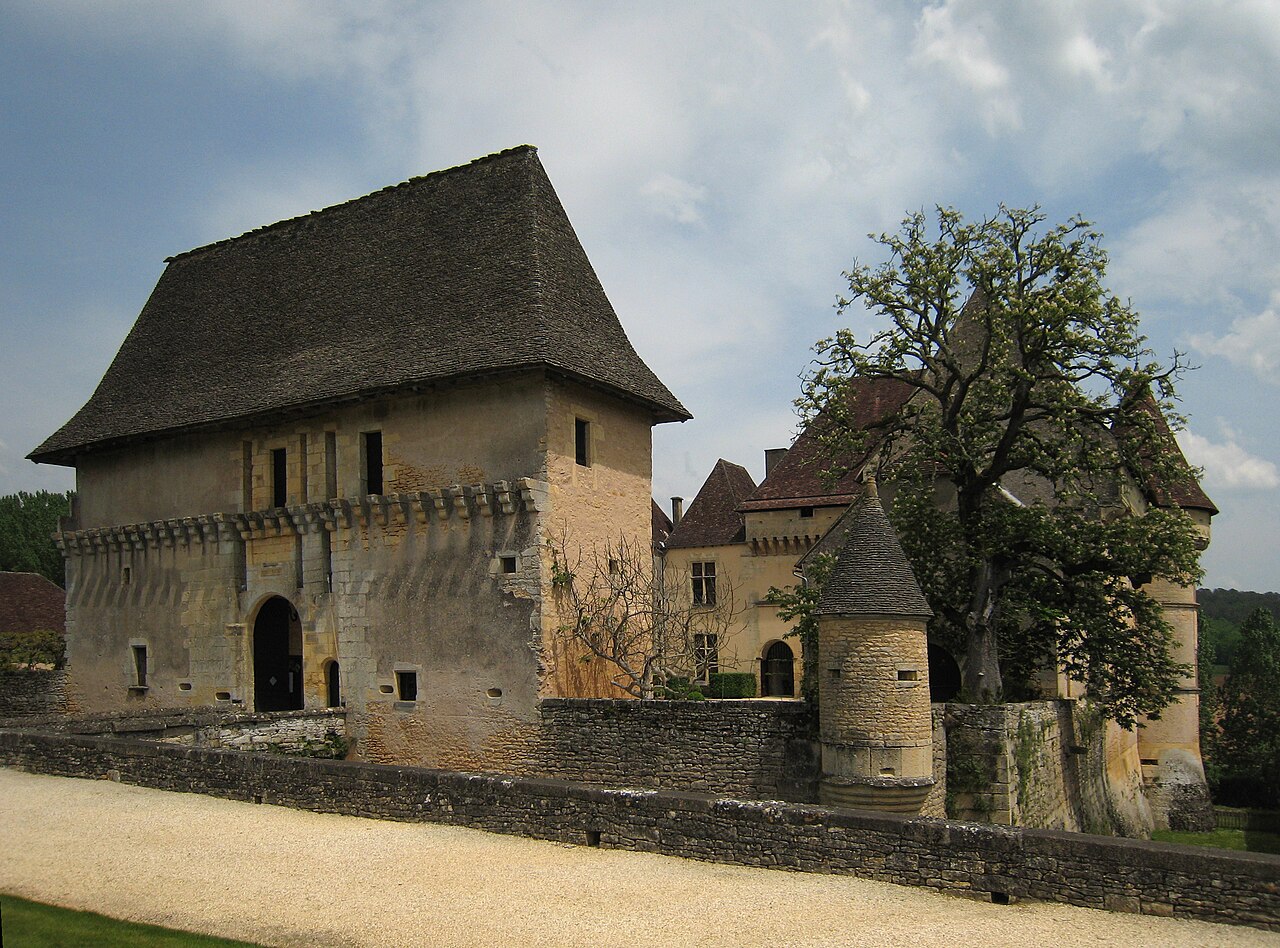
Château de la Grande Filolie
The Château de la Grande Filolie stands as a remarkable example of a late medieval hill castle in the Hauts-de-France region of France, near the historic town of Saint-Amand-de-Coly. Its origins span from the 15th to the 17th centuries, reflecting a fascinating evolution from a fortified noble residence to a more domesticated estate with Renaissance influences. The castle’s name is derived from a nearby former oil mill, a common feature in the Dordogne area, highlighting the estate’s connection to local agricultural and industrial activities.
The château’s history is deeply intertwined with the Beaulieu family, a noble lineage recognized in Montignac since the late 15th century. Antoine de Beaulieu, acknowledged in 1479, and his descendant of the same name, lord of La Filolie in 1536, likely initiated the construction of the château as it is known today. The estate remained in the family through the 16th and early 17th centuries, notably linking with the influential Fénelon family through marriage, which enhanced its social and political stature in the region.
Ownership passed to the Gaubert family in the 18th century, with Jeanne Chapt de Rastignac, widow of Nicolas de Gaubert, noted for her charitable contributions to the hospice in Sarlat. By the late 18th century, the estate belonged to Dominique de Beauroyre, Marquis de Villar, whose death in 1792 coincided with the turbulent years of the French Revolution. Despite the upheaval, the Beauroyre family retained ownership into the 19th century. The château was sold in 1891 to Octave Rousselet, who documented its features, and later to M. Babaud de Prasnaud de la Croze, who initiated restorative efforts. In the 20th century, prominent owners such as François Coty continued preservation work, ensuring the château’s survival.
Architectural features and layout
The Château de la Grande Filolie presents a harmonious blend of defensive medieval architecture and Renaissance stylistic elements. The complex is dominated by a large western building constructed in the early 17th century, notable for its two square towers with machicolations—defensive openings in the parapets used for dropping projectiles on attackers. The western wall is crenellated and pierced with firing holes, underscoring the castle’s military preparedness during periods of regional unrest.
One of the oldest parts of the château is a small northeastern building with an L-shaped plan, dating from the 15th century. This section reflects the late medieval architectural style typical of the region, built with traditional stone materials and designed for both habitation and defense.
Above an extensive vaulted cellar that historically served as a wine press, the main wing features dormer windows with pediments decorated by shell motifs, a hallmark of Renaissance ornamentation. The southeastern angle of the western wing houses the main entrance, which includes a bretèche, a small projecting defensive structure allowing defenders to observe or attack anyone approaching the gate.
Religious and auxiliary buildings
Adjacent to the main entrance is a chapel dedicated to Sainte-Marie de la Conception, believed to have been built in the 17th century. This private chapel illustrates the château’s religious significance and the role of faith in noble households. Nearby stands a building that once housed the concierge, terminating in a tower with a distinctive pepperpot roof—a steep, conical roof shape commonly used in French castle architecture. This tower also features machicolations, reinforcing the defensive character of the estate.
The château’s former eastern wing enclosed the courtyard and contained several outbuildings, including a drying room, workshop, and bakery. These structures supported the estate’s agricultural and domestic functions but were demolished after 1892, leaving the main defensive and residential buildings as the primary surviving elements.
Historical significance and social context
The Château de la Grande Filolie embodies the transition of noble estates from purely military fortresses to multifunctional residences blending defense, agriculture, and domestic comfort. Its history is marked by the influence of prominent families such as the Beaulieu, Gaubert, and Beauroyre lineages, whose stewardship reflects the social and political dynamics of the region from the late medieval period through the early modern era.
The estate’s agricultural heritage is evident in features like the vaulted cellar wine press and the former oil mill nearby, emphasizing the economic activities that sustained noble households. The château’s survival through the French Revolution and subsequent centuries, including restorative efforts by owners like Octave Rousselet and François Coty, highlights its cultural and architectural importance.
Preservation and current condition
Today, the Château de la Grande Filolie is well-preserved, showcasing a blend of medieval fortifications and Renaissance elegance. Its stone roofs, defensive towers, and internal vaulted spaces remain largely intact, offering valuable insights into the architectural and historical evolution of noble estates in the Hauts-de-France region.
While some sections, such as the eastern wing and associated outbuildings, have been lost, the château’s surviving structures provide a comprehensive view of its defensive and residential functions. The estate continues to attract interest for its architectural features, historical associations, and its role in illustrating the complex history of French noble residences.
Frequently asked questions (FAQ)
- When was Château de la Grande Filolie built?
- The château was constructed primarily between the 15th and 17th centuries, reflecting late medieval origins with Renaissance modifications.
- What architectural styles are present in Château de la Grande Filolie?
- The château features a mix of late medieval defensive architecture and Renaissance decorative elements, including machicolated towers and ornamental dormer windows.
- Is Château de la Grande Filolie open to visitors?
- Visitor access details are limited; it is advisable to check local tourism resources for current opening hours and tour availability.
- What notable families owned Château de la Grande Filolie?
- The Beaulieu, Gaubert, and Beauroyre families were prominent owners, with connections to the Fénelon family and regional nobility.
- What defensive features does Château de la Grande Filolie have?
- Key defensive features include crenellated walls, machicolated square towers, firing holes, and a bretèche above the main entrance.
Information
Loading map...
Visitor reviews
No reviews yet. Been here? Write the first review and help other travelers!
Write the first reviewVisited this castle? Share your experience
Your review helps other travelers and adds first-hand knowledge to our encyclopedia.