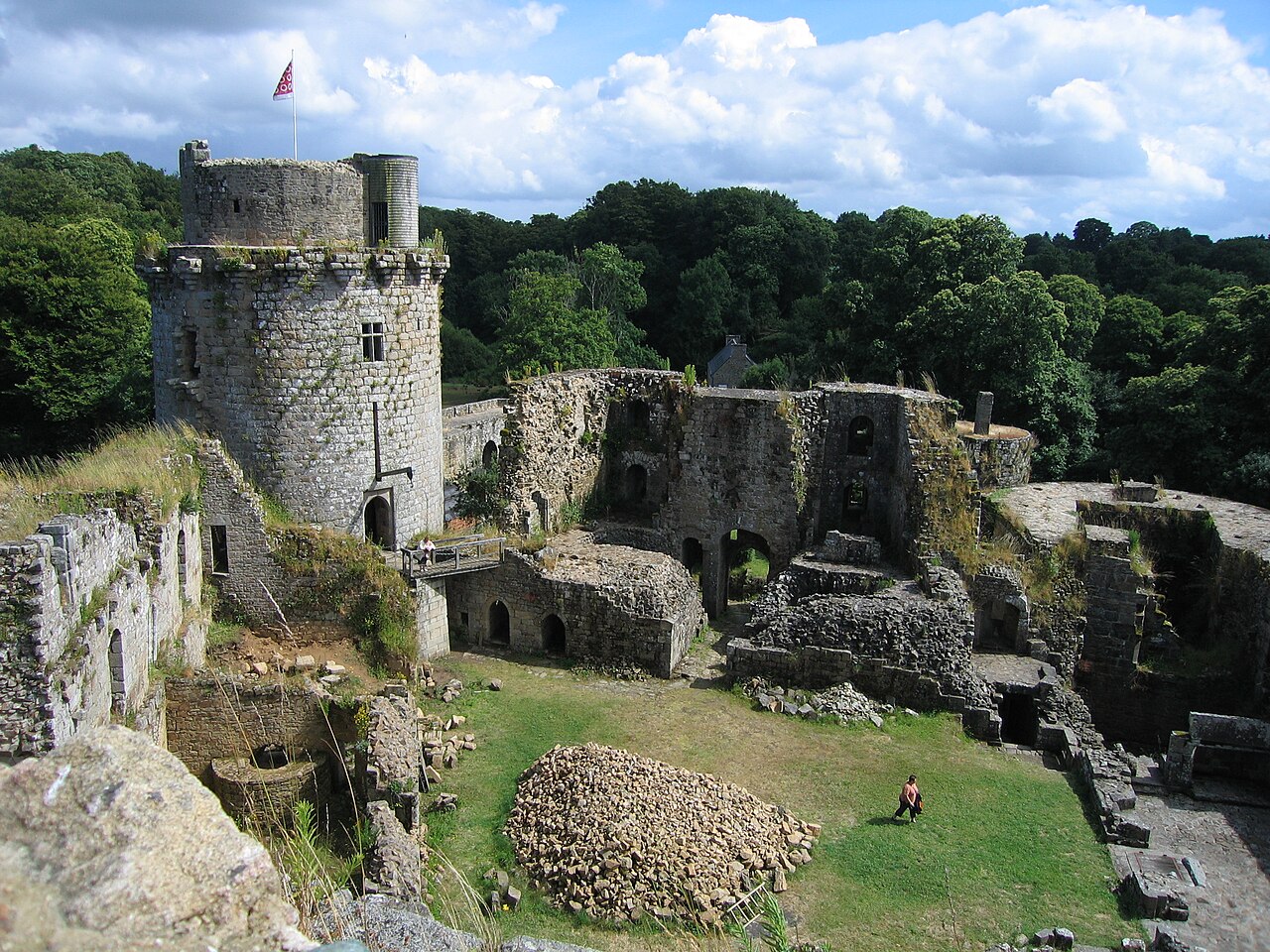
Château de Kergrist
The Château de Kergrist stands as a remarkable example of a Renaissance manor in the historic region of Trégor, Brittany. Originally constructed in the 15th century, the château reflects the architectural evolution from late medieval fortification traditions to Renaissance residential elegance. Its location in the municipality of Ploubezre, France, situates it within the culturally rich landscape of Hauts-de-France, where Breton nobility once asserted their influence through such estates.
The château’s construction began under the direction of Jehan de Kergrist and Gilette le Cozic, who established a manor centered on an octagonal tower flanked by two principal residential wings. This layout provided both defensive and domestic functions, with a vaulted passage linking the northern courtyard to a walled kitchen garden on the southern side. This spatial organization was typical of the period and region, blending practicality with aesthetic considerations.
Architectural development and expansions
During the 16th century, the château underwent significant enlargement with the addition of a second, larger tower opposite the original octagonal one. This extension symbolized the growing wealth and stature of the Kergrist family. The new tower altered the building’s symmetry and scale, enhancing its visual prominence and residential capacity.
In the same century, ownership passed through marriage to Jonathas de Kergariou and Marie de Kergrist. Their tenure marked a transition towards classical architectural elements, notably the construction of an east façade featuring a double straight-flight staircase that opened onto a formal French garden. This façade embodies the Renaissance-to-Classical stylistic shift, integrating grandeur and formality into the estate’s appearance.
17th and 18th-century modifications
The château’s southern façade, added during the 17th and 18th centuries, presents a more restrained interpretation of the eastern front’s design. This simpler façade reflects evolving tastes and possibly economic considerations of the later owners. Opposite the main building, the former stables have been fully converted into residential spaces, illustrating adaptive reuse practices that preserve historic structures while accommodating modern needs.
Historical context and ownership transitions
The Barbier family, marquises of Lescoët, acquired the château in the 18th century through marriage. Their tenure was disrupted by the French Revolution in 1792, which forced the family to abandon the property. Subsequently, the estate was confiscated as national property, divided into three parts, and suffered extensive looting, a fate common to many aristocratic residences during this turbulent period.
In 1867, the château was reacquired by Charles and Julien Huon de Penanster, who undertook a restoration aimed at reviving the 17th-century style of the building and its park. Their efforts included acquiring period furnishings and artworks, such as wood paneling from the Abbey of Beauport and paintings by renowned artists like Pierre Paul Rubens and Luca Giordano. These cultural enhancements enriched the château’s interiors, especially in the dining room, grand salon, and private chambers.
Gardens and landscape design
The château is surrounded by a park of approximately four hectares, featuring a diverse layering of garden styles that reflect centuries of landscape design evolution. The 19th-century redesign introduced a northern parterre aligned with the original Renaissance façade, an eastern French garden inspired by the work of André Le Nôtre, and a southern English garden positioned before a façade evoking the Louis XIV style.
This combination of formal French and informal English garden elements demonstrates a sophisticated approach to landscape architecture, blending geometric precision with naturalistic planting. The park also contains numerous aged trees dating from the 18th and 19th centuries, some of which were damaged during the storm of 1987. The creation of the "Jardin des Roches" in the 20th century introduced a unique feature using large granite blocks from a natural vein, integrating geological heritage into the garden’s design.
Architectural features and artistic heritage
The château’s core architectural elements include the octagonal tower, the second larger tower, and the vaulted passage connecting the courtyard to the kitchen garden. These features highlight the blend of defensive and residential functions typical of Breton manors transitioning from medieval fortifications to Renaissance estates.
The classical east façade with its double staircase is a key architectural highlight, showcasing the influence of Renaissance and Classical aesthetics. The southern façade provides a contrast with its simpler design, reflecting later stylistic preferences.
Inside, the château houses important artworks from the 17th century, including paintings by Luca Giordano and Pierre Paul Rubens. These pieces contribute significantly to the château’s cultural and historic value, enhancing the atmosphere of the dining room, grand salon, and private chambers.
Saint-Laurent chapel ruins
Nearby lie the ruins of the Saint-Laurent chapel, a spiritual site historically linked to the estate. The chapel’s remains add a layer of religious and cultural significance to the château’s surroundings, reflecting the intertwined nature of noble residences and ecclesiastical structures in Brittany.
Preservation and cultural significance
The façades of the Château de Kergrist were officially recognized as historic monuments in 1926, ensuring their protection and conservation. This status acknowledges the château’s architectural and historical importance, preserving a tangible link to Brittany’s Renaissance and Classical heritage.
Today, the château stands as a well-preserved example of a Breton manor that encapsulates centuries of architectural evolution, noble lineage, and cultural enrichment. Its combination of Renaissance architecture, classical garden design, and artistic heritage makes it a significant landmark within the region.
Frequently asked questions (FAQ)
- What are the opening hours of Château de Kergrist?
- Château de Kergrist is open to visitors from April to October, typically from 10 AM to 6 PM. During the off-peak months, the hours may vary, so it's best to check the official website before your visit. Guided tours are usually available during these hours, providing insights into the castle's rich history.
- How do I get to Château de Kergrist?
- Château de Kergrist is located in Ploubezre, France, and can be accessed by car or public transport. If you are driving, there is ample parking available near the site. For those using public transport, local buses connect Ploubezre with larger cities in the region.
- What is the historical significance of Château de Kergrist?
- Château de Kergrist dates back to the 16th century and is an important example of Breton architecture. It has been a witness to various historical events and represents the feudal history of the region. The castle has been well-preserved, making it a great location for those interested in French history.
- Can I take guided tours at Château de Kergrist?
- Yes, guided tours are available at Château de Kergrist, providing visitors with in-depth knowledge of its history and architecture. Tours are typically offered in multiple languages, making it accessible to a wider audience. It's recommended to book in advance during peak seasons to secure your spot.
- Is Château de Kergrist accessible for visitors with mobility issues?
- Château de Kergrist strives to be accessible to all visitors, including those with mobility challenges. While some areas of the castle may have limited accessibility due to historical preservation, staff is available to assist where possible. It's advisable to contact the castle in advance to discuss specific needs.
- What are the ticket prices for Château de Kergrist?
- Ticket prices for Château de Kergrist vary based on age and group size, with discounts often available for students and seniors. Children under a certain age may enter for free. For the most accurate and up-to-date pricing, it is best to check the official website before your visit.
- When is the best time to visit Château de Kergrist?
- The best time to visit Château de Kergrist is during the spring and early autumn months when the weather is mild, and the gardens are in full bloom. These seasons also tend to have fewer crowds compared to the peak summer months, allowing for a more enjoyable experience. Special events and exhibitions are often held during these times, enhancing your visit.
- Are there any nearby attractions to visit along with Château de Kergrist?
- Yes, there are several attractions near Château de Kergrist, including the picturesque coastal town of Perros-Guirec and the stunning pink granite coast. Visitors can also explore local markets and enjoy traditional Breton cuisine in nearby restaurants. These attractions make for a perfect day trip combined with your visit to the castle.
Information
Website
Visit websiteSources & official resources
Verify the information above using these authoritative references.
Loading map...
Visitor reviews
No reviews yet. Been here? Write the first review and help other travelers!
Write the first reviewVisited this castle? Share your experience
Your review helps other travelers and adds first-hand knowledge to our encyclopedia.