Château de Crussol
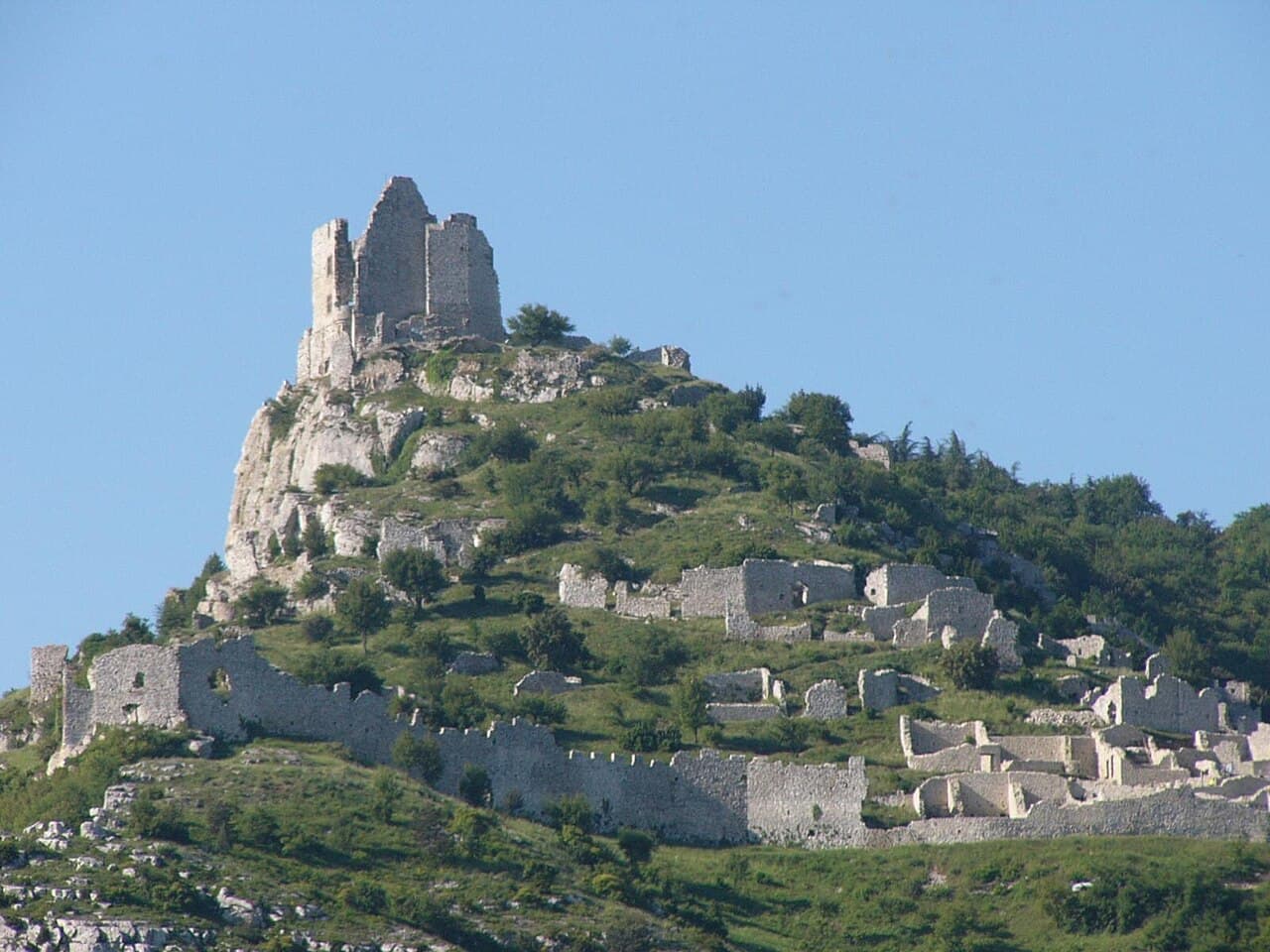
Château de Crussol stands as a remarkable medieval fortress perched atop a limestone cliff in the commune of Saint-Péray, France. This hill castle was originally constructed in the 12th century by the Bastet de Crussol family, a noble lineage that played a significant role in the region's medieval history. The castle's strategic location on a cliff 337 meters high overlooking the Rhône valley provided both defensive advantages and commanding views over the surrounding landscape, spanning several French départements including the Alps and Cévennes.
The site of Château de Crussol has a rich history of human occupation that predates the castle itself, with archaeological evidence revealing continuous settlement since the Upper Paleolithic era. Successive cultures, including those from the Neolithic, Bronze Age, Roman, and early medieval periods, utilized this location due to its natural prominence and defensibility. Historical documents from 963 AD mention a wooden fortification here, which was eventually replaced by the stone castle founded by Giraud I. Bastet in the early 12th century after acquiring the land through marriage in 1110.
Medieval origins and expansion
The initial construction of Château de Crussol reflects typical medieval military architecture of the period, emphasizing strong defensive walls and towers. Over the centuries, the Bastet de Crussol family expanded the castle complex, enhancing its fortifications and residential quarters. By the 15th century, the castle was not only a fortress but also a fortified village known as the Villette, capable of housing around 700 inhabitants. This village included essential communal facilities such as a chapel dedicated to the Virgin Mary, communal ovens, and a windmill, which supported the local population especially during times of conflict.
Architectural features and fortifications
The castle's defenses were formidable, featuring a ring wall approximately 335 meters in length, with thicknesses ranging from 0.8 to 1 meter and an average height of 8 meters. This wall was reinforced by two prominent towers: a round corner tower and a semicircular wall tower. The presence of wooden hoardings—overhanging wooden galleries used for defense—along the walls indicates advanced medieval defensive techniques, although the absence of arrow slits suggests construction methods dating back to before the 12th century.
The main entrance to the castle is marked by a fortified 12th-century gatehouse or châtelet, protected further by an outer barbican. This entrance led into the fortified village area, which served both as a residential and refuge zone. The core of the castle lies on the highest southern point of the site, dominated by a rectangular donjon or keep, which was the primary stronghold and last line of defense. Adjacent to the donjon is a 13th-century stone residential building notable for its stair tower, which provided access to upper floors. Within the central courtyard, a cistern carved into the bedrock collected water, essential for sustaining the inhabitants during sieges.
Historical significance and decline
Château de Crussol played a significant role during the French Wars of Religion in the 16th century, a period marked by intense conflict between Catholic and Protestant factions. The castle changed hands multiple times, suffering damage from sieges and fires. In 1622, to prevent its use by Protestant forces, Catholic commanders deliberately destroyed the castle's defensive structures through controlled explosions, leading to its ruin.
Subsequent centuries saw further degradation. In 1855, quarry explosions severely damaged the structure, and a lightning strike in 1952 destroyed the north tower. Despite this, the castle's historical importance was recognized early, and it was classified as a protected monument in 1927. Restoration efforts began in the 1960s under the Fondation de Crussol, with ongoing conservation managed by the municipality of Guilherand-Granges since 1984.
Current remains and natural environment
Today, the remnants of Château de Crussol cover about three hectares atop the cliff. Visitors can explore the surviving sections of the ring wall, the foundations of the donjon, parts of the residential building including the northern gable wall, and the ruins of the fortified village. The site offers panoramic views that highlight its strategic medieval significance.
Beyond its architectural and historical value, the castle's surroundings are ecologically important. The area is protected as a Natura 2000 site and designated an Espace naturel sensible, reflecting its role as a nature reserve. It supports a diverse ecosystem with around forty species of orchids, some unique to the region, as well as birds of prey, bats, wild boars, and various insects, making it a site of both cultural heritage and natural biodiversity.
Visitor experience and cultural heritage
Visitors to Château de Crussol can appreciate the blend of medieval architecture and natural beauty. The site’s ruins invite exploration of its defensive structures and village layout, while the surrounding landscape offers opportunities for hiking and wildlife observation. The castle remains a symbol of the region's rich medieval past and ongoing commitment to heritage preservation.
Frequently asked questions (FAQ)
- How do I get to Château de Crussol?
- Château de Crussol is located just outside of Saint-Péray, France. You can reach the castle by car, with parking available nearby, or by taking a local bus that services the area. The scenic drive offers beautiful views of the surrounding landscape.
- What is the historical significance of Château de Crussol?
- Château de Crussol dates back to the 12th century and played a crucial role in the region's defense during the Middle Ages. It was strategically positioned to oversee the Rhône River and the surrounding valleys. The castle is a testament to the military architecture of its time and offers insight into the feudal system.
- When was Château de Crussol built?
- Construction of Château de Crussol began in the late 11th century and was completed in the 12th century. Over the centuries, it underwent several modifications and expansions, reflecting the architectural styles of different periods. Today, it stands as a mix of historical influences.
- Can I visit Château de Crussol year-round?
- Yes, Château de Crussol is open to visitors throughout the year, although opening hours may vary by season. It is advisable to check the official website for the most current visiting times before planning your trip. Guided tours are available to enrich your experience.
- Why is Château de Crussol a popular tourist attraction?
- Château de Crussol is popular due to its stunning panoramic views of the Rhône Valley and the surrounding mountains. Its rich history and well-preserved ruins attract history enthusiasts and architecture lovers alike. Visitors also appreciate the tranquil setting ideal for leisurely exploration.
- Is it possible to access Château de Crussol with mobility challenges?
- While Château de Crussol is a historical site, some areas may be challenging for those with mobility issues due to uneven terrain and steep paths. However, visitors can enjoy the scenic views from the base of the castle and some accessible viewpoints around the area. It's recommended to contact the site in advance for specific accessibility options.
- What are the ticket prices for visiting Château de Crussol?
- Ticket prices for Château de Crussol are generally affordable, with discounts available for students and seniors. Children under a certain age may enter for free. It's best to check the official website for current pricing and any special offers before your visit.
- What is the best time to visit Château de Crussol?
- The best time to visit Château de Crussol is during the spring and early autumn when the weather is pleasant and ideal for outdoor exploration. These seasons also feature fewer tourists, allowing for a more relaxed experience. Summer can be hot, while winter may bring colder conditions.
- What nearby attractions can I explore while visiting Château de Crussol?
- While visiting Château de Crussol, you can explore the charming town of Saint-Péray, known for its vineyards and local wines. Additionally, the city of Valence is just a short drive away, offering cultural sites, shopping, and dining options. Nature lovers can enjoy hiking trails in the nearby hills.
Photo gallery

Information
Website
Visit websiteSources & official resources
Verify the information above using these authoritative references.
Loading map...
Visitor reviews
No reviews yet. Been here? Write the first review and help other travelers!
Write the first reviewVisited this castle? Share your experience
Your review helps other travelers and adds first-hand knowledge to our encyclopedia.