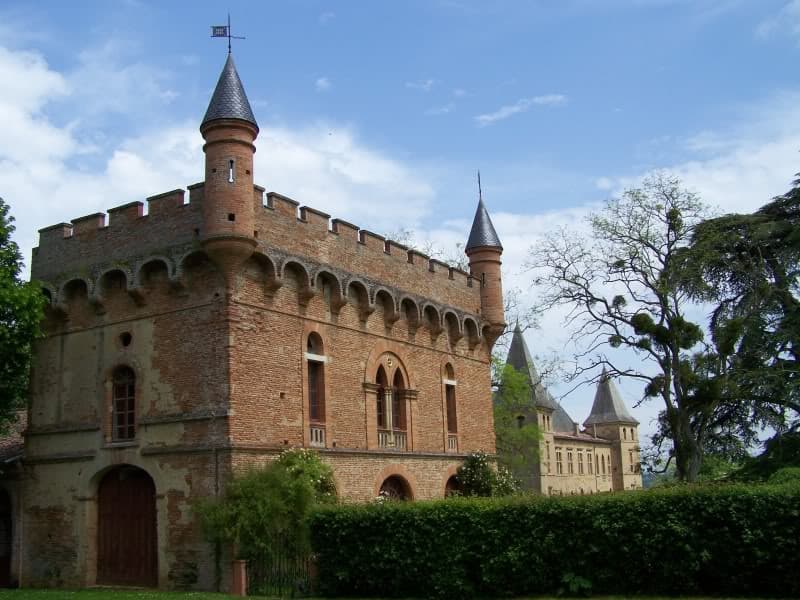
Château de Caumont
Château de Caumont stands as a remarkable example of Renaissance architecture nestled in the serene landscape of Cazaux-Savès, France. This hill castle overlooks the picturesque Save river valley from its elevated position, offering commanding views that once served both defensive and aesthetic purposes. The castle's origins trace back to an earlier fortified structure associated with the medieval noble Gaston Phoebus, but the present edifice was constructed between 1525 and 1535, during a period of significant architectural transition in France.
Architectural features and design
The castle is built on a foundation of two levels of extensive underground vaults, which provided both storage and structural support. Its layout is characterized by a U-shaped plan formed by three wings that enclose a spacious, beautifully restored courtyard. The exterior walls display an alternating pattern of bricks and stone bands, a distinctive Renaissance decorative technique that creates a lively interplay of light and shadow across the facades.
Four robust towers flank the castle, each strategically positioned to oversee the surrounding terrain. Two of these are octagonal towers guarding the western side, notable for their elegant geometry and defensive slits. The eastern and northern sections are protected by four smaller towers, colloquially known as "pepper towers" for their shape and distribution, which enhance the castle's fortified appearance.
The windows of the castle vary in style and size according to their location. On the ground floor, divided windows open onto the courtyard, allowing light to flood the interior spaces. The upper floor features windows with fewer divisions, reflecting Renaissance preferences for larger, clearer panes. The main entrance is marked by an imposing Florentine-style staircase with vaulted bays, showcasing three classical Greek architectural orders in its design, a rare and sophisticated feature in French Renaissance castles.
Interior highlights and artistic elements
Inside the north wing, visitors can admire a remarkable shuttle race—a type of outdoor gallery or loggia—on the first floor. This feature is reminiscent of the work of the architect Mr. Bachelier, known for his contributions to the Hotel d'Assézat in Toulouse. The shuttle race offers views over the castle's park, including majestic Cedars of Lebanon, and is accessible by a sixteenth-century spiral staircase.
The castle also houses a Romantic chapel adorned with a stained glass window crafted by the master glassmaker Marechal, who is noted for his work on the Fourvière Basilica in Lyon. This chapel adds a spiritual and artistic dimension to the castle's interior, blending Renaissance architecture with later artistic influences.
Historical significance and notable residents
Château de Caumont has a rich history intertwined with prominent figures of French nobility. The current castle was commissioned by Pierre de Nogaret de La Valette upon his return from the Italian Wars alongside King Francis I. His grandson, Jean-Louis de Nogaret de La Valette, was born here in 1554 and later became the powerful Duke of Épernon. He was a key political figure, serving under Kings Henry III, Henry IV, and Louis XIII.
The castle also has a connection to King Henri III of Navarre, the future Henry IV of France, who stayed in one of the north wing rooms. The Duke of Épernon's fortunes declined when Cardinal Richelieu seized his properties and imprisoned him in the dungeons of Loches, where he died. However, Château de Caumont was spared this fate as it had already been passed to one of his sons.
In the 19th century, the castle was home to Armand, Marquis de Castelbajac, a notable figure who served in Napoleon's Grand Army and later as Ambassador to St. Petersburg during the reign of Napoleon III. He also held political office as Senator of the Empire and President of the General Council of Gers, dedicating much of his life to the region.
Preservation and current use
Today, Château de Caumont is well preserved and has undergone recent restoration efforts to maintain its structural integrity and historical character. The castle complex includes the main Renaissance building and an orangery, both of which have been adapted for modern use. These spaces serve as elegant venues for special events such as weddings, seminars, and exhibitions, allowing visitors to experience the castle's grandeur firsthand.
The castle's location in the Gers department places it within a region rich in cultural heritage and scenic beauty, making it a valuable destination for those interested in French history and Renaissance architecture.
Frequently asked questions (FAQ)
- When was Château de Caumont built?
- Château de Caumont was constructed between 1525 and 1535 during the French Renaissance period.
- What architectural style characterizes Château de Caumont?
- The castle is a fine example of Renaissance architecture, featuring brick and stone banding and classical Greek elements in its staircase.
- Who were some notable historical figures associated with Château de Caumont?
- Notable figures include Pierre de Nogaret de La Valette, Jean-Louis de Nogaret de La Valette (Duke of Épernon), and King Henri III of Navarre (future Henry IV).
- What is the current condition of Château de Caumont?
- The castle is well preserved and has been restored for use as a venue for weddings, seminars, and exhibitions.
- Can visitors see the interior features like the Florentine staircase and chapel?
- Yes, visitors can explore interior highlights such as the Florentine-style staircase, the Renaissance courtyard, and the Romantic chapel with stained glass windows.
Photo gallery

Information
Website
Visit websiteSources & official resources
Verify the information above using these authoritative references.
Loading map...
Visitor reviews
No reviews yet. Been here? Write the first review and help other travelers!
Write the first reviewVisited this castle? Share your experience
Your review helps other travelers and adds first-hand knowledge to our encyclopedia.



