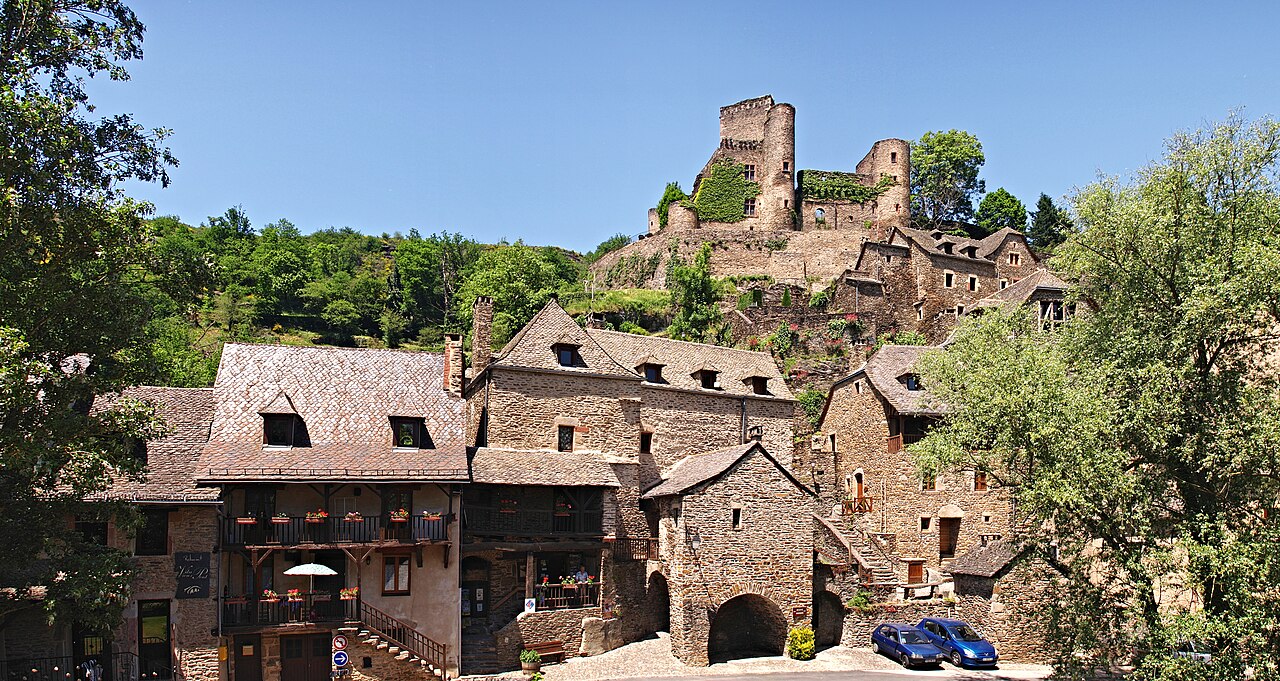
Château de Balsac
Château de Balsac stands as a remarkable example of a French castle that bridges the medieval and Renaissance periods, located in the commune of Druelle Balsac in France. This historic site reflects centuries of architectural evolution, noble lineage, and regional conflict, all embodied within its fortified walls and elegant Renaissance features.
Originally constructed during the medieval period, Château de Balsac was initially a stronghold for the noble families of Balsac and Glandières. Its strategic location on a hill provided defensive advantages typical of hill castles, allowing control over the surrounding landscape. Over time, the castle underwent significant transformations, especially during the 16th century, when Renaissance influences reshaped its architecture and function.
The castle complex comprises several buildings arranged around a central courtyard, a layout that evolved from its medieval origins to accommodate Renaissance domesticity alongside military utility. The corps de logis, or main residential building, is a centerpiece of the château, featuring Renaissance-style mullioned windows that exemplify the period’s architectural refinement. These windows, divided by stone mullions, allowed more light into the living spaces, a shift from the narrow openings typical of earlier fortifications.
Historical background and significance
The history of Château de Balsac is deeply intertwined with the turbulent religious and political landscape of France during the 16th century. In 1570, amid the French Wars of Religion, the castle was partially destroyed by fire during a conflict involving Bertrand de Glandières, a captain of arquebusiers loyal to the Catholic cause. Bertrand was captured by the Huguenots, the Protestant faction, and the castle was set ablaze by the sire de Montaigut to weaken his enemies. The ransom paid by the States General of Rouergue for Bertrand’s release highlights the castle’s strategic and symbolic importance in regional power struggles.
Following this destructive episode, Bertrand’s son, Louis de Glandières (also known as Louis de Balzac), undertook extensive rebuilding efforts. Educated in Paris under the renowned Hellenist Daurat, Louis was not only a nobleman but also a poet and playwright, contributing to the cultural milieu of the Renaissance. His restoration of the château incorporated elegant Renaissance elements, signaling a transition from purely defensive architecture to a residence reflecting humanist ideals and noble status.
Later ownership and military relevance
The castle remained a contested site through the 17th century, enduring a documented siege in 1660 that attests to its ongoing military relevance. Ownership passed through several noble families, including the Glandières, Faramond, and Grailhe lineages. The Grailhe family acquired the property in 1779, marking the last noble stewardship before the château changed hands multiple times in the 19th century. Among these later owners was Ernest Mercadier, an engineer and inventor, reflecting a shift from feudal to private, professional possession.
Architectural features and layout
The château’s architectural composition showcases a blend of medieval fortification and Renaissance elegance. The central courtyard is surrounded by interconnected buildings, including the main residential block and defensive towers. The presence of a donjon (keep) and circular towers illustrates the retention of medieval defensive strategies, while the Renaissance-style details such as pilasters and a pedimented gate emphasize the château’s residential refinement.
The entrance gate, framed by flat pilasters and topped with a decorative pediment, marks a ceremonial threshold, blending function with aesthetic appeal. This architectural feature signals the château’s dual role as a fortress and a noble residence.
Notable elements: pigeon house and restoration
One distinctive feature of Château de Balsac is its pigeon house porch, a structure traditionally used to house doves or pigeons. Such dovecotes were common in noble estates for practical purposes—providing meat and fertilizer—and also symbolized lordly privilege. The preservation of this feature adds to the château’s historical authenticity and rural character.
Despite the devastating fire in 1570, the château was carefully rebuilt, allowing many Renaissance architectural elements to survive or be restored. Photographic documentation captures the castle’s exterior and key features, although detailed records of the interior remain limited. The current state of the château reflects a well-preserved example of Renaissance architecture layered upon medieval foundations.
Château de Balsac in cultural heritage
Recognized for its historical and architectural significance, Château de Balsac was officially listed as a historic monument in 2007. This designation ensures the preservation of its legacy within France’s rich cultural heritage and highlights its importance as a site where medieval military architecture and Renaissance humanism converge.
Today, the château stands as a testament to the enduring presence of noble families in the region and the architectural transitions that shaped French castles from fortresses to elegant residences. Its story reflects broader themes of conflict, culture, and continuity in French history.
Frequently asked questions (FAQ)
- When was Château de Balsac originally built and what periods does it reflect?
- Château de Balsac was originally constructed during the medieval period, with significant rebuilding in the 16th and 17th centuries reflecting Renaissance architectural styles.
- What historical events affected Château de Balsac during the French Wars of Religion?
- In 1570, the château was partially destroyed by fire during conflicts involving Bertrand de Glandières, who was captured by Huguenots, highlighting its strategic importance.
- What are the key architectural features of Château de Balsac?
- The château features a central courtyard, Renaissance-style mullioned windows, a donjon, circular towers, a pedimented gate with pilasters, and a notable pigeon house porch.
- Is Château de Balsac open to visitors and how is it preserved?
- Château de Balsac is well preserved and listed as a historic monument since 2007, ensuring its protection. Visitor access details vary and should be confirmed locally.
- Who were some notable owners of Château de Balsac?
- Notable owners include the noble families of Balsac, Glandières, Faramond, Grailhe, and later Ernest Mercadier, an engineer and inventor.
Information
Website
Visit websiteSources & official resources
Verify the information above using these authoritative references.
Loading map...
Visitor reviews
No reviews yet. Been here? Write the first review and help other travelers!
Write the first reviewVisited this castle? Share your experience
Your review helps other travelers and adds first-hand knowledge to our encyclopedia.