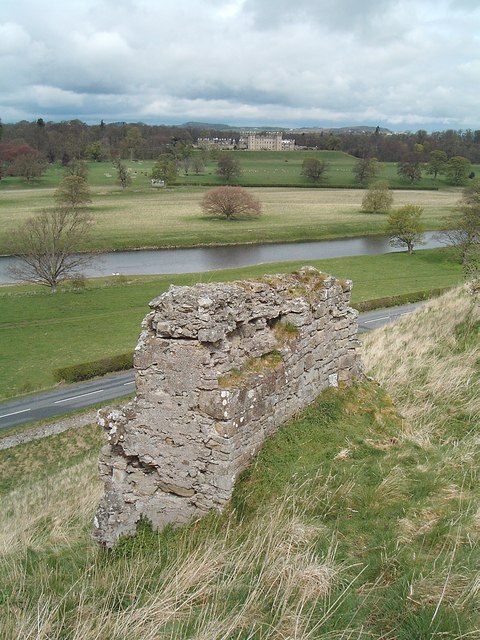
Cessford Castle
Cessford Castle stands as a prominent example of a 15th-century bastioned fortress located in the Scottish Borders, near the village of Cessford. Built around 1450 by Andrew Ker, the castle served as the principal stronghold of the influential Kerr family, a powerful Border clan known for their role as Wardens of the Middle March and their involvement in the turbulent Anglo-Scottish frontier conflicts. The castle's strategic location atop a flat hill overlooking the Kale Water valley and the nearby Cheviot Hills made it a formidable defensive site controlling key border routes.
The castle is characterized by its distinctive L-shaped plan, consisting of a main block and an adjoining wing of nearly equal size. Constructed primarily from robust red sandstone, the walls of the main keep are remarkably thick, averaging around 4 meters, reflecting the castle's primary role as a military fortress. With up to six storeys, including two barrel-vaulted floors, the castle was designed to house not only the Kerr family and their servants but also a garrison of up to 60 soldiers, emphasizing its dual residential and defensive functions.
Historical background and the ker family
The Kerrs were a prominent Border family, often embroiled in the violent feuds and raids that characterized the Anglo-Scottish borderlands during the late medieval period. Andrew Ker, the castle's builder, established Cessford as the family's main seat and a symbol of their power. The Kerrs frequently served as Wardens of the Middle March, charged with maintaining law and order in a region notorious for lawlessness and cross-border conflict.
Throughout the 16th century, Cessford Castle was a focal point in the ongoing struggles between Scotland and England. The castle endured several significant attacks, including a siege in 1523 by the Earl of Surrey, who regarded it as the third strongest fortress in Scotland. Despite the intensity of these assaults, the castle's robust fortifications and determined defenders prevented its capture. The castle also suffered repeated burnings by English forces under the Earl of Hertford during the 1540s, which weakened its defenses but did not lead to permanent loss.
The Kerr family's influence extended beyond military matters. By the late 16th and early 17th centuries, they had been elevated to the nobility as Earls and later Dukes of Roxburghe. Around 1600, the castle underwent remodeling to update its upper sections, reflecting changing architectural tastes and the reduced need for purely military defenses as border conflicts subsided. However, by about 1650, Cessford Castle was abandoned, and in the early 18th century, much of its stone was quarried for the construction of Floors Castle, marking the end of its active use.
Architectural features and defensive structures
The castle's design is a testament to late medieval military architecture in Scotland. The main block measures approximately 19.4 by 13.8 meters, with the adjoining wing extending about 11 by 6.7 meters. The walls, built from thick red sandstone, reach up to 4 meters in thickness, providing formidable resistance to siege weaponry of the period.
Surrounding the castle was a defensive earth bank and ditch, enhancing its protection against attackers. Additionally, the castle featured a forework—an outer defensive enclosure—that added another layer of security. Before the 1523 siege, the defenders constructed a false barbican, an outer wall 4 to 5 meters high equipped with gun loops for firearms and a gate to control access, demonstrating adaptation to evolving military technology.
Access to the castle was carefully controlled through two entrances located at the internal corner where the main block meets the wing. One entrance was at ground level leading into the main block, while the other was higher up, reached by a wooden staircase, granting entry into the wing. Both doors were fitted with inner and outer doors and likely defended by a wooden gallery, providing layered defense against intrusion.
Interior layout and vaulted chambers
The ground floor of the main block was barrel vaulted, providing durable storage space and housing an intermediate floor called an entresol. Above this was a large vaulted hall on the first floor, measuring approximately 12.2 meters long and over 6 meters high. This great hall featured four large windows with stone seats, allowing ample light and ventilation. A decorated fireplace centered on the north wall provided heating, flanked by two small adjacent rooms: a latrine accessed via a passage near a window and a storage chamber.
The adjoining wing contained four floors, three of which were vaulted. The ground floor included three small rooms, two serving as guardrooms and the third as a dark prison accessible only through a ceiling hatch, with a prison chamber possibly above. The wing also housed a kitchen roughly level with the great hall, equipped with its own fireplace and oven but illuminated by a narrow east-facing window. Above the kitchen was a chamber with a private latrine, likely reserved for the castle steward.
Outbuildings and later modifications
North of the main keep are the remains of a two-story outbuilding, which may have been converted into living quarters during the late 16th or early 17th century remodeling. These modifications correspond with the period when the Kerr family elevated their status and adapted the castle for more comfortable residential use, reflecting the declining military threats along the border.
Cultural significance and legacy
Cessford Castle remains an important historical site that illustrates the complex social and military dynamics of the Anglo-Scottish border during the late medieval and early modern periods. Its architecture embodies the evolution of defensive strategies, from thick stone walls and vaulted chambers to adaptations for firearms with gun loops and false barbicans.
Though now a ruin, the castle's remains offer valuable insights into the life of the Border Reivers and the turbulent history of the region. The Kerr family's legacy, including their role as Wardens of the Marches and their elevation to nobility, is closely tied to the castle's history. Today, Cessford Castle is a protected heritage site, attracting visitors interested in Scotland's medieval past and the enduring story of border conflict and clan rivalry.
Visitors to the site can explore the surviving walls, earthworks, and vaulted chambers, gaining a tangible connection to the castle's storied past. The castle's commanding position continues to offer sweeping views of the surrounding landscape, underscoring its strategic importance through centuries of conflict.
Frequently asked questions (FAQ)
- What is the historical significance of Cessford Castle?
- Cessford Castle, dating back to the late 15th century, is a prime example of a Scottish Border stronghold. It was once the seat of the powerful Kerr family and played a crucial role in the turbulent history of the Scottish Borders, serving both as a defensive structure and a symbol of feudal power in the region.
- When was Cessford Castle built?
- Cessford Castle was constructed in the late 1400s, specifically around 1450. It showcases the architectural style of the period, featuring tall stone walls and distinctive battlements that reflect its purpose as a fortress.
- Can I visit Cessford Castle?
- Yes, visitors can explore the grounds of Cessford Castle, though interior access may be limited due to its status as a private property. It’s advisable to check local guidelines and any specific visiting arrangements before planning your trip.
- Is it possible to access Cessford Castle by public transport?
- While Cessford Castle is located in a rural area, public transport options may be limited. However, local buses do serve nearby towns, and visitors may need to arrange for a taxi or private vehicle to reach the castle directly.
- What are the opening hours for Cessford Castle?
- Cessford Castle does not have fixed public opening hours since it is a private site. Visitors should check in advance for any special open days or events that might allow access to the castle grounds.
- When is the best time to visit Cessford Castle?
- The best time to visit Cessford Castle is during the spring and summer months when the weather is more favorable for outdoor exploration. Additionally, the surrounding scenery is particularly beautiful during these seasons, providing a stunning backdrop for your visit.
- Are there any nearby attractions to Cessford Castle?
- Yes, Cessford Castle is situated near several attractions, including the picturesque town of Kelso and the historic Floors Castle. Visitors can also enjoy the scenic walks and nature trails in the surrounding area, making it a great spot for a full day of exploration.
- What are the ticket prices for visiting Cessford Castle?
- As Cessford Castle is a private property, there are no standard ticket prices for entry. It is recommended to check with local tourism information or the property's management for any specific fees associated with planned visits or events.
Information
Loading map...
Visitor reviews
No reviews yet. Been here? Write the first review and help other travelers!
Write the first reviewVisited this castle? Share your experience
Your review helps other travelers and adds first-hand knowledge to our encyclopedia.