Celje
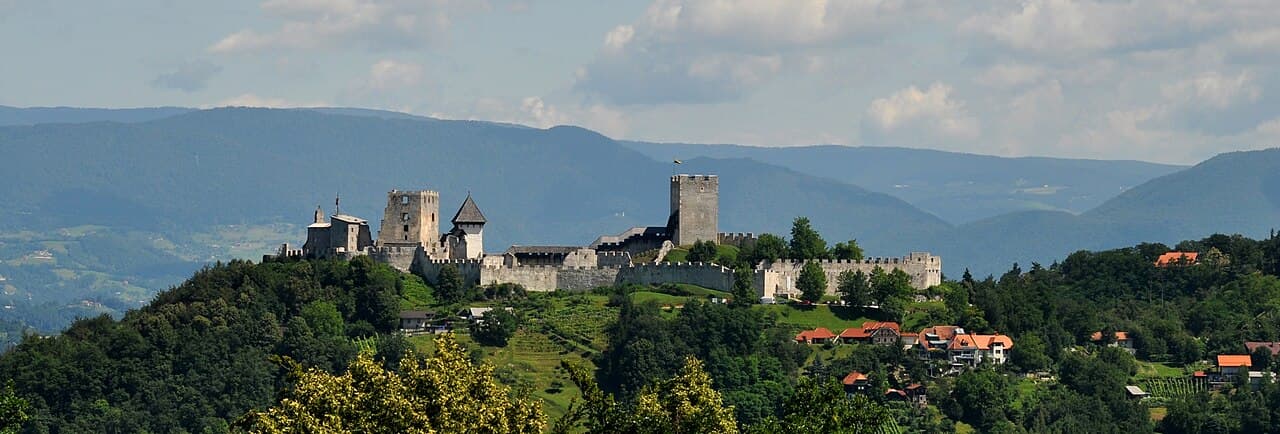
Celje Castle is a monumental medieval fortress perched on three steep hills overlooking the town of Celje, Slovenia. Its strategic location above the Savinja River allowed it to dominate the surrounding landscape and control vital trade routes. The castle's origins trace back to the early 13th century, when the Counts of Heunburg from Carinthia constructed the initial Romanesque palatium on the western end of the ridge. This original structure featured a multi-storied residential building surrounded by an irregular curtain wall adapted to the natural topography, with a water cistern in the inner courtyard and a heavily fortified eastern wall nearly three meters thick.
By the 14th century, the castle had become the seat of the powerful Lords of Sanneck, who later became the Counts of Celje. Their rise to prominence marked a significant turning point, as they expanded and transformed the fortress into a comfortable noble residence as well as a military stronghold. In 1341, Frederick I was granted the title of Count of Celje by Emperor Louis IV of Bavaria, initiating a period of ambitious architectural development. A four-story Gothic residential building replaced the eastern curtain wall, featuring heated chambers on the upper floors and storage spaces below. The entrance was relocated and fortified with a new gatehouse and a drawbridge spanning a dry moat formed by deepening a natural ditch between the hills.
Architectural evolution and fortifications
Roman and early medieval foundations
The castle's earliest phase included a five-sided Romanesque palace with a robust curtain wall and defensive features typical of ministerialis castles. The thick eastern wall with battlements and a defensive gallery exemplified the military architecture of the time, designed to withstand sieges and assaults.
Gothic expansions and defensive towers
In the late 14th and early 15th centuries, the Counts of Celje enhanced the fortress with the construction of a massive 23-meter-high tower on an artificially raised mound to the east, with walls three meters thick. This tower contained a dungeon on its lowest level, armory rooms above, and a defensive gallery at the top. The outer bailey was extended eastward and reinforced with a pentagonal bastion, reflecting evolving military needs. The Andrej Tower, named after its chapel dedicated to Saint Andrew, was added as a three-story residential and defensive structure in the northern section.
Renaissance modernization and later modifications
The castle underwent significant renovations in the second half of the 16th century, likely prompted by an earthquake that damaged the oldest Romanesque sections. Renaissance-style embrasures were incorporated into the walls of the inner and outer wards, and new buildings were erected around the courtyard to serve as service and storage facilities. At its peak, Celje Castle covered approximately 5500 square meters, making it the largest castle complex in Slovenia.
Historical significance and noble lineage
The counts of celje and their rise to power
The Lords of Sanneck, elevated to Counts of Celje, became one of the most influential noble families in Central Europe during the 14th and 15th centuries. Their strategic marriages and political alliances extended their influence across Slovenian, Croatian, and Hungarian territories. Notably, Barbara of Celje married Emperor Sigismund of Luxembourg, linking the family to the Holy Roman Empire's imperial house.
Military exploits and political rivalries
The Counts of Celje were renowned for their military prowess, with Herman II earning distinction for saving Emperor Sigismund at the Battle of Nikopol in 1396 and for his victory in a prestigious tournament at Constance. Their rivalry with the Habsburgs culminated in the Celje-Habsburg Wars, which ended with a treaty affirming the Counts' princely status. However, the assassination of the last Count, Ulrich III, in 1456 by Hungarian magnates marked the end of their dynasty.
Decline, ruin, and preservation efforts
Post-medieval decline
Following the extinction of the Counts of Celje, the castle became an imperial administrative center but gradually lost its military importance. It suffered damage during the peasant uprising of 1515 and was repaired in the late 16th century. By the 17th century, the fortress was largely abandoned, and its materials were repurposed for nearby constructions, including the Novo Celje Mansion.
19th and 20th-century restoration
In the 19th century, the castle was used as a quarry until the Styrian regional authorities acquired it to prevent further destruction. The Celje Museum Society, founded in 1882, initiated restoration efforts that have continued into the present day. Modern conservation work has stabilized the ruins and made the site accessible to visitors, with the Frederick Tower serving as a popular viewpoint over Celje.
Architectural highlights and visitor experience
The frederick tower
The best-preserved part of the castle is the Frederick Tower, named after Frederick II, son of Herman II. The tower's history is steeped in legend, including tales of imprisonment and secret tunnels used to supply food during captivity. Today, visitors can climb the tower for panoramic views of the town and surrounding countryside.
Castle layout and defensive features
Celje Castle's layout reflects its adaptation to the rugged terrain, with multiple defensive walls, towers, and a dry moat enhancing its fortifications. The combination of Romanesque, Gothic, and Renaissance architectural elements showcases the castle's long history and the evolving military technologies over centuries.
Cultural and historical importance
As the largest castle complex in Slovenia, Celje Castle is a symbol of the region's medieval heritage and the political power once wielded by its noble families. It hosts cultural events and concerts, contributing to the vibrant cultural life of Celje and attracting tourists interested in history and architecture.
Frequently asked questions (FAQ)
- What is the historical significance of Celje Castle?
- Celje Castle, also known as the Old Castle, is one of the most important historical landmarks in Slovenia. It dates back to the 12th century and served as the residence of the influential Counts of Celje, who played a key role in the region's history during the late Middle Ages.
- When was Celje Castle built?
- Construction of Celje Castle began in the 12th century, with significant expansions and renovations occurring over the following centuries. The castle's architecture reflects the evolution of styles from the medieval period to the Renaissance, showcasing its historical development.
- How do I get to Celje Castle?
- Celje Castle is easily accessible by car and public transport, located just a short distance from the center of Celje. There are designated parking areas nearby, and visitors can also take a pleasant walk from the town to the castle along scenic pathways.
- What are the opening hours for Celje Castle?
- Celje Castle is typically open to visitors from 9 AM to 6 PM during the summer months and from 9 AM to 4 PM in the winter. It's advisable to check the official website for any seasonal changes or special holiday hours before your visit.
- Can I buy tickets online for Celje Castle?
- Yes, visitors can purchase tickets online through the official Celje Castle website, which can help you avoid queues at the entrance. Ticket prices are generally affordable, and discounts may be available for students, seniors, and group visits.
- Is Celje Castle accessible for visitors with disabilities?
- Yes, Celje Castle is committed to making the site accessible for all visitors. There are pathways and ramps in place to ensure that those with mobility challenges can navigate the castle grounds and enjoy the stunning views.
- What is the best time to visit Celje Castle?
- The best time to visit Celje Castle is during the spring and early autumn when the weather is mild and ideal for exploring the outdoor areas. Additionally, visiting during off-peak hours can enhance your experience by avoiding large crowds.
- Are there any nearby attractions to explore after visiting Celje Castle?
- Yes, after visiting Celje Castle, you can explore several nearby attractions, including the Celje City Museum, which showcases the region's rich history. The beautiful Savinja River and the charming old town of Celje are also worth a visit for their picturesque scenery and cultural heritage.
Photo gallery

Information
Loading map...
Visitor reviews
No reviews yet. Been here? Write the first review and help other travelers!
Write the first reviewVisited this castle? Share your experience
Your review helps other travelers and adds first-hand knowledge to our encyclopedia.