Castra Pinnata
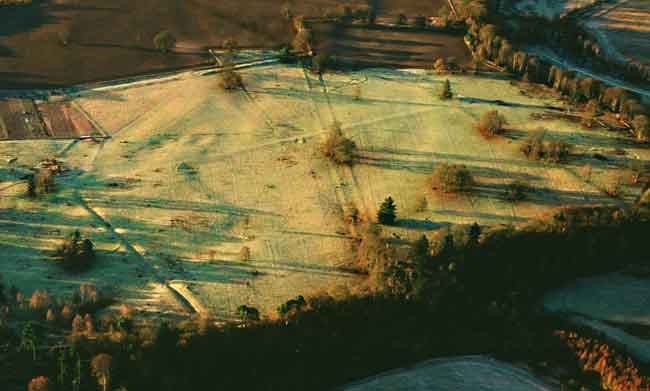
Castra Pinnata is the name given to a significant Roman legionary fortress located in what is now Scotland, near the north bank of the River Tay, southwest of Blairgowrie in Perth and Kinross. This fortress was a key installation during the Roman occupation of Caledonia, the Roman term for Scotland. It was constructed in AD 82 or 83 under the command of the Roman governor Gnaeus Julius Agricola, who led campaigns aimed at subduing the native Caledonian tribes. The fortress served as a vital military base and administrative center during this period of Roman expansion into northern Britain.
Strategic location and military significance
The fortress was strategically positioned on a natural platform overlooking the River Tay, at the head of a primary route into the Scottish Highlands. This location allowed the Romans to control access through the region and provided a strong defensive position. Castra Pinnata covered an extensive area of approximately 21.5 hectares (53 acres), making it one of the largest known Roman military bases in northern Britain. It was occupied primarily by the Legion XX Valeria Victrix, a well-known legion that played a crucial role in Roman military campaigns in Britain.
The size and scale of the fortress indicate its importance as a central hub for Roman operations in the area. It was the only site large enough to serve as a launching point for further invasions into the Highlands and beyond, functioning as the lynchpin of Roman military strategy in the region.
Construction and architectural features
The construction of Castra Pinnata was a significant engineering undertaking, likely taking two to three construction seasons to complete. The fortress was built with typical Roman military engineering precision, including strong defensive walls, gates, and internal structures to house troops and support military logistics.
During the construction phase, a temporary camp was established nearby to accommodate soldiers over the winter months, reflecting the Romans' strategic planning and adaptability to local conditions. The fortress would have included barracks, granaries, workshops, and command buildings, arranged in a well-organized layout typical of Roman legionary fortresses.
The glenblocker forts and regional defense system
Castra Pinnata is considered part of a wider network of Roman military installations known as the Glenblocker forts. These smaller forts were strategically placed at the mouths of glens (valleys) to control movement and provide early warning of any advances by hostile tribes. Other notable forts in this system include Cardean and Stracathro, located in the nearby Strathmore region.
This network, combined with watchtowers along the Gask Ridge Roman road, formed a uniform and interconnected defensive system. The Glenblocker forts and the Strathmore forts worked together to secure the Roman frontier and maintain control over the surrounding territory.
Historical context and legacy
The fortress at Castra Pinnata represents a significant phase in Roman Britain's northernmost expansion under Agricola's leadership. Although the Roman presence in Caledonia was relatively short-lived, the fortress stands as evidence of the empire's military reach and strategic planning in a challenging and hostile environment.
Today, the site is recognized for its archaeological importance, providing valuable insights into Roman military architecture, logistics, and frontier policy. While much of the fortress remains unexcavated or visible only as earthworks, its scale and historical role continue to attract scholarly interest and contribute to understanding Roman Britain's complex history.
Frequently asked questions (FAQ)
- What is Castra Pinnata and where is it located?
- Castra Pinnata is a Roman legionary fortress located near the River Tay, southwest of Blairgowrie in Perth and Kinross, Scotland.
- When was Castra Pinnata built and by whom?
- It was constructed in AD 82 or 83 under the command of Roman governor Gnaeus Julius Agricola during his campaign against the Caledonian tribes.
- What was the strategic importance of Castra Pinnata?
- The fortress controlled a main route into the Scottish Highlands and served as the largest military base in the region, enabling Roman advances further north.
- What are the Glenblocker forts?
- The Glenblocker forts are a network of smaller Roman forts at the mouths of glens, designed to block and monitor movement into the Highlands, with Castra Pinnata as the central stronghold.
- Is Castra Pinnata accessible to visitors today?
- The site is primarily an archaeological site with visible earthworks; access details vary, and visitors should check local resources for visiting information.
Photo gallery

Photo by Baron Delvine•Public domain
Information
Loading map...
Visitor reviews
No reviews yet. Been here? Write the first review and help other travelers!
Write the first reviewVisited this castle? Share your experience
Your review helps other travelers and adds first-hand knowledge to our encyclopedia.



