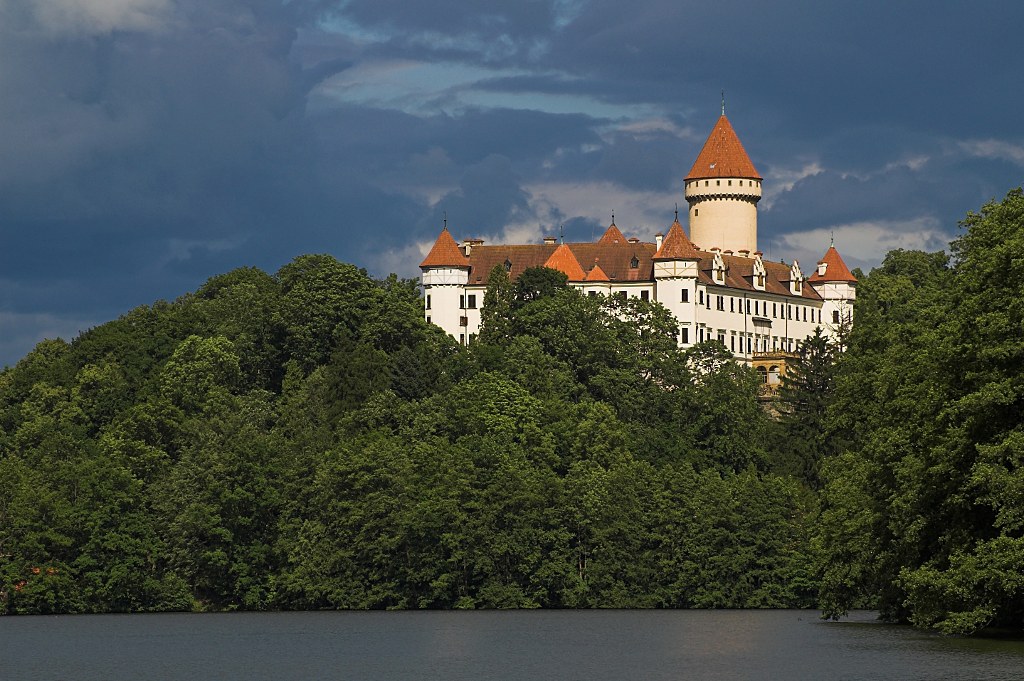
Castle Zborený Kostelec

Zbořený Kostelec Castle: medieval hill fortress in Czechia
Týnec nad Sázavou, Czech Republic
High Medieval (11th–13th c.)
Ruins

Zbořený Kostelec Castle stands as a compelling testament to the medieval fortifications of the Bohemian Kingdom, located near the village of Zbořený Kostelec within the municipality of Týnec nad Sázavou in the Czech Republic. Perched on a steep promontory at approximately 300 meters above sea level, the castle overlooks the confluence of the Sázava River and Kamenický Creek, a strategic position that underscores its historical military significance. Founded likely in the last third of the 13th century by King Wenceslas II, the fortress was part of a network of defensive sites aimed at securing the kingdom's borders and trade routes.

The earliest written record of the castle dates to 1342, when it was held as a pledge by Oldřich Medek of Valdek. Ownership changed hands multiple times, including acquisition by King Charles IV in 1356, who soon pawned it again. The castle's history is marked by a series of sieges and political upheavals, notably during the 15th century under the control of Kuneš Rozkoš of Dubá. His lawless actions in the region led to a siege in 1449, which the castle successfully withstood. However, a subsequent siege in May 1450 resulted in its capture by the forces of Zdeněk Konopišťský of Šternberk, who fortified it further as a military stronghold.

Historical context and significance

The castle's turbulent history reflects the broader political and military conflicts of Bohemia during the High medieval and Late medieval periods. After its capture in 1450, the castle became a focal point in the opposition against King George of Poděbrady. Zdeněk Konopišťský's leadership in this anti-Poděbrady faction ultimately led to the royal army besieging and destroying the castle in 1467 to suppress dissent. This event marked the end of the castle's active military use and its transition into ruin.

Architectural features and layout

Zbořený Kostelec exemplifies the characteristics of a hill castle, making use of natural topography for defense. The fortress is arranged around a central citadel positioned at the highest point, surrounded on three sides by a lower outer ward. The oldest surviving architectural element is the eastern curtain wall, a robust defensive structure dating to the castle's initial construction phase.

Defensive structures

The castle's entrance gate is a notable feature from the period of Kuneš Rozkoš's ownership. It includes remnants of a drawbridge mechanism that once spanned a moat, controlling access to the inner ward. Seating niches within the gate suggest areas designated for guards or officials overseeing entry. Above the river, a round tower was constructed on a rocky outcrop, providing critical vantage for surveillance and defense of the waterway.

Additional fortifications include an outer rampart initially built during Rozkoš's tenure and later adapted to support artillery, reflecting the evolving military technology of the 15th century. A new gate with a bridge crossing the moat was also constructed to accommodate these changes.

Residential and administrative buildings

The southwestern section of the castle housed a tall palace structure reinforced by buttresses, underscoring the importance of stability and height in medieval castle architecture. Under Zdeněk Konopišťský, two additional buildings were added adjacent to this palace, indicating an expansion of the castle's residential or administrative capacity. On the northern side, a two-room palace remains the best-preserved domestic structure, offering insight into the living arrangements within the fortress.

Across the courtyard from this palace, another building once stood above the riverbank, now reduced to remnants of its courtyard-facing wall. These structures illustrate the complex layout and multifunctional nature of the castle, combining defense with noble residence.

Military significance and sieges

The castle's location made it a critical military asset, particularly during the mid-15th century conflicts. Archaeological remains of a fortified camp on the northern slopes belong to King George of Poděbrady's forces, highlighting the area's strategic importance. These earthworks served as temporary encampments during sieges and battles, reflecting the castle's role in regional power struggles.

The sieges of 1449 and 1450 demonstrate the castle's resilience and strategic value. While it withstood the first siege, the second resulted in a change of ownership and significant fortification efforts. The final siege in 1467 by royal troops led to the castle's destruction, a deliberate act to end its role as a rebel stronghold.

Preservation and cultural heritage

Today, the ruins of Zbořený Kostelec Castle are protected as a cultural monument and form part of a nature reserve. The site is freely accessible, inviting visitors to explore its historical layers and architectural remnants. The castle's ruins provide a tangible connection to the medieval history of Bohemia and offer valuable insights into castle construction, military strategy, and noble life during the High medieval and Late medieval periods.

The preservation of the eastern curtain wall, gate structures, and palace remains allows for ongoing archaeological study and public education. The site's integration into a natural landscape reserve also highlights the interplay between historical heritage and environmental conservation.

Frequently asked questions (FAQ)

How do I get to Castle Zborený Kostelec?
Castle Zborený Kostelec is located in Týnec nad Sázavou, Czechia, and can be easily reached by car or public transport. The nearest train station is a short distance away, and local buses also service the area. Detailed directions can be found on the castle's official website.
What is the historical significance of Castle Zborený Kostelec?
Castle Zborený Kostelec dates back to the 14th century and is a notable example of Gothic architecture in the region. It has served various purposes throughout its history, including as a noble residence and a military stronghold. The castle is an important cultural landmark that reflects the historical development of the area.
When was Castle Zborený Kostelec constructed?
Construction of Castle Zborený Kostelec began in the early 14th century, with the main structure completed by the late 1400s. Over the centuries, it has undergone several renovations and restorations to preserve its architectural heritage. The castle's long history makes it a fascinating site for visitors interested in medieval architecture.
Can I take guided tours of Castle Zborený Kostelec?
Yes, guided tours are available at Castle Zborený Kostelec, providing visitors with an in-depth look at its history and architecture. Tours typically last around an hour and are led by knowledgeable guides who share interesting stories about the castle. It's advisable to check the schedule in advance, especially during peak tourist seasons.
Why is the architecture of Castle Zborený Kostelec noteworthy?
The architecture of Castle Zborený Kostelec showcases a blend of Gothic and Renaissance styles, making it a unique example of historical design. Key features include its imposing towers, decorative facades, and intricate stonework. Visitors can appreciate the craftsmanship and architectural details that have been preserved over the centuries.
Is it possible to host events at Castle Zborený Kostelec?
Yes, Castle Zborený Kostelec offers facilities for hosting various events, including weddings, conferences, and cultural gatherings. The picturesque setting and historic ambiance provide a unique backdrop for special occasions. Interested parties should contact the castle management for more information on booking and available services.
What are the opening hours for Castle Zborený Kostelec?
Castle Zborený Kostelec is generally open to visitors from April to October, with varying hours depending on the season. During peak months, the castle may extend its hours to accommodate more visitors. It’s recommended to check the official website for the most current opening hours before planning your visit.
What are the ticket prices for visiting Castle Zborený Kostelec?
Ticket prices for Castle Zborený Kostelec are reasonably priced, with discounts available for students, seniors, and families. Children under a certain age may enter for free, making it a great destination for family outings. Detailed pricing information can be found on the castle's official website or at the ticket office on-site.
What are some nearby attractions to visit while in Týnec nad Sázavou?
While visiting Castle Zborený Kostelec, you can also explore the beautiful natural surroundings, including the Sázava River and nearby hiking trails. Additionally, the charming town of Týnec nad Sázavou offers local shops and cafes that reflect the area's culture. Other historical sites in the vicinity include churches and smaller castles that are worth a visit.

Information

Hill Castle

Loading map...

Visitor reviews

No reviews yet. Been here? Write the first review and help other travelers!

Write the first review

Visited this castle? Share your experience

Your review helps other travelers and adds first-hand knowledge to our encyclopedia.

Write a review

(5/5)

0/2000 characters

Your review will be visible after admin approval

Nearby castles

2.6 km

Týnec nad Sázavou Castle

Týnec nad Sázavou, Czech Republic

Týnec nad Sázavou Castle stands as a remarkable example of a medieval hill castle nestled in the municipality of Týnec nad Sázavou, Czechia. Its strategic position on a hill overlooking the Sázava River provided a natural defense, leveraging the surrounding ravine and stream to protect the stronghold on multiple sides. This location was crucial for controlling and safeguarding the vital trade routes that passed through the region, marking the castle as an important military and administrative center throughout its history. The castle's origins trace back to early medieval Bohemia, where archaeological evidence confirms occupation as early as the 11th century. Initially, the site featured a wooden fortification typical of early Slavic or Czech settlers. Over time, this evolved into a more permanent stone structure, with the first documented mention of the castle dating to the early 14th century. By this period, the fortress had developed significant architectural features, including a Romanesque rotunda dedicated to Saint Wenceslaus, which served as the castle chapel. This rotunda remains the oldest preserved monument within the castle complex and is a rare surviving example of Romanesque ecclesiastical architecture in the region. Architectural features and layout The Romanesque rotunda The rotunda chapel is a circular stone structure that exemplifies the Romanesque architectural style, characterized by its thick walls, small windows, and semicircular arches. Its construction during the castle's early stone phase highlights the religious significance embedded within the fortress. The rotunda continues to be used for religious services today, maintained by the Czechoslovak Hussite Church, which owns the site. The prism-shaped tower A prominent feature of the castle is the prism-shaped tower, notable for its rectangular form and sturdy stone construction. This tower dates from the earliest stone phase of the castle and offers commanding views over the surrounding landscape, including the town of Týnec nad Sázavou. Its elevated position made it a key defensive structure, allowing occupants to monitor approaching threats. Interestingly, the tower's upper floor serves as a summer roost for a colony of greater bats, linking the castle's architectural heritage with its natural environment. Palace remains and courtyard Within the castle courtyard, remains of a former palace building survive, reflecting the castle's role as a noble residence and administrative hub. These structures now accommodate the local town museum, which exhibits the region's cultural history, including a permanent display dedicated to traditional pottery. The courtyard is encircled by several auxiliary buildings historically tied to the Hodějovský estate, further illustrating the castle's multifaceted function beyond military defense. Historical significance and ownership Early medieval origins and noble ownership The earliest known owner, Oldřich of Týnec, is documented in 1318 as a member of the Medek family from Valdek. This family maintained control of the castle through much of the 14th century and into the 15th century. Subsequent owners included prominent noble houses such as Litvín of Kinský and the Hodějovský family. The latter combined Týnec Castle with the nearby Konopiště estate, thereby expanding their influence in the region. Early modern period and decline During the turbulent periods of Bohemian history, the castle changed hands several times. It was confiscated and came under the possession of the renowned military leader Albrecht of Wallenstein. Later, it was held by Pavel Michna of Vacínov. From the early 17th century, the castle gradually fell into disuse as it no longer met the residential and defensive needs of its owners, leading to neglect and decay. 18th-century restoration and modern era In the 18th century, the Vrtba counts acquired the Týnec and Konopiště estates. Restoration efforts were undertaken by Marie Anna O’Kelly in the mid-1700s, reviving the castle's livability. Following the establishment of Czechoslovakia in 1918, parts of the castle were adapted for residential purposes. It was owned briefly by František Xaver Jiřík, director of Prague’s Museum of Decorative Arts, before passing to the Czechoslovak Hussite Church, which continues to use the site for religious functions. Cultural and natural heritage Týnec nad Sázavou Castle is protected as a cultural monument since 1965, underscoring its historical and architectural importance. The castle grounds also hold natural significance, as the rotunda and adjacent areas serve as a summer shelter for a colony of greater bat species. This dual heritage status highlights the castle's unique blend of cultural history and environmental conservation. The castle regularly hosts events, exhibitions, and cultural activities that celebrate local traditions and history. The permanent exhibition on regional pottery within the town museum connects visitors to the broader cultural landscape of the area, making the castle a vibrant center for both heritage and community engagement. Visitor experience and accessibility Visitors to Týnec nad Sázavou Castle can explore the preserved Romanesque rotunda, the prism-shaped tower, and the courtyard museum. The site offers panoramic views of the surrounding countryside and town, providing a rich historical context alongside natural beauty. The castle's ongoing use by the Czechoslovak Hussite Church adds a living dimension to the experience, with occasional religious services held in the rotunda. The castle's location on a hill makes it accessible by foot from the town center, with pathways that accommodate most visitors. The combination of architectural heritage, natural environment, and cultural programming makes Týnec nad Sázavou Castle a notable destination for those interested in medieval history, architecture, and Czech cultural heritage.

High Medieval (11th–13th c.)
Details
9.5 km
Konopiště Castle — Czech Republic castle

Konopiště Castle

Konopiště, Czech Republic

Konopiště Castle stands as a remarkable example of a medieval hill castle with a rich history spanning over seven centuries. Located about 50 km southeast of Prague in the Czech Republic, it is renowned primarily as the last residence of Archduke Franz Ferdinand of Austria, heir to the Austro-Hungarian throne, whose assassination in Sarajevo in 1914 triggered the outbreak of World War I. Originally constructed in the late 13th century as a Gothic fortress, Konopiště underwent significant architectural transformations over the centuries, reflecting changing styles and owners. Its evolution from a defensive stronghold to a luxurious noble residence showcases the layered history of Central European castle architecture. The castle's initial foundation likely dates to around 1294, possibly established by Bishop Tobiáš of Benešov of Prague, although documentary evidence first mentions it in 1318 as property of the Benešovic family. The Benešovics held it until 1327, after which it passed to the influential Šternberk family, who maintained ownership for over 250 years. During their tenure, Konopiště played a strategic role in regional conflicts, notably enduring an eighteen-month siege during the Hussite Wars (1467–1468) against forces loyal to King George of Poděbrady. Historical ownership and political significance In the early 17th century, the castle came under the Protestant Hodějovský family, who participated in uprisings against Habsburg rule. Following their defeat, the castle was confiscated and passed through several noble families, including the prominent Albrecht of Wallenstein, and later the Michna, Vrtba, and Lobkowicz families, each leaving their imprint on the castle’s legacy. The most transformative chapter began in 1887 when Archduke Franz Ferdinand d’Este purchased Konopiště with his inheritance from the last reigning Duke of Modena. He extensively remodeled the castle into a luxurious residence, preferring it over his official home in Vienna. Franz Ferdinand resided here until his assassination in 1914, a pivotal event that precipitated the First World War. After the formation of Czechoslovakia, the castle was confiscated by the state in 1921 and opened to the public. During World War II, it served as the headquarters of the SS in Bohemia. Post-war restoration efforts focused on preserving the castle’s historical character, particularly the original furnishings and collections of Franz Ferdinand. Today, Konopiště is a national cultural monument under state ownership and a popular tourist destination. Architectural evolution and features The castle’s original Gothic fortress design is organized around a rectangular plan divided by a transverse wall into two courtyards. The eastern courtyard was elevated, featuring two long palace wings running parallel on the northern and southern sides. The western courtyard contained the main access gate. Defensive elements included at least seven towers, with four large round towers at the corners. Two massive round bergfrieds stood at the short ends of the rectangle, with only the eastern bergfried surviving intact today. The northern wall featured a central tower with a distinctive double stair turret composed of two slender turrets side by side, adding complexity to the defense. Additional smaller round towers flanked strategic points along the walls. The fortress was encircled by a parkán—an outer defensive curtain wall—and a large double-sided stone moat, providing formidable protection. Early Gothic stonework survives in parts of the castle, including characteristic pointed twin windows incorporated into later modifications. Late gothic and renaissance modifications During the late Gothic and Renaissance periods, the castle’s interiors were transformed. Vaulted ceilings were introduced in the northern palace wing, and two chambers feature windows blending Gothic and Renaissance styles. An early 16th-century chapel with a four-part ribbed vault once adorned the castle, although the vaulting was later concealed beneath painted decorations. Baroque renovation and artistic embellishments The 18th century brought significant Baroque alterations that reshaped the castle’s silhouette. The main entrance was relocated from the western to the eastern façade. The wings and towers were unified in height, reducing the original varied profile. A new stone bridge replaced the traditional drawbridge at the entrance. The Baroque gate, built in 1725 by architect František Maxmilián Kaňka, was decorated with sculptures by Matyáš Bernard Braun. Interior enhancements included carved fireplaces and altars by Lazar Widman, and a grand Rococo ceiling fresco by František Julius Lux depicting scenes of the Olympian gods and bacchanalian revelries. Neo-gothic restoration and 19th-century expansions In the 19th century, the castle underwent neo-Gothic renovations in two phases. Before 1872, the Lobkowicz family added polygonal battlements with keyhole-shaped windows to several towers. Later, in the 1890s, architect Josef Mocker led extensive restorations commissioned by Franz Ferdinand, modifying or removing some earlier Gothic and neo-Gothic elements. Interior decoration was overseen by František Schmoranz, and a new library wing was added in the early 20th century. Collections and cultural heritage Konopiště Castle is famous for its extensive collection of arms and armor, displayed in a large hall on the third floor of the northern palace wing. The collection includes 16th-century Italian plate armor and a variety of firearms from Europe and the Orient. Additionally, Franz Ferdinand’s hunting trophies, numbering over 300,000 specimens, are housed here, reflecting his passion as an avid hunter. The castle grounds feature an expansive English-style landscape park covering approximately 340 hectares. Created after 1887 under Franz Ferdinand’s direction, the park was designed with input from Viennese landscape architect Mösmer and Prague’s chief gardener Karel Rozínek. It includes a rose garden, terraced areas, and the St. George Museum, which showcases artworks dedicated to the legend of St. George. A unique feature of the park is the Cross Path (Křížová cesta), a devotional trail established in 1775 consisting of fourteen stone pillars, centered on a chapel and Lourdes grotto. Franz Ferdinand later enhanced this religious site following his pilgrimage to Lourdes in 1905. Historically, the castle moat was home to bears, continuing a medieval tradition of castle menageries. Records indicate bears were kept there from the late 20th century until 2011, maintaining this unique aspect of Konopiště’s heritage. Archaeological significance and preservation Archaeological excavations around Konopiště have uncovered remains of medieval siege works adjacent to the fortress, notably from the prolonged 1467–1468 siege during the Hussite Wars. These findings provide valuable insights into the military strategies and fortification techniques of the period. Today, Konopiště Castle is well preserved, with much of its historical architecture intact and accessible to visitors. The castle offers a compelling journey through Central European history, architecture, and aristocratic life, making it a significant cultural and tourist landmark in the Czech Republic.

High Medieval (11th–13th c.)
Details
10 km

Kožlí Castle

Tisem-Neveklov, Czech Republic

Kožlí Castle stands as a significant medieval hill castle located in the municipality of Tisem-Neveklov in the Czech Republic. The castle's origins trace back to the early 14th century, with the earliest written record dating to 1318, when it was associated with the nobleman Ctibor of Kožlí. This early mention establishes Kožlí as a seat of local Bohemian nobility during the medieval period, reflecting the feudal landscape of the region. Throughout its history, Kožlí Castle was controlled by various noble families, each contributing to its evolving role and structure. By the mid-14th century, the castle was held by brothers Konrád and Heřman, who had previously owned lands near Chvojno. Their influence extended beyond mere landownership, as they exercised the right to appoint clergy at the Church of St. James in Chvojno, underscoring the castle's integration into both secular and ecclesiastical power networks. Historical significance and ownership transitions During the late 14th century, Kožlí Castle remained under the control of lesser noble families, but the castle's reputation became complicated by reports from 1399 describing it as a refuge for bandits. This turbulent period reflects the instability and lawlessness that occasionally characterized medieval Bohemian strongholds. In the early 15th century, ownership passed to Petr of Pětichvost, an ally of King Václav IV, linking the castle more directly to the royal political sphere. From 1414 onward, the Libún family of Dubá became prominent holders of Kožlí. Notably, Beneš (III.) Libún was an influential figure involved in key historical events such as the Battle of Lipany and the siege of Ostromeč. His son, Beneš (IV.) Libún, along with his wife Buzka of Makov, resided at Kožlí during a period when the castle began to lose its status as a noble residence. By the early 1490s, the castle came under the ownership of the Sternberg family, who also possessed the nearby Konopiště Castle. By 1495, Kožlí was no longer described as a full castle but rather as a fortified manor within the larger Konopiště estate. This transition marked the beginning of the castle's decline. Throughout the 16th century, Kožlí gradually fell into disuse and was eventually abandoned. By the century's end, written sources referred to it as a ruined or deserted chateau, a fate common among many medieval castles that lost their strategic or residential importance. Architectural features and defensive structures The original layout of Kožlí Castle was notably complex, comprising two main sections: an outer bailey and an inner castle. These were separated by a deep moat carved directly into the rock, a formidable defensive feature designed to impede attackers and protect the castle's core. The connection between the outer and inner courtyards was controlled by a passage likely featuring a drawbridge over the moat, accessed through a small gate tower projecting from the main curtain wall. This setup allowed for regulated entry and enhanced security against siege tactics. The inner castle is distinguished by an early example of a two-palace architectural layout, rare in Bohemia. The design centers on a rectangular courtyard with an entrance gate leading into the first palace building. Beyond this courtyard lay a second palace on the southeast side, connected by an inner curtain wall that enclosed the space and defined the castle's heart. Surrounding the entire complex was an outer defensive parkán wall, creating a continuous enclosure that added a further layer of protection. Today, the best-preserved elements include the southeastern section of the parkán wall and part of the inner curtain wall on the same side, while other areas remain as uneven terrain with traces of former fortifications. Archaeological research and preservation efforts Recent archaeological clearing has removed overgrown vegetation, revealing the fundamental layout of Kožlí Castle and allowing for detailed study of its construction techniques. These efforts have highlighted the castle's role as a fortified noble residence throughout the medieval period until its decline in the late 16th century. Although the castle now exists primarily as ruins, the remaining walls and earthworks provide valuable insights into medieval defensive architecture and noble lifestyle in Bohemia. The site serves as an important cultural heritage landmark, attracting historians and visitors interested in medieval fortifications and Bohemian history. Cultural legacy and historical context In the 19th century, the site of Kožlí Castle attracted the attention of the renowned Czech poet Karel Hynek Mácha, who visited during his travels in the Posázaví region in 1835. Although no visual records from his visit survive, the castle was documented under the name "Kožly," reflecting historical variations in the place name. Kožlí Castle's story encapsulates the broader narrative of medieval castles in Central Europe: from noble stronghold to decline and ruin, shaped by political shifts, military conflicts, and changing social structures. Its architectural innovations, such as the two-palace layout and rock-cut moat, mark it as a noteworthy example of Bohemian castle design. Today, Kožlí Castle remains a testament to the region's rich medieval heritage, offering a tangible connection to the past and a subject of ongoing archaeological and historical interest.

High Medieval (11th–13th c.)
Details