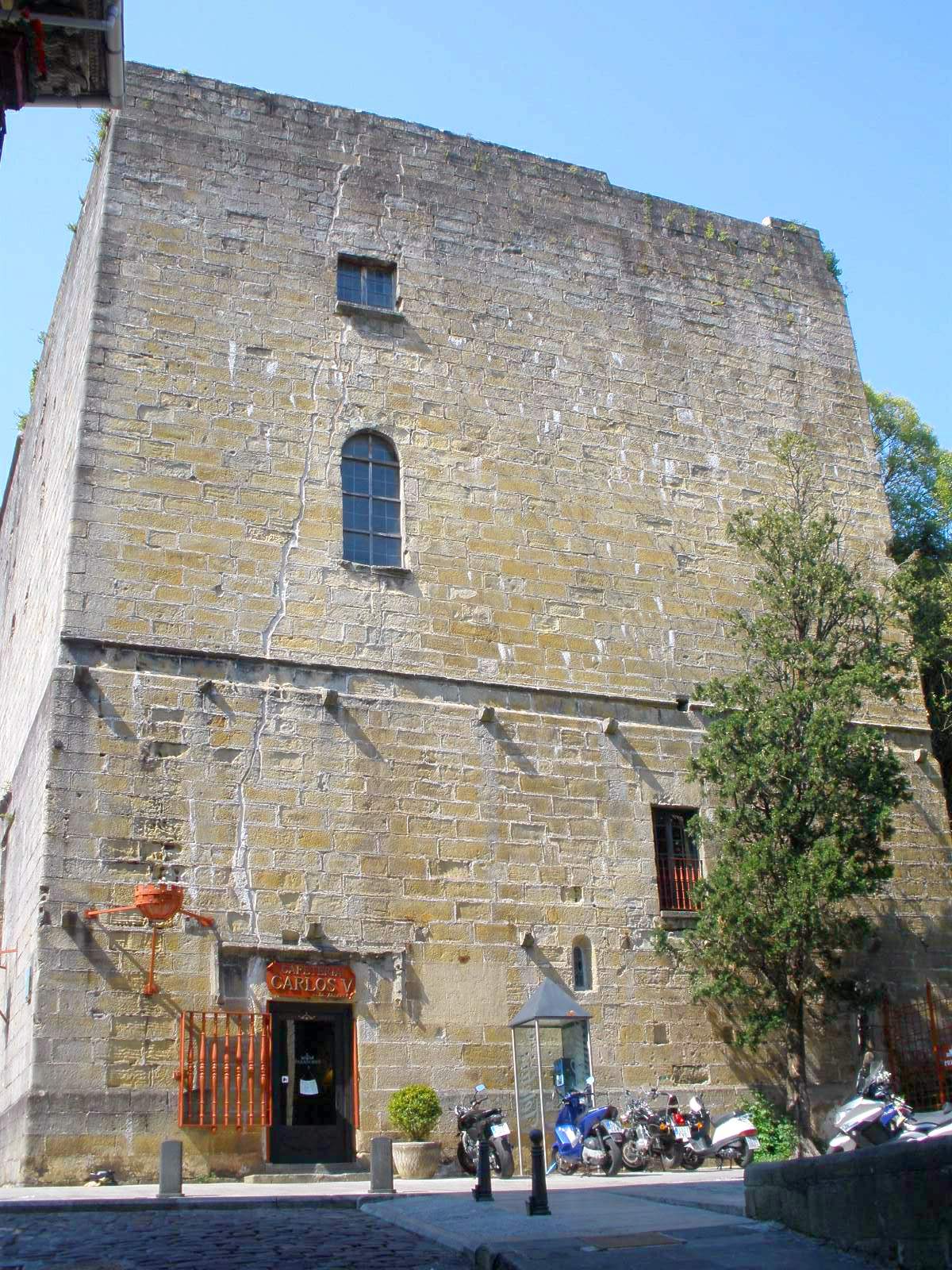
Castle of San Telmo
The Castle of San Telmo is a significant 16th-century hill castle located on the Higer headland in Hondarribia, Spain. Constructed under the reign of King Philip II, this fortress was part of a strategic coastal defense system safeguarding the entrance to the bay and the harbor from frequent attacks by British privateers in the Cantabrian Sea. The castle’s commanding position atop a rocky promontory allowed it to control maritime approaches effectively, integrating with the adjacent city walls of Hondarribia and the nearby Castle of Charles V.
Construction began in 1598 under the supervision of Juan Velazquez, the Captain General of Gipuzkoa. The castle was built atop an earlier tower, incorporating the natural cliff formations into its defenses. Its original rectangular layout was oriented with its north and east facades facing the sea, featuring a battery platform capable of mounting five cannons to repel naval threats. The use of ashlar masonry with finely dressed stone blocks laid in orderly rows characterizes the castle’s robust construction.
Architectural features and defensive design
Fortifications and layout
The castle’s design cleverly integrates natural and man-made defenses. Two of its facades are carved directly from the rocky cliff outcrop, eliminating the need for walls on those sides and enhancing its natural protection. The remaining sides are enclosed by an outer defensive wall built of finely cut ashlar stone, which includes a vaulted arched entrance guarded by a sentry box. This wall extends along one side of the castle, terminating at another sentry box, providing vantage points for surveillance and defense.
Internal structures and adaptations
Within the outer wall lies the castle’s core structure, a cubic building constructed from sandstone ashlar blocks. An adjoining smaller building contains a concealed entrance, traditionally dated to the time of Philip II, marked by a Latin inscription commemorating its dedication to resisting piracy and robbery. The sea-facing facade combines ashlar stone and brickwork, supporting an artillery platform designed for mounting cannons aimed at maritime targets.
The castle also features a well designed to collect rainwater, an essential resource during sieges or isolation. In the 18th century, the fortress was adapted to serve as a powder magazine, reflecting a shift from active frontline defense to storage and logistical support. This period saw the addition of the outer defensive wall and the construction of the arched entrance passage with sentry boxes.
Historical context and military significance
16th-century origins and coastal defense
The Castle of San Telmo was built during a time of heightened maritime conflict in the late 16th century. The Spanish Crown sought to protect its northern coastline from the persistent threat of British privateers who targeted shipping and coastal settlements. The castle formed part of a broader network of fortifications, including the city walls of Hondarribia and the nearby Castle of Charles V, designed to secure the bay’s entrance and safeguard the valuable harbor.
18th and 19th-century modifications
In the mid-18th century, under King Ferdinand VI, the castle’s military role evolved. It ceased to be a frontline fortress and was repurposed as a powder magazine for storing gunpowder and munitions. The outer wall and sentry boxes were constructed during this time to enhance security around the storage facilities.
During the 19th century, particularly in the period of the Carlist Wars, the castle underwent further modifications to improve its defensive capabilities. These included enclosing the main tower with additional defensive walls and adding sentry boxes to increase surveillance. These changes reflect the castle’s continued strategic importance amid evolving military technologies and conflicts.
Later uses and current status
Throughout the 20th century, the Castle of San Telmo transitioned from military use to civilian purposes. It served as a residential building for some time before becoming privately owned. Currently, the castle stands abandoned with restricted access to its interior, preserving its historical fabric but limiting public engagement.
Local folklore adds a layer of mystery to the castle’s history. Stories tell of a secret underground passage beginning in the castle’s kitchen, reputedly leading to the sea and possibly navigable by boat. Residents have confirmed the presence of a trapdoor in the floor, lending some credibility to these tales.
Cultural heritage and preservation
The castle has been legally protected since 1949, recognizing its historical and architectural significance. It received specific designation under Spain’s Historical Heritage Law of 1985, ensuring measures for its preservation. Despite its current abandoned state, the Castle of San Telmo remains a valuable example of late 16th-century military architecture and coastal defense strategy in the Basque region.
Its combination of natural cliff defenses, ashlar masonry construction, and adaptations across centuries illustrate the evolving nature of fortress design responding to changing military needs. The castle’s integration into the broader defensive network of Hondarribia highlights its role in regional security and maritime control during a turbulent period in Spanish history.
Today, the castle stands as a monument to the strategic importance of coastal fortifications in early modern Spain and the ongoing efforts to preserve such sites as part of the country’s cultural heritage.
Frequently asked questions (FAQ)
- When was the Castle of San Telmo built and by whom?
- The Castle of San Telmo was constructed beginning in 1598 under Juan Velazquez, Captain General of Gipuzkoa, during the reign of King Philip II.
- What was the primary purpose of the Castle of San Telmo?
- The castle was built as part of a coastal defense system to protect the bay entrance and harbor of Hondarribia from British privateers and maritime threats.
- Can visitors access the interior of the Castle of San Telmo?
- Currently, the castle is privately owned and access to its interior is restricted, so public visits inside the castle are generally not permitted.
- What architectural features make the Castle of San Telmo unique?
- The castle uniquely incorporates natural cliff faces into its defenses, has finely dressed ashlar masonry, and features a battery platform designed for mounting cannons aimed at the sea.
- Are there any legends or secret passages associated with the castle?
- Local folklore mentions a secret underground passage starting in the kitchen that may lead to the sea, supported by the presence of a trapdoor in the castle floor.
- What is the current condition and ownership status of the castle?
- The Castle of San Telmo is currently abandoned and privately owned, with no public access to the interior.
- How is the Castle of San Telmo protected as a heritage site?
- The castle has been legally protected since 1949 and is designated under Spain’s Historical Heritage Law of 1985, ensuring its preservation.
Information
Sources & official resources
Verify the information above using these authoritative references.
Loading map...
Visitor reviews
No reviews yet. Been here? Write the first review and help other travelers!
Write the first reviewVisited this castle? Share your experience
Your review helps other travelers and adds first-hand knowledge to our encyclopedia.