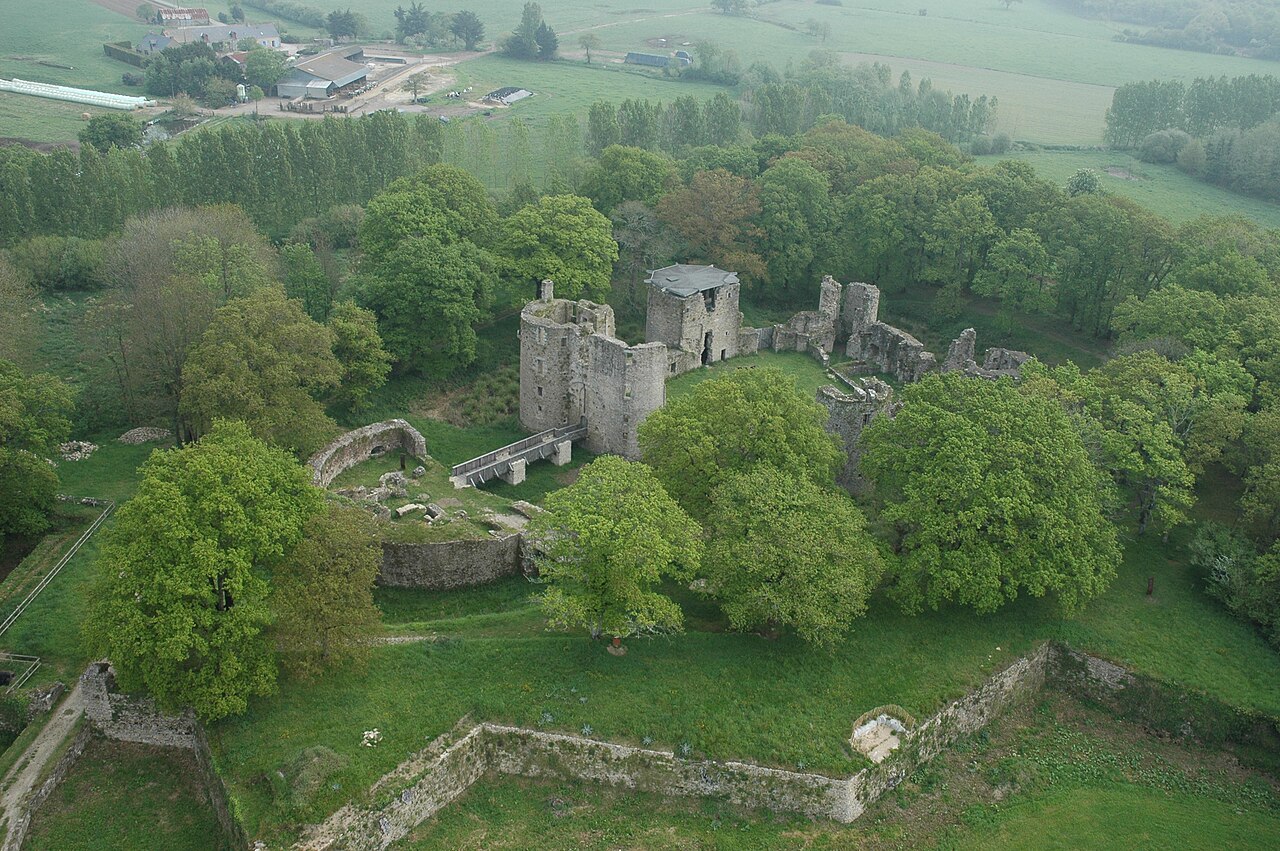
Castle of Rieux
The castle of Rieux stands as a significant medieval fortress located in the municipality of Rieux, within the region of Hauts-de-France, France. Originally constructed in the 9th century by the noble Rieux family, the castle was strategically positioned on the site of an ancient fortified settlement known as an oppidum. This location was chosen to control the vital traffic along the Vilaine River, a key waterway in the region.
Medieval origins and strategic importance
The castle's early history is deeply intertwined with the military and political dynamics of medieval Brittany. As a hill castle, it was built on a rocky promontory overlooking the Vilaine valley, providing commanding views and defensive advantages. The fortress was trapezoidal in layout, enclosed by robust curtain walls fortified with towers positioned at each corner and at intervals along the longer sides. This design created a formidable defensive perimeter that controlled access through the valley and the river route.
The eastern end of the castle featured the main keep, a central fortified tower that served as the last line of defense and a symbol of the lord's power. On the opposite western side was the entrance postern, a secondary gate historically equipped with a drawbridge controlling access across a moat or ditch. This entrance postern is today the only standing part of the castle and is surrounded by a 19th-century English garden, which was developed during the site's partial transformation in that century.
The castle's role in regional conflicts
Throughout the medieval period, the castle of Rieux played a crucial role as a strategic stronghold overseeing the Vilaine valley. It was closely linked to the local nobility, notably Jean IV de Rieux, who commanded Breton forces during the Battle of Saint-Aubin-du-Cormier in 1488. This battle was a pivotal conflict during the "Mad War," a struggle involving Brittany's resistance to French royal authority.
In the same year, French troops destroyed the fortress amid the conflict. Reconstruction efforts were promptly initiated, supported by Duchess Anne of Brittany, who allocated a substantial grant of 100,000 écus to rebuild Rieux and other castles in the region. This rebuilding underscored the castle's continued military and administrative importance in the late medieval period.
Decline and partial demolition
The castle remained inhabited through the mid-16th century but saw decline following the War of the League and the departure of the Rieux family from the area. In 1629, Cardinal Richelieu, then governor of Brittany, ordered the demolition of the fortress as part of a broader campaign to dismantle regional strongholds that could challenge royal authority.
Due to the extensive scale of the site, only parts of the walls and outer towers were taken down, leaving much of the structure partially standing. The castle's keep suffered further damage in 1799 when an earthquake caused its collapse, marking a significant loss to the fortress's architectural integrity.
19th and 20th-century transformations and preservation
During the 19th century, the surviving ruins were partially transformed with the creation of an English garden around the entrance postern, blending romantic landscaping with the medieval remains. This garden remains a key feature of the site today, framing the solitary standing gate and enhancing the site's aesthetic and historical appeal.
In the 20th century, the local municipality took steps to develop the site for public engagement, establishing an interpretive trail that guides visitors through the castle's historical and natural significance. In 1971, the castle was designated a protected natural area, recognized for its artistic, scenic, scientific, historical, and legendary significance.
Architectural features and surviving elements
The castle's ruins rest on a rocky promontory east of the town of Rieux, overlooking the Vilaine River. The trapezoidal layout with curtain walls and towers is still discernible, though much of the stonework survives only as fragments. The entrance postern gate is the only structure that remains intact, offering a glimpse into the castle's medieval defensive architecture.
Historical records indicate the presence of a wooden bridge near the castle that crossed the Vilaine River, serving as a toll point for river traffic. After the bridge's collapse in 1543, it was replaced by a toll boat, highlighting the castle's role in controlling both land and river routes.
Despite the extensive ruin, the site remains a powerful testament to the castle's long history as a military stronghold and administrative center in the region. Its remnants continue to attract visitors and scholars interested in medieval fortifications and Breton history.
Cultural and historical significance
The castle of Rieux is an important heritage site in Hauts-de-France, illustrating the evolution of medieval fortifications and the shifting political landscape of Brittany. Its connections to notable historical figures such as Jean IV de Rieux and Duchess Anne of Brittany underscore its significance in regional and national history.
Today, the castle's ruins, combined with the surrounding natural landscape and the 19th-century garden, offer a unique cultural experience that blends history, architecture, and nature. The site's protected status ensures its preservation for future generations to explore and appreciate.
Information
Loading map...
Visitor reviews
No reviews yet. Been here? Write the first review and help other travelers!
Write the first reviewVisited this castle? Share your experience
Your review helps other travelers and adds first-hand knowledge to our encyclopedia.