Castle of Nógrád
The Castle of Nógrád stands as a remarkable testament to Hungary's medieval architectural and historical heritage. Located in the village of Nógrád, this hill castle is perched on a commanding plateau approximately 60 meters above the surrounding landscape, offering strategic views over the Börzsöny region and the Ipoly River. Its origins trace back to the 11th century, when it was first established as a wooden fortress by the medieval Hungarian kingdom. This early fortification served as the administrative center for the county head, known as the ispán, overseeing Nógrád county. The castle's location was chosen for its defensive advantages and its control over important regional routes.
Initially constructed with timber-framed walls filled with earth, the original fortress was a typical early medieval stronghold designed for rapid assembly and local defense. Although no visible remains of these wooden structures survive today, archaeological excavations have confirmed their presence beneath the later stone constructions. Over the centuries, the castle evolved significantly, reflecting changes in military technology, architectural styles, and political ownership.
Medieval transformation and renaissance influence
Throughout much of the medieval period, the estate remained under royal ownership until the reign of King Ladislaus IV of the Árpád dynasty, who granted the castle to the Diocese of Vác. This transfer marked a shift in the castle's stewardship from royal to ecclesiastical hands. The late 15th century was a pivotal era for the Castle of Nógrád, as it underwent significant rebuilding and expansion under the direction of Bishop Miklós Báthory of Vác. The transformation replaced the earlier wooden fortress with a substantial stone stronghold, including the construction of a large, three-story stone keep enclosed by a deep dry moat. This phase of construction exhibits the influence of Renaissance architectural trends, which began to permeate Hungarian castle design during this period.
The castle's Renaissance character was further enhanced by the addition of palace wings designed by the Dalmatian master builder Jacobus Tragurinus, with artistic contributions from the renowned sculptor and architect Giovanni Dalmata, who was associated with the court of King Matthias Corvinus. Completed in 1483, these palace wings introduced refined residential and representational spaces that balanced military functionality with comfort and aesthetic appeal. The Báthory family coat of arms, decorated with distinctive dragon and wolf tooth motifs, was discovered during excavations within the filled moat, symbolizing the family's lasting influence on the castle's history and design.
Defensive evolution and military history
The castle's fortifications evolved in response to advancements in military technology. The outer castle initially featured artillery rondelles, circular bastions designed to accommodate early cannon. In the 17th century, these were replaced by more modern Italian-style bastions, characterized by angular shapes optimized for defense against artillery siege. These bastions represent the adaptation of the castle's defenses to the changing nature of warfare in the early modern period.
The military significance of the Castle of Nógrád is underscored by its turbulent history during the Ottoman expansion into Central Europe. In 1544, the garrison abandoned the fortress amid Ottoman advances, though it was recaptured approximately fifty years later. The castle endured a notable 27-day siege in the autumn of 1663, after which it fell to Ottoman forces once more. This period of conflict highlights the castle's strategic importance as a frontier fortress in the defense of the Kingdom of Hungary.
The castle's military role effectively ended in 1685 when a lightning strike ignited stored gunpowder within the keep, causing a catastrophic explosion. This event destroyed much of the inner castle and led to its abandonment. Subsequent neglect and the removal of stone for other building projects contributed to the castle's gradual decline into ruin.
Archaeological efforts and restoration
Minimal archaeological investigations took place in 1949, with more extensive restoration efforts commencing in 1997. These efforts focused on reconstructing the Italian-style bastions and installing protective roofing over the artillery rondelle to prevent further weathering. Protective railings were also added along the inner edges of the castle walls to enhance visitor safety and preserve structural integrity.
Although the castle was once part of a national preservation program, it was later removed from the official list. Safety concerns led to the closure of the site in April 2023, prompting renewed excavation and conservation measures in 2024. Following these works, the castle partially reopened to the public on April 19, 2025, allowing visitors to explore its rich history and architectural features.
Architectural characteristics and remains
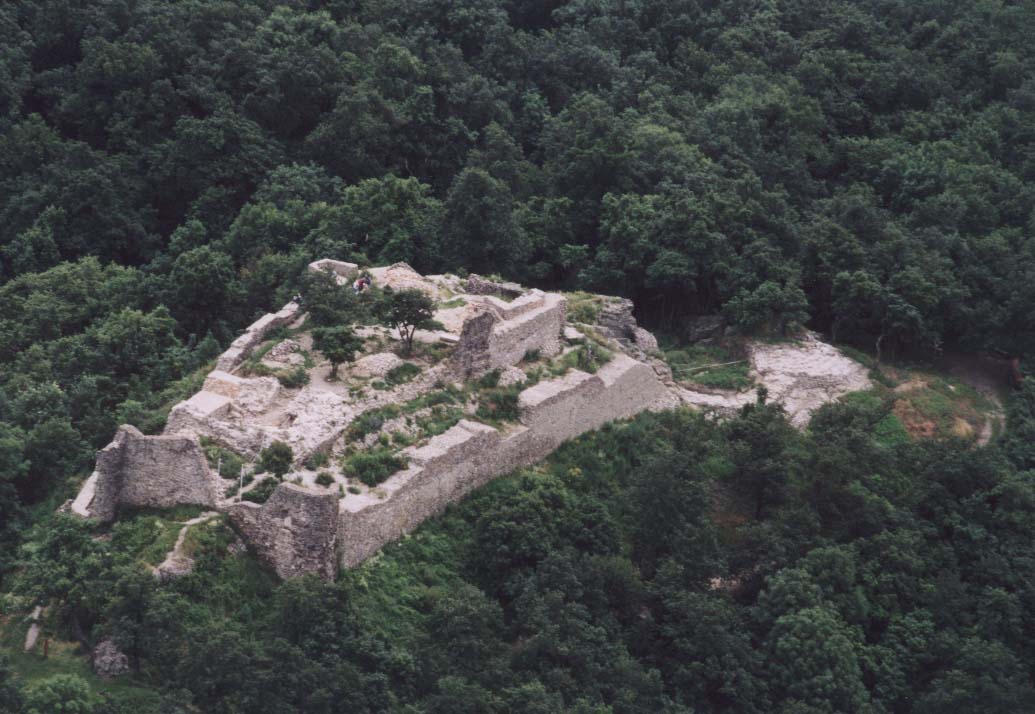
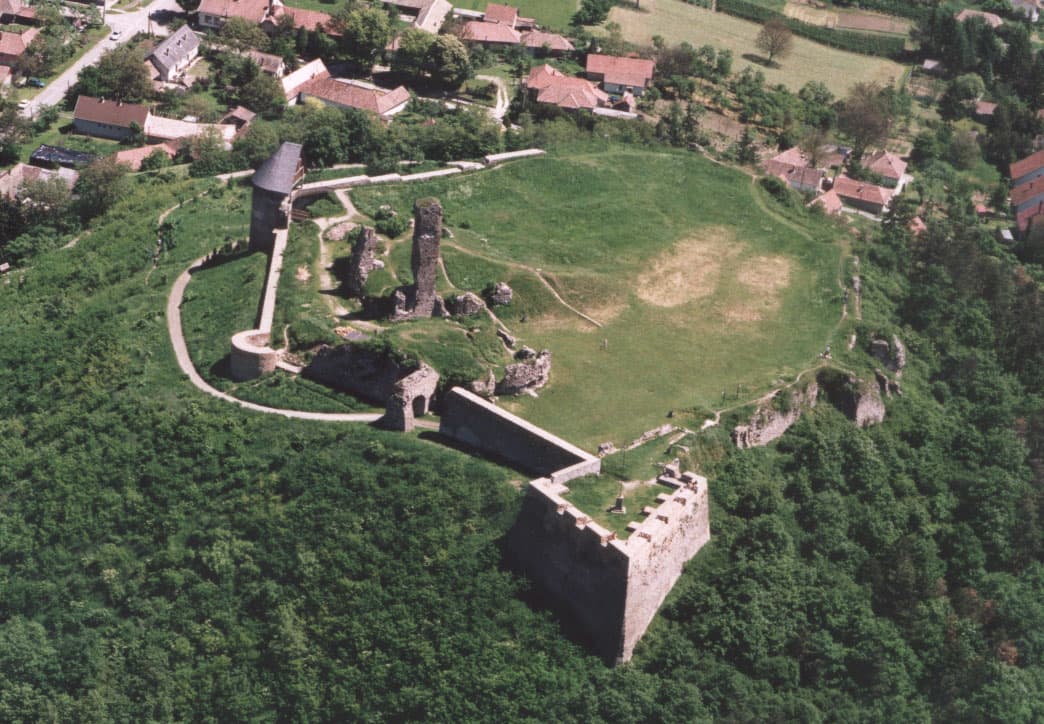
The Castle of Nógrád's layout is irregular, reflecting its development over several centuries. The most prominent feature is the ruined stump of the three-story stone keep, which remains a striking visual landmark within the village. The keep was originally surrounded by a deep dry moat, which played a crucial defensive role. Excavations within the moat uncovered the Báthory family coat of arms, a significant artifact linking the castle to its Renaissance patrons.
Adjacent to the keep, the remnants of the Renaissance palace wings demonstrate the influence of Dalmatian craftsmanship and Renaissance aesthetics. These wings were designed to provide both comfort and representational grandeur, marking a departure from the castle's earlier purely military function.
The outer defenses include the reconstructed Italian bastions, which replaced earlier artillery rondelles. These bastions exemplify the castle's adaptation to evolving military technologies and the increasing importance of artillery in fortress design.
Today, the castle stands as a partially restored site combining significant ruins with reconstructed elements. The keep's remains dominate the silhouette of the village, while the restored bastions and palace ruins offer insight into the castle's architectural evolution and historical significance.
Visitor experience and cultural significance
Visitors to the Castle of Nógrád can explore a site that encapsulates over a millennium of Hungarian history, from its early medieval origins to its Renaissance transformation and military struggles during the Ottoman period. The castle's strategic location and architectural features provide a tangible connection to Hungary's past defensive strategies and noble patronage.
The restoration and archaeological work have enhanced the site's accessibility and educational value, although ongoing preservation efforts are necessary to maintain its structural integrity. The castle's blend of military and residential architecture offers a unique case study of Hungarian castle development and the influence of Renaissance art and design in Central Europe.
Frequently asked questions (FAQ)
- When was the Castle of Nógrád originally built?
- The Castle of Nógrád was originally built in the 11th century as a wooden fortress, serving as an administrative center for Nógrád county.
- What architectural styles are visible at the Castle of Nógrád?
- The castle features a mix of medieval stone fortifications and Renaissance palace wings, reflecting its evolution over several centuries.
- What caused the decline of the Castle of Nógrád?
- A lightning strike in 1685 ignited stored gunpowder in the keep, causing a massive explosion that destroyed much of the inner castle and led to its abandonment.
- Is the Castle of Nógrád open to visitors?
- The castle partially reopened to the public on April 19, 2025, following restoration and safety improvements.
- What defensive features does the Castle of Nógrád have?
- The castle's defenses include a three-story stone keep, a deep dry moat, artillery rondelles, and later Italian-style bastions adapted for artillery defense.
Photo gallery

Information
Website
Visit websiteSources & official resources
Verify the information above using these authoritative references.
Loading map...
Visitor reviews
No reviews yet. Been here? Write the first review and help other travelers!
Write the first reviewVisited this castle? Share your experience
Your review helps other travelers and adds first-hand knowledge to our encyclopedia.