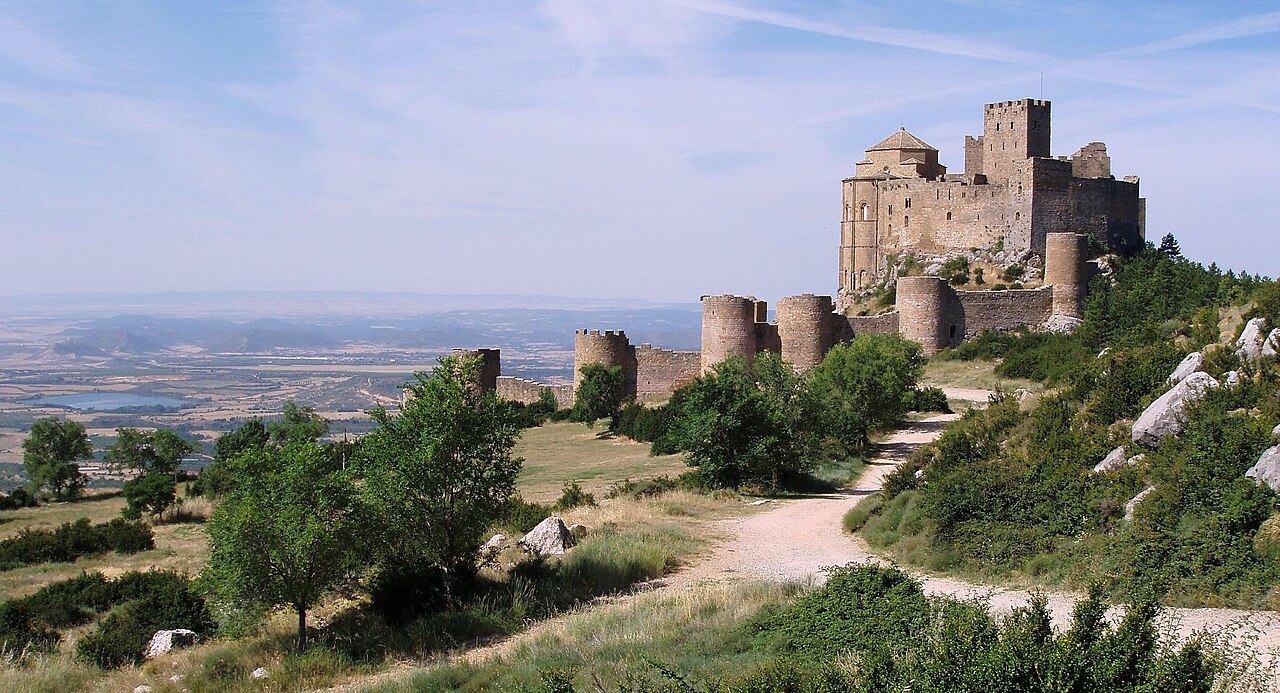
Castle of Marcuello
The Castle of Marcuello stands as a significant medieval fortress located within the municipality of Loarre in Aragón, Spain. Constructed during the High Medieval period, this hill castle was strategically positioned on a high, flat rocky outcrop overlooking the Gállego River valley. Its location provided commanding views of the surrounding landscape, including the distinctive Mallos de Riglos rock formations, making it a critical defensive stronghold for controlling the region and monitoring river traffic.
Built before 1074, the castle is believed to have been commissioned under the reign of King Sancho Ramírez of Aragón. Its primary role was to protect the kingdom's borders from incursions and to secure the vital river route below. The castle's early history is closely tied to the military governance of Pedro Sánchez, who was responsible for overseeing multiple fortifications in the area, including those at Luesia, Cacabiello, and Boltaña. This highlights the castle's importance within a network of defensive sites during the 11th and early 12th centuries.
Historical ownership and usage
Between approximately 1110 and 1160, the castle changed hands among various tenants such as Barbatuerta and later Sancio Enecones. By 1170, tenancy had passed to Pedro Ortiz. Although records from the subsequent centuries are sparse, documentation resumes in the early 15th century with Antón de Luna listed as lord of the castle. A notable document from 1488 confirms that the castle was still inhabited during this time, although its residential function was declining as nearby villages like Sarsamarcuello and Linás de Marcuello became more prominent living centers.
By the early 17th century, specifically in 1610, the castle was reported abandoned by the geographer João Baptista Lavanha. Its decline continued until it was described as a ruin by 1808. Recognizing its cultural and historical value, the Spanish government designated the Castle of Marcuello as a Bien de Interés Cultural heritage monument in 2006.
Architectural features and construction details
The castle's most prominent feature is its large square keep or donjón, which measures approximately 11 meters on each side. This tower is unusually large for an 11th-century fortification and rises through five floors, as revealed by the surviving architectural remains. The keep was constructed directly on solid bedrock, utilizing finely cut stone blocks arranged with ashlar masonry techniques of high quality. This contrasts with the rougher masonry observed in the adjoining defensive walls, of which only a straight section remains today.
The upper three floors of the keep feature splayed arrow slits, narrow openings that widen inward to enable defenders to shoot while remaining protected. The lowest floor's arrow slits are topped with semicircular arches, whereas the upper two floors have lintelled openings with flat tops. Additional architectural elements include continuous imposts, horizontal bands marking transitions between wall sections, and putlog holes that once supported scaffolding during construction.
Notably, there are no springing points for stone transverse arches, suggesting that the floors were supported by a different structural system compared to other regional keeps such as those at Abizanda and Biel. This architectural detail highlights a unique construction approach at Marcuello.
Defensive structures and layout
The castle's defensive walls originally enclosed the keep, but today only fragments survive, including a straight section of wall. The elevated position on the rocky spur provided natural defense, supplemented by man-made fortifications designed to protect against attacks from the river valley below.
Religious buildings on site
Adjacent to the castle ruins are two Romanesque churches, including the 12th-century Chapel of San Miguel. These religious structures indicate the dual military and spiritual functions of the site during the medieval period, serving the needs of the castle's inhabitants and the surrounding community.
Strategic importance and legacy
The Castle of Marcuello played a crucial role in the defense system of the Kingdom of Aragón, guarding the borders and controlling access along the Gállego River. Its location allowed for early warning of enemy movements and served as a deterrent against raids. Although its military significance diminished over time, the castle remains an important historical landmark illustrating medieval fortification techniques and regional power dynamics.
Today, the castle is valued for its archaeological significance and its contribution to understanding medieval military architecture in northern Spain. Visitors to the site can appreciate the impressive scale of the keep, the craftsmanship of the stonework, and the panoramic views that once made it a formidable fortress.
Frequently asked questions (FAQ)
- When was the Castle of Marcuello built?
- The Castle of Marcuello was constructed before 1074 during the High Medieval period under the Kingdom of Aragón.
- What is the architectural style of the Castle of Marcuello?
- The castle features high-quality ashlar masonry typical of medieval fortifications, with a large square keep and Romanesque elements seen in nearby chapels.
- Can visitors access the Castle of Marcuello today?
- The castle is in ruins, but visitors can explore the remains and enjoy panoramic views of the Gállego River valley and the Mallos de Riglos formations.
- Why was the Castle of Marcuello strategically important?
- Its elevated position on a rocky outcrop overlooking the Gállego River allowed it to control river traffic and provide early warning against attacks.
- Are there any religious buildings near the Castle of Marcuello?
- Yes, two Romanesque churches, including the 12th-century Chapel of San Miguel, are located near the castle ruins, indicating the site's religious significance.
Information
Loading map...
Visitor reviews
No reviews yet. Been here? Write the first review and help other travelers!
Write the first reviewVisited this castle? Share your experience
Your review helps other travelers and adds first-hand knowledge to our encyclopedia.