Castle of Manzanares and Real
The castle of Manzanares and Real, also known as the New Castle of Manzanares el Real or the Castle of los Mendoza, is a remarkable example of late medieval Spanish military architecture. Situated on the sun-drenched foothills of the La Pedriza National Park in Manzanares el Real, Madrid, this fortress-palace was constructed beginning in 1475 by the influential House of Mendoza. It stands on the site of a 13th-century Romanesque-Mudéjar shrine dedicated to Santa Maria de la Nava, parts of which were incorporated into the castle's eastern wing, preserving a tangible link to its earlier religious heritage.
Historical context and origins
The castle was built during a turbulent period following the Reconquista, when Christian monarchs consolidated their control over the Iberian Peninsula. Despite the end of Islamic rule, internal conflicts among noble families continued, making fortified residences essential for defense and status. The House of Mendoza, one of the most powerful noble families in Castile, sought a grand residence that combined military strength with palatial luxury, reflecting their rising political and economic influence.
The new castle replaced an older fortress nearby, known as the Old Castle of Manzanares el Real, attributed to Diego Hurtado de Mendoza, Admiral of Castile. The decision to build a new, larger castle-palace was initiated by Diego Hurtado de Mendoza y de la Vega, the 1st Duke of the Infantado, and continued by his son Íñigo López de Mendoza y de la Vega, who commissioned the renowned architect Juan Guas to unify and enhance the design.
Architectural features and style
Fortress layout and defensive elements
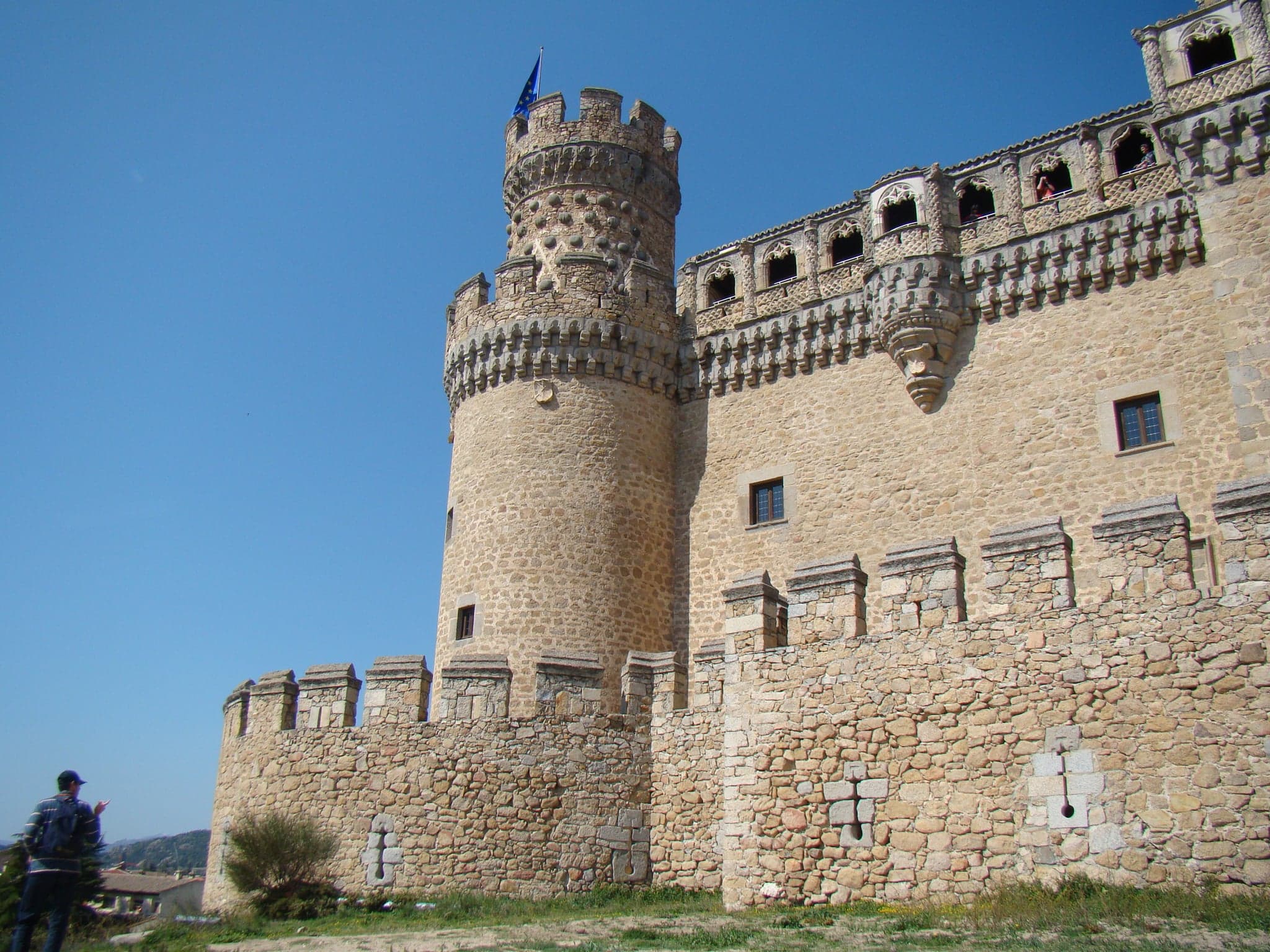
The castle is a quadrangular structure constructed primarily of granite stone sourced from the nearby Sierra de Guadarrama. It measures approximately 30 by 30 meters and rises six stories plus a basement, including a ground floor, two mezzanines, a main floor, an upper gallery, and a roof terrace. Four towers anchor the corners: three cylindrical towers and a taller square keep tower with an octagonal top at the southeast corner. The castle is surrounded by a formidable five-meter-high barbican with loopholes adapted for artillery and decorated with the cross of the Holy Sepulchre of Jerusalem in low relief, a symbol linked to Pedro Gonzalez de Mendoza.
Additional defensive features include a moat (now mostly filled), a firing gallery, machicolations on the walkway for dropping projectiles on attackers, battlements, and a main gate flanked by two smaller towers. The castle’s chemin de ronde on the southern side features a gallery with flaming trace parapets decorated with diamond shapes, reflecting the Isabelline Gothic style.
Residential and artistic elements
The interior is centered around a rectangular porticoed courtyard originally designed by Juan Guas and fully reconstructed in the early 20th century by architect Vicente Lampérez y Romea. The courtyard features two stacked galleries with segmental arches supported by octagonal columns adorned with floral and figurative capitals. The upper gallery has a balustrade decorated with rosettes. Three 16th-century mural coats of arms in the courtyard represent the Mendoza, Enríquez, and Álvarez de Toledo families, all connected to the Duchy of the Infantado.
The southern gallery, known as the Gallery of Juan Guas or Paseador, is a loggia with lowered arches and double ogival and lobed tracery. It exemplifies the Isabelline Gothic style and offers panoramic views over the Manzanares valley. Decorative motifs show strong Hispano-Muslim influences, including sebka-style diamond patterns supporting the gallery, muqarnas (stalactite-like) moldings on the machicolations, and large four-lobed diamond shapes framing stone balls atop the towers, though some decorations have faded over time.
Chapel and religious heritage
The castle chapel, located in the eastern wing’s lower level, preserves the Romanesque-Mudéjar apse and presbytery arch from the original 13th-century church. It features a later Gothic arcade forming three naves with octagonal pillars and a mix of semicircular and pointed arches. The upper floors above the chapel, once containing rooms including a library, remain unrestored and in ruins.
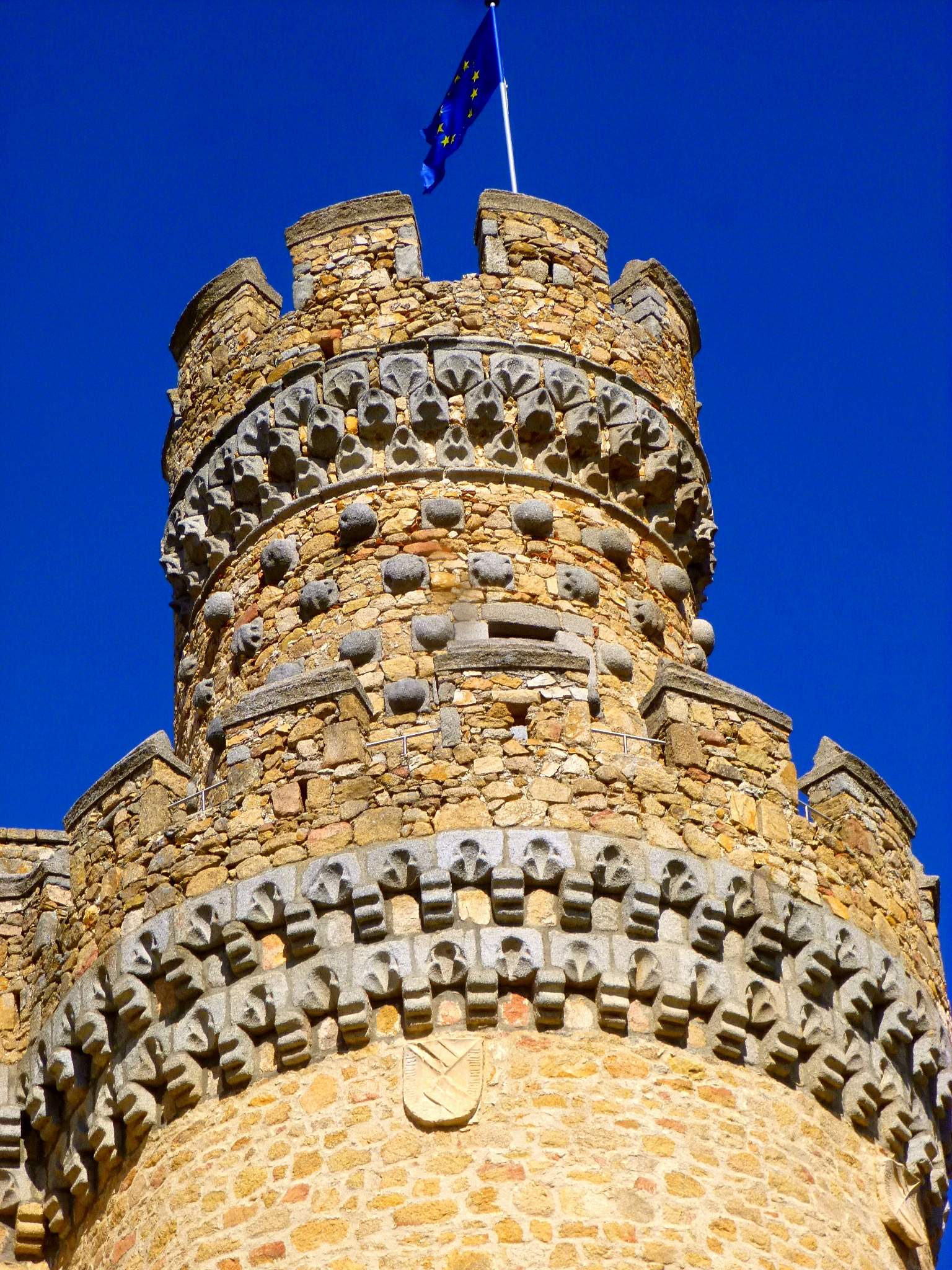
Photo by Zarateman • CC0
Historical significance and later history
For about a century, the castle served as a noble residence for the Mendoza family, symbolizing their power and prestige. However, after the death of Íñigo López de Mendoza y Pimentel, the 4th Duke of the Infantado, in 1566, the castle fell into decline due to economic difficulties and family disputes. It ceased to be inhabited as a primary residence and gradually lost its former prominence.
In the 20th century, significant restoration efforts began in 1914 under architect Vicente Lampérez y Romea, who used historicist methods and anastylosis to reconstruct the porticoed courtyard and other parts of the castle. Further restorations occurred in 1964 and from 1965 onward, allowing the castle to open to the public in 1977. It was declared a Monumento Histórico-Artístico in 1931, recognizing its cultural and architectural importance.
In 1982, the castle hosted the founding session of the Parliamentary Assembly of Madrid, where the draft Statute of Autonomy of the Community of Madrid was presented. Ownership remains with the Duchy of the Infantado, while administration was managed by the Community of Madrid until early 2025.
Museum and cultural role today
Today, the castle functions as a museum dedicated to Spanish castles and houses a notable collection of 17th-century Flemish tapestries, including series depicting the Life of Julius Caesar and the Life of Man, some attributed to artists linked to Rubens’ workshop. The interior rooms are arranged to evoke the atmosphere of a noble residence, featuring original and replica furnishings, paintings, and armors.
In 2005, the Community of Madrid undertook further improvement works, creating an interpretation center and a new audiovisual room where visitors can interactively explore the castle’s history. Permanent exhibition rooms were expanded, and art collections restored. The Renaissance garden, completed in 2013, adds to the castle’s charm and historical ambiance.
Frequently asked questions (FAQ)
- What is the historical significance of the Castle of Manzanares and Real?
- The Castle of Manzanares and Real, built in the late 15th century, is a prime example of medieval military architecture in Spain. It played a vital role in the defense of the region during the conflicts of the 16th century and is now considered a symbol of the area's rich historical heritage.
- When was the Castle of Manzanares and Real built?
- Construction of the Castle of Manzanares and Real began in 1475 and was completed in the early 16th century. Its strategic location and impressive structure have made it a significant landmark since its inception.
- Can I visit the Castle of Manzanares and Real?
- Yes, the Castle of Manzanares and Real is open to visitors year-round. Guests can explore its beautifully preserved interiors and enjoy stunning views of the surrounding landscape.
- What are the opening hours of the Castle of Manzanares and Real?
- The castle is typically open from 10 AM to 6 PM during the weekdays and from 10 AM to 8 PM on weekends. However, it is advisable to check the official website for any seasonal changes or special holiday hours.
- How much are the ticket prices for the Castle of Manzanares and Real?
- Ticket prices for the Castle of Manzanares and Real are generally around €5 for adults and discounted rates for children and seniors. There may be free admission on specific days, so it's a good idea to verify this before your visit.
- Is it possible to access the Castle of Manzanares and Real via public transport?
- Yes, the Castle of Manzanares and Real is accessible by public transport from Madrid. Buses run regularly to Manzanares el Real, making it convenient for visitors to reach the castle without a car.
- What is the best time to visit the Castle of Manzanares and Real?
- The best time to visit the Castle of Manzanares and Real is during the spring and fall months when the weather is mild and pleasant. Visiting during the weekdays can also help you avoid larger crowds and enjoy a more peaceful experience.
- Are there any nearby attractions to the Castle of Manzanares and Real?
- Yes, the area surrounding the Castle of Manzanares and Real offers several attractions, including the beautiful La Pedriza Natural Park, ideal for hiking and outdoor activities. Additionally, the charming village of Manzanares el Real itself has quaint shops and restaurants to explore.
Photo gallery


Information
Website
Visit websiteSources & official resources
Verify the information above using these authoritative references.
Loading map...
Visitor reviews
No reviews yet. Been here? Write the first review and help other travelers!
Write the first reviewVisited this castle? Share your experience
Your review helps other travelers and adds first-hand knowledge to our encyclopedia.