
Castle of Caen
The castle of Caen stands as a monumental example of Norman military and residential architecture, constructed around 1060 by William the Conqueror, Duke of Normandy and later King of England. This vast fortress, located on a strategic limestone plateau overlooking the Orne valley in the city of Caen, France, exemplifies the fusion of military strength and princely residence characteristic of high medieval Norman castles. With an area of approximately 5.5 hectares, it ranks among the largest medieval castles in Western Europe, reflecting its historical importance as a center of ducal authority and later royal power.
Early construction and architectural features
The initial construction phase began under William the Conqueror shortly before his conquest of England in 1066. The castle was strategically placed on a hillock, providing commanding views over the surrounding landscape, which was critical for defense and control. The early fortifications likely included wooden palisades and earthworks, which were soon replaced by robust stone curtain walls by the late 11th century. These walls, about one meter thick, incorporated battlements and arrow slits, enhancing the castle's defensive capabilities against siege warfare.
Within the castle precincts, the Vieux Palais or Old Palace, built by William, featured a great hall, princely apartments, and a chapel dedicated to Saint George. This complex was separated from the rest of the castle by a deep ditch, emphasizing its importance and providing additional security. The chapel itself was later modified in the 15th century with Gothic windows and buttresses, illustrating the evolving architectural styles over the centuries.
Henry i's enhancements and the donjon
In the early 12th century, Henry I Beauclerc, William’s son, significantly enhanced the castle's fortifications and residential facilities. Around 1123, he commissioned the construction of a massive square donjon or keep near the original gate tower. This keep, built in the Romanesque style, measured approximately 24 by 27.5 meters with walls up to 4.3 meters thick at the base and an estimated height exceeding 25 meters. It contained a deep internal well reaching 21 meters, a chapel dedicated to Saint Gabriel, and was accessed by an external staircase on the first floor.
The donjon served multiple purposes: it was a symbol of ducal power, a secure refuge in times of siege, and a center for administration and justice. It housed the ducal treasury, the provost’s seat, and a prison. The keep's formidable construction and strategic placement underscored the castle's role as a seat of Norman authority.
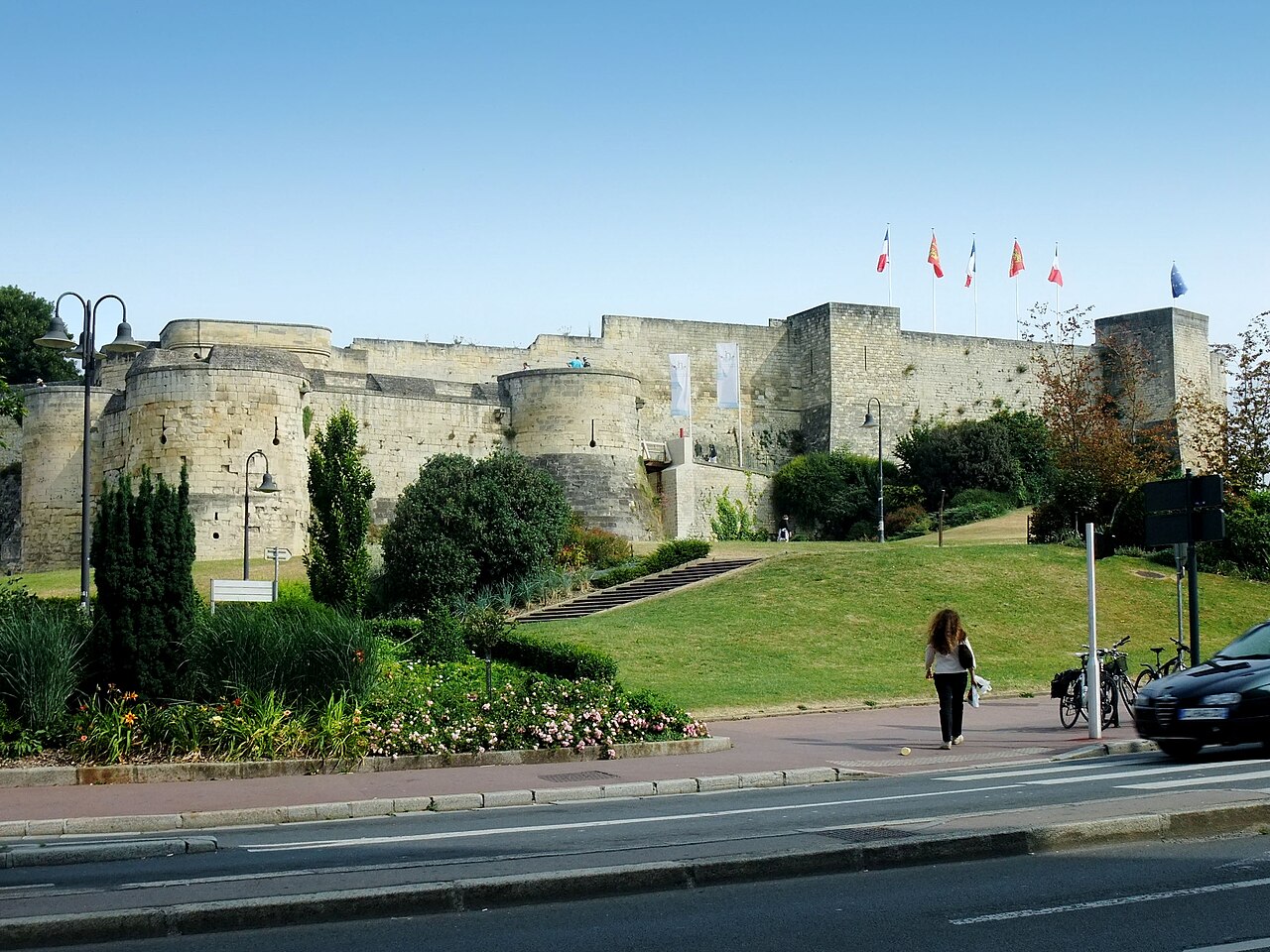
Photo by Nikater • Public domain
French modifications and late medieval fortifications
Following the capture of Normandy by King Philip Augustus of France in 1204, the castle underwent extensive modernization to meet evolving military needs. A trapezoidal stone wall, or chemise, was constructed around the donjon about 15 meters away, featuring walls three meters thick and four round towers named Cheval Blanc, Cheval Noir, Cheval Rouge, and Cheval Gris. These towers, each approximately 4.5 meters in diameter, provided additional layers of defense.
A deep rock-cut ditch, up to 10 meters deep and 16 meters wide, separated this enclosure from the rest of the castle, enhancing its defensibility. The northern defenses were strengthened with the construction of the fortified Porte des Champs gate, which included a double horseshoe-shaped barbican with four round towers and machicolations—openings through which defenders could drop stones or boiling liquids on attackers. This gate was reinforced or rebuilt in the 15th century, reflecting the castle's ongoing strategic importance during the late medieval period.
Role during the hundred years' war and subsequent decline
The castle of Caen was a focal point during the Hundred Years’ War, changing hands multiple times between the English and French. It was captured by the English in 1346 and again in 1417, before the French recaptured it in 1450. These conflicts caused damage and necessitated repairs and upgrades to the fortifications.
From the 16th century onward, the castle's military role diminished as artillery and new warfare techniques rendered some medieval defenses obsolete. The castle increasingly served as a prison and barracks, with civilian populations within its walls declining. The moats and ditches were partly filled in to accommodate new military buildings, especially during the transformation into the Lefèvre barracks in the 19th century, which housed up to 5,000 infantrymen.
Damage and restoration in modern times
The castle suffered significant damage during the French Revolution, including the partial demolition of the donjon in 1793. It continued to function as a military prison and barracks throughout the 19th century, with new constructions altering the medieval landscape.
World War II inflicted heavy damage on the castle, particularly during the Battle of Caen in 1944. Key structures such as the donjon remains, the governor’s palace, and the Saint-Georges church were severely affected. Post-war restoration and archaeological efforts, led notably by Michel de Boüard, began in the 1950s and 1960s, uncovering medieval foundations and preserving remaining structures.
Since 1956, the castle has been owned by the city of Caen and repurposed as a cultural site. It now houses the Musée de Normandie and the Musée des Beaux-Arts. Ongoing restoration and public access improvements have made the castle a prominent heritage destination, with guided tours of the donjon foundations starting in 2025 and plans to open towers and prison cells to visitors.
Architectural layout and surviving structures
The castle occupies a roughly polygonal area of about 250 by 225 meters, enclosed by robust stone walls and thirteen towers, mostly square and dating from the 12th century. Two large semi-circular towers, Tour Mathilde and Tour Puchot, anchor the southeast and northwest corners, linking the castle to the city's medieval walls.
The main gates, the Porte Saint-Pierre to the south and the Porte des Champs to the east, are fortified with barbicans and flanked by towers, exemplifying advanced medieval defensive architecture. The castle's walls were thickened and earthworks added in the 16th century to counter artillery threats.
Inside the walls, important buildings include the Logis des Gouverneurs, originally built in the early 14th century and rebuilt in the 17th century, which now houses the Musée de Normandie. The Salle de l’Échiquier, a large Romanesque great hall from the 12th century, was used for court sessions and ceremonies. Excavations have revealed another large hall, likely from the late 12th century under Henry II Plantagenet.
Archaeological excavations have also uncovered well-preserved prison cells with 19th-century graffiti, medieval forges decorated with frescoes, and a medieval cistern. The castle's moats and ditches, especially on the north side, were deepened over centuries but partly filled in during later urban development.
Frequently asked questions (FAQ)
- How do I get to the Castle of Caen?
- The Castle of Caen is located in the heart of Caen, France, making it easily accessible by public transport. You can take a bus or tram to the nearby stops, and there is also parking available if you are driving.
- What is the historical significance of the Castle of Caen?
- The Castle of Caen was built in the 11th century by William the Conqueror and served as a stronghold during the Norman conquest. It played a key role in the history of Normandy and has witnessed many significant events over the centuries.
- When was the Castle of Caen constructed?
- Construction of the Castle of Caen began in 1060 under the orders of William the Conqueror. The castle was completed in 1077 and has since been a symbol of Norman power and influence.
- Can I visit the Castle of Caen year-round?
- Yes, the Castle of Caen is open to visitors throughout the year, although specific areas may be closed for maintenance or renovations. It's best to check the official website for the latest updates on accessibility.
- Why is the architecture of the Castle of Caen unique?
- The architecture of the Castle of Caen is notable for its impressive ramparts and the large keep, which is one of the oldest in France. Its design reflects the military needs of the time, combining both functionality and the grandeur of Norman architecture.
- Is it possible to take guided tours of the Castle of Caen?
- Yes, guided tours are available and provide a deeper insight into the castle's rich history and architectural features. These tours are led by knowledgeable guides and are an excellent way to enhance your visit.
- What are the opening hours for the Castle of Caen?
- The Castle of Caen typically opens at 9 AM and closes at 6 PM, but hours may vary seasonally. It is advisable to check the official website for specific holiday hours and any changes to the schedule.
- What are the ticket prices for the Castle of Caen?
- Ticket prices for the Castle of Caen vary, with discounts available for students, seniors, and groups. Children under a certain age may enter for free, so check the official site for detailed pricing information.
- What is the best time to visit the Castle of Caen?
- The best time to visit the Castle of Caen is during the spring and early fall when the weather is pleasant for outdoor exploration. Additionally, visiting during weekdays can help you avoid larger crowds and enhance your experience.
- Are there any nearby attractions to the Castle of Caen?
- Yes, nearby attractions include the Abbaye aux Hommes, the Memorial de Caen, and various museums showcasing the region's rich history. These sites are within walking distance and make for a full day of exploration in Caen.
Photo gallery

Photo by Nikater•Public domain
Information
Website
Visit websiteSources & official resources
Verify the information above using these authoritative references.
Loading map...
Visitor reviews
No reviews yet. Been here? Write the first review and help other travelers!
Write the first reviewVisited this castle? Share your experience
Your review helps other travelers and adds first-hand knowledge to our encyclopedia.