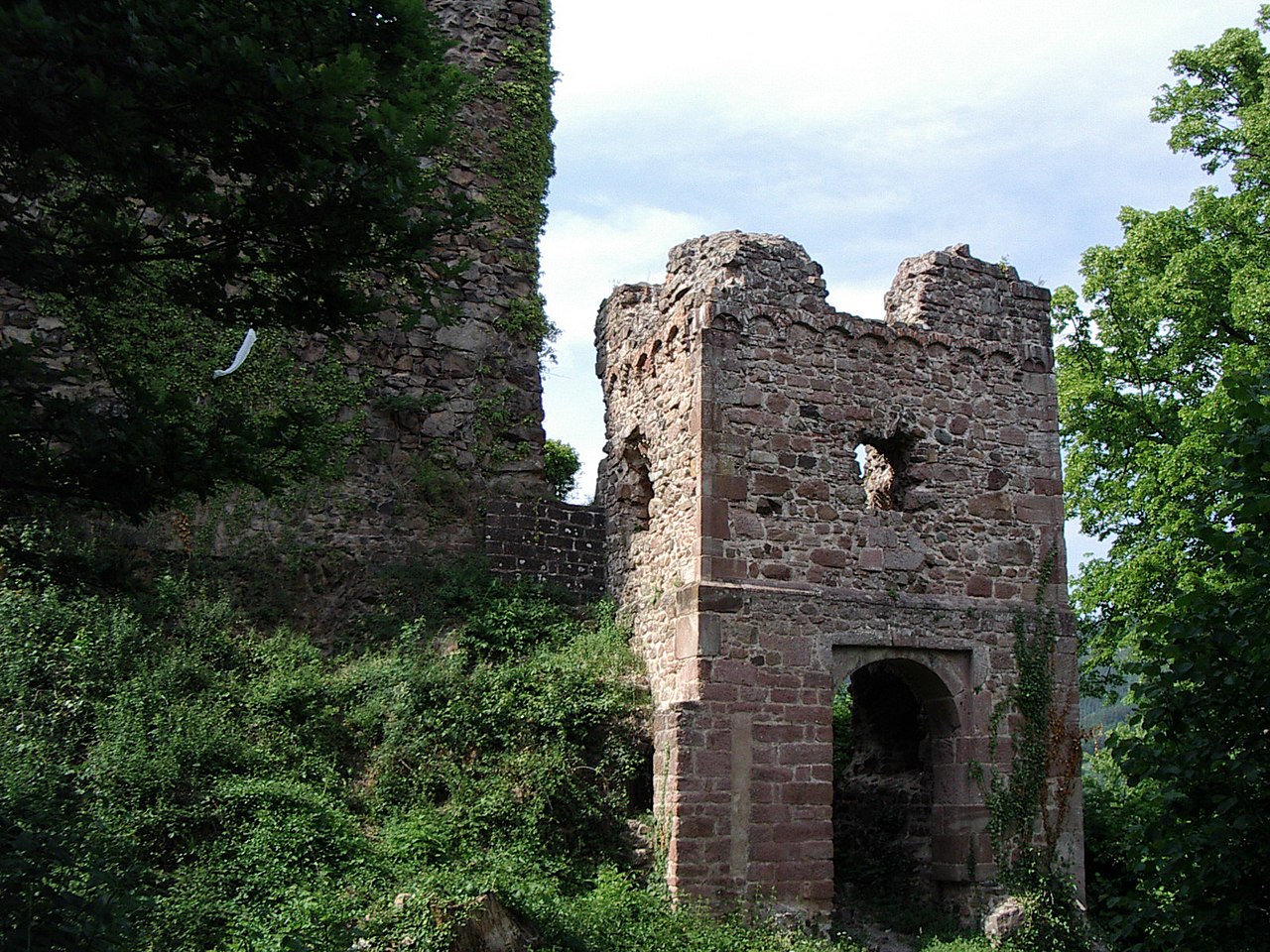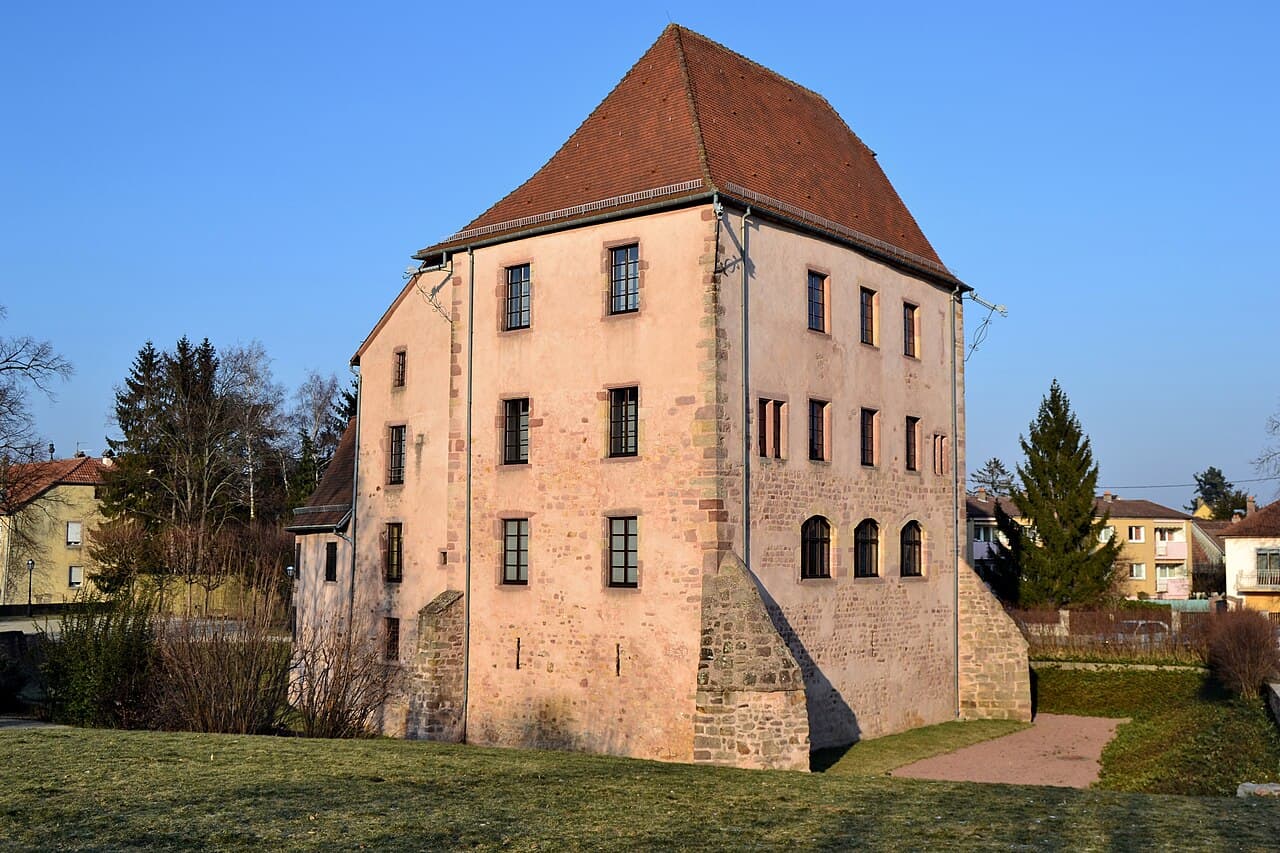
Castle of Buchenek — France castle

Castle of Buchenek

Castle of buchenek in soultz-haut-rhin
Soultz-Haut-Rhin, Grand-Est, France
High Medieval (11th–13th c.)
Restored

The Castle of Buchenek stands as a remarkable example of High Medieval military architecture in the Alsace region of France. Located in the commune of Soultz-Haut-Rhin, this fortress dates back to the 13th century, with its first documented mention in 1251. The castle's origins lie in its strategic position and its role as a noble residence and defensive stronghold during a turbulent period of feudal conflicts and territorial disputes.

Architectural evolution and structural features

The castle’s initial construction phase, evidenced by the lower parts of the building, reflects typical medieval fortification techniques of the 13th century. It originally featured a rectangular logis or main residential block, which formed the heart of the castle complex. This logis likely included defensive walls with narrow windows and arrow slits, designed to withstand sieges and attacks.

During the 14th century, the castle underwent significant modifications, as archaeological and architectural studies reveal clear traces of building work from this period. These alterations may have included strengthening of the walls, addition of new defensive elements, or expansion of living quarters to accommodate changing needs and advances in military technology.

One of the most notable additions to the castle is the staircase tower, constructed in the second half of the 16th century. This feature illustrates the transition from purely defensive architecture towards more comfortable and accessible residential designs, reflecting Renaissance influences on castle construction. The tower not only provided vertical circulation but also served as a symbol of status and architectural refinement.

Historical context and later uses

After the devastation wrought by the Thirty Years' War (1618–1648), the Castle of Buchenek was restored to maintain its structural integrity and historical significance. Following the war, the castle was sold as national property, a common fate for many noble estates during the period of French revolutionary reforms and redistribution of lands.

In the 19th century, the castle’s role shifted dramatically when it was repurposed as a factory. This industrial use led to a period of neglect and physical decline, causing the once formidable fortress to fall into a state of ruin. Despite this, the castle’s essential structure endured through the centuries.

Restoration and cultural significance

The turning point for the Castle of Buchenek came in 1976, when it was purchased by the municipality of Soultz-Haut-Rhin. Recognizing its cultural and historical value, the town undertook comprehensive restoration efforts to preserve the castle’s architectural heritage. These restorations aimed to stabilize the structure, restore key architectural features, and adapt the castle for public use.

Since 1990, the castle has housed the municipal museum, which showcases local history, art, and cultural artifacts, thus transforming the fortress into a vibrant center for education and tourism. The castle’s designation as a historic monument in 1984 underscores its importance as a protected heritage site in France.

Architectural details and visitor experience

Visitors to the Castle of Buchenek can explore its well-preserved medieval walls, the distinctive staircase tower, and the restored logis. The museum inside offers insights into the castle’s layered history, from its medieval origins through Renaissance modifications and industrial era transformations.

The castle’s location in the scenic Alsace region adds to its appeal, offering picturesque views and a tangible connection to the region’s rich past. The combination of architectural authenticity and adaptive reuse makes the Castle of Buchenek a noteworthy destination for enthusiasts of medieval architecture and French history alike.

Frequently asked questions (FAQ)

What is the historical significance of the Castle of Buchenek?
The Castle of Buchenek has a rich history dating back to the 12th century, serving as a strategic stronghold in the region. It has witnessed numerous historical events, including conflicts and sieges, that shaped the local landscape and culture.
When was the Castle of Buchenek built?
The construction of the Castle of Buchenek began in the early 12th century and continued to evolve over the following centuries. Its architecture reflects various styles from different historical periods, showcasing the castle's adaptation to changing needs and influences.
Can I visit the Castle of Buchenek?
Yes, the Castle of Buchenek is open to visitors. You can explore its grounds and learn about its fascinating history through guided tours and informational displays.
What are the opening hours for the Castle of Buchenek?
The Castle of Buchenek is typically open to the public from 10 AM to 6 PM during the tourist season, which runs from April to October. It’s advisable to check the official website for any seasonal changes or special events that may affect opening hours.
Is it possible to access the Castle of Buchenek with a wheelchair?
The Castle of Buchenek has made efforts to improve accessibility for all visitors. However, due to its historical structure, some areas may present challenges for wheelchair users, so it's best to inquire in advance about specific accessibility options.
What is the best time to visit the Castle of Buchenek?
The best time to visit the Castle of Buchenek is during the late spring and early fall when the weather is pleasant and the surrounding landscapes are in full bloom. Visiting during this period allows you to enjoy the outdoor scenery and participate in various seasonal events.
Are there any nearby attractions to the Castle of Buchenek?
Yes, there are several nearby attractions, including the picturesque village of Soultz-Haut-Rhin and several hiking trails in the surrounding countryside. Visitors can also explore local wineries and historical sites that highlight the cultural heritage of the region.
What are the ticket prices for visiting the Castle of Buchenek?
Ticket prices for the Castle of Buchenek vary depending on age and group size, with discounts often available for students and seniors. It’s recommended to check the official website for the most current pricing and any special promotions or family packages.

Photo gallery

Castle of Buchenek
Click to view

Photo by Florival fr•CC BY-SA 3.0

1 photo • Click any image to view in full screen

Information

Hill Castle

Sources & official resources

Verify the information above using these authoritative references.

Loading map...

Visitor reviews

No reviews yet. Been here? Write the first review and help other travelers!

Write the first review

Visited this castle? Share your experience

Your review helps other travelers and adds first-hand knowledge to our encyclopedia.

Write a review

(5/5)

0/2000 characters

Your review will be visible after admin approval

Nearby castles

2.8 km

Castle of Saint-Ulrich

Ribeauvillé, France

Saint-Ulrich Castle, perched above the picturesque town of Ribeauvillé in the Grand Est region of northeastern France, is a remarkable example of medieval military architecture and noble residence. This hill castle stands at an altitude of approximately 528 meters and forms part of a trio of castles, including Girsberg and Haut-Ribeaupierre, that dominate the Alsatian landscape. Its strategic location allowed control over the vital road linking the Alsatian Plain to the valley of Liepvre, underscoring its military and administrative importance during the High Medieval period. The castle's origins date back to the 11th century, when it was initially constructed by the noble von Rappolstein family, later known as the Ribeaupierres. The earliest documented reference to the site is from 1038, under the name "rocher de Reginbald," likely linked to a local lord named Reginboldi. In 1084, Emperor Henry IV granted the castle to the Bishop of Basel, marking its significance within the feudal hierarchy. Throughout the 12th and 13th centuries, the castle witnessed multiple sieges and changes in control, including military occupation by Henry V and defense against attacks by King Rudolf IV and Adolph I. Architectural evolution and features Early construction and layout The original fortress was a robust stone structure comprising an upper castle or citadel, and a lower castle known as the outer bailey. The core of the castle included a square keep (donjon) and a main residential building dating from the 12th century, which featured defensive and domestic elements such as a chimney. Around 1200, the castle was remodeled to include a representative building with paired windows topped by circular openings called oculi and lateral benches, though only the lower level of this structure survives today. The knights hall and later additions One of the castle's most distinguished features is the 13th-century knights hall, a large rectangular room illuminated by nine exquisite Romanesque windows. This hall served as a grand gathering space and is still admired for its architectural beauty. During the 14th century, the castle's defenses were strengthened with the addition of a barbican and an outer enceinte, enhancing its fortifications against siege warfare. The 15th century saw the addition of the chapel of Saint Ulrich, dedicated to the bishop of Augsburg, which gave the castle its present name. This chapel, though partially ruined, reflects the religious significance within the castle grounds. Historical significance and ownership The castle served as the principal residence of the powerful Ribeaupierre family from the 11th to the 16th centuries. It was a symbol of their authority and influence in the region. Throughout its history, the castle endured sieges, political intrigue, and changing military needs. Notably, in the late 15th century, the castle's dungeon held Lady Cunegonde d'Hungerstein, a prisoner accused of murder, for nearly two decades. By the 16th century, the Ribeaupierres abandoned Saint-Ulrich in favor of a more modern Renaissance residence in Ribeauvillé. The castle subsequently lost its military importance and was damaged during the Thirty Years' War. Following this, it fell into ruin as local inhabitants repurposed its stone for other constructions. Current state and conservation Today, the ruins of Saint-Ulrich Castle impress visitors with their size, complexity, and the interplay of architectural styles ranging from Romanesque to Gothic and Renaissance elements. The site includes the remains of the keep, knights hall, chapel, barbican, and outer walls, offering a vivid glimpse into medieval castle life and defense. Conservation efforts initiated in the late 19th century and ongoing preservation have stabilized the ruins, which are protected as a historic monument since 1841. Visitors can explore the castle grounds and climb the keep to enjoy panoramic views over the Alsatian plains and the village of Ribeauvillé below. The castle's layered history, architectural diversity, and scenic setting make it a significant cultural landmark in the region. The castle within the regional castle group Saint-Ulrich is part of a unique ensemble of three castles overlooking Ribeauvillé, alongside Haut-Ribeaupierre Castle and Girsberg Castle. Haut-Ribeaupierre, the oldest of the trio, is located higher on the mountain and served as a watchtower and prison in later centuries. Though mostly in ruins and closed to the public for safety reasons, it remains a striking feature of the landscape. This group of castles collectively illustrates the medieval defensive network and noble power structures in Alsace. Their proximity and mutual visibility demonstrate strategic planning and territorial control during the Middle Ages.

High Medieval (11th–13th c.)
Details
4.6 km
Château du Hugstein — France castle

Château du Hugstein

Buhl, France

Château du Hugstein stands as a remarkable example of a medieval hill castle in the Alsace region of France, perched strategically on a rocky outcrop at 389 meters above sea level. Constructed in 1227 by Hugo (Hugues) de Rothenbourg, the prince-abbot of the influential Murbach Abbey, this fortress was designed to protect the abbey's interests and control access to the Florival valley. As the oldest recorded monastic castle in Alsace, it embodies the dual religious and military functions typical of High Medieval fortifications. The castle was built during a period when abbots wielded significant secular power, and Hugo’s role as abbot prince combined spiritual leadership with territorial governance. The castle's location between the communes of Buhl and Guebwiller was chosen to oversee and defend the entrance to the valley and safeguard the abbey’s lands. This strategic positioning highlights the castle’s importance not only as a residence but also as a military stronghold. Historical development and significance Founding and early use In its early years, Château du Hugstein served as both a fortified residence for the abbots of Murbach and a defensive bastion. The castle chapel, consecrated in 1313 by Abbot Conrad Wiedergrun de Stauffenberg, was dedicated to the Holy Cross and Saint Benoît (Saint Benedict), reflecting the religious character of the site. This chapel’s Gothic keystone, adorned with the Easter lamb or Agnus Dei, is a notable artifact now displayed in the Musée Théodore Deck in Guebwiller. 15th-century modernization The castle underwent significant modernization in the 15th century under Abbot Barthélémy d’Andlau. Between 1447 and 1476, he reinforced the fortress by adding a distinctive gate tower decorated with a brick frieze and equipped with a drawbridge. Two additional towers were incorporated into the defensive system, although the castle’s primary function was shifting towards a more residential role. These enhancements were aimed at adapting the castle to evolving military technologies and threats during the Late Medieval period. 16th-century conflicts and decline During the early 16th century, under the stewardship of Georges de Masevaux, restoration efforts continued, but the castle’s role darkened as it became a prison for Lutherans and those accused of witchcraft. The castle’s grim history includes the imprisonment and possible execution of accused witches, reflecting the religious turmoil of the Reformation era. In 1542, the castle was embroiled in a violent succession dispute between Henri de Jestetten and his cousin Rodolphe Stoer de Stoerenbourg, the abbot of Honcourt and Capitulary of Murbach. This conflict resulted in the siege and partial destruction of the fortress, marking the beginning of its decline as a military stronghold. The castle suffered further damage in 1598 when it was struck by lightning. The devastation of the Thirty Years’ War (1618–1648) and subsequent neglect led to its abandonment. By the 18th century, the castle was no longer inhabited and was used as a quarry, with many stones removed to build local structures. Architectural features and layout Fortified structure and defensive design Château du Hugstein is notable for its two-part fortified layout, consisting of an outer bailey (Vorburg) and an inner bailey (Kernburg), enclosed by a double ring wall. The castle takes full advantage of the natural topography, with steep ditches protecting the south and west sides. The inner fortress is a rectangular enclosure approximately 18 by 25 meters, elevated several meters above the outer bailey. The inner ring wall reaches up to 10 meters in height and is 2.6 meters thick, constructed primarily of locally quarried gneiss rubble with sandstone facing for decorative and structural elements. Uniquely, three corners of the wall are rounded, creating an optical illusion of cylindrical towers to potential attackers, although only one true cylindrical bergfried (keep) exists. Distinctive bergfried and gate tower The cylindrical bergfried on the western side, measuring about 10 meters in diameter and height, is a rare feature in Alsace. Built from finely hewn sandstone blocks, its outer wall is thicker to withstand attacks, while the inner side is thinner. The upper part of the bergfried was removed during the 18th-century quarrying activities. The gate tower, dating from the 15th-century renovations, originally had three stories but now retains two. It features a round-arched entrance, a brick frieze, and blind tracery decoration. The tower was equipped with a drawbridge and smaller pedestrian door, with narrow arrow slits and shooting windows for defense. Residential quarters and chapel The main corps de logis likely rose two or three stories along the southern edge of the inner bailey, providing a residence of notable grandeur. The castle chapel was probably housed in a rectangular building on the eastern side and held significant religious importance, as evidenced by the consecration records and surviving Gothic keystone. Later history and preservation efforts Post-medieval decline and quarrying Following its abandonment, the castle was used as a shelter for the poor before becoming a source of building materials. The removal of sandstone blocks, door and window frames, and parts of the outer walls significantly altered the castle’s appearance and structural integrity. Archaeological rediscovery and protection In 1862, archaeological clearing revealed painted decorations hidden beneath layers of plaster, shedding light on the castle’s artistic heritage. Recognizing its cultural and historical significance, French authorities designated Château du Hugstein as a Monument historique in 1898. The formation of the preservation group Pro Hugstein in 2006 has helped safeguard the ruins and promote awareness of this important medieval site. Location and cultural context Château du Hugstein uniquely straddles the boundary between the communes of Buhl and Guebwiller, with the administrative border running through the bergfried. This positioning underscores the castle’s historical role in controlling access between these communities and maintaining regional security. Today, the ruins of Château du Hugstein offer visitors a compelling glimpse into the military architecture and monastic power of the High Medieval period in Alsace. Its distinctive features, including the rare cylindrical keep and cleverly designed defensive walls, make it a significant heritage site for both history enthusiasts and scholars of medieval architecture.

High Medieval (11th–13th c.)
Details
8 km

Freundstein Castle

Goldbach-Altenbach, France

Freundstein Castle, locally known as Château de Freundstein, is a late medieval castle ruin perched atop a 948-meter high mountain near the village of Goldbach-Altenbach in the Haut-Rhin department of France. This region, part of the Southern Alsace or Southern Vosges, is known for its rugged terrain and historical fortifications. The castle's strategic location afforded commanding views over the surrounding landscape, making it a valuable defensive site throughout its history. The castle was likely constructed in the late 13th century, with the first documented mention dating to 1297. Initially, Freundstein Castle was enfeoffed to the Lords of Waldner, a noble family who adopted the name Waldner von Freundstein after taking possession. Ownership of the castle was complex, being shared between two powerful overlords: the Murbach Abbey and the Bishop of Strasbourg. This dual overlordship reflects the intertwined secular and ecclesiastical power structures typical of the region during the Middle Ages. Architectural features and construction The castle's architecture is characteristic of late medieval fortifications in the Vosges mountains, designed primarily for defense. Although now in ruins, remnants of the high castle walls are still visible, featuring loopholes—narrow vertical slits used for archery—and later period openings that indicate modifications over time. The castle's position on a steep mountain slope added a natural layer of defense, complemented by its stone walls and battlements. Freundstein's structure would have included essential elements typical of the period, such as a keep or donjon serving as the last line of defense and living quarters, curtain walls surrounding the inner courtyard, and possibly a gatehouse controlling access. The castle's elevation and rugged setting made it a formidable fortress despite its relatively modest size. Historical events and sieges Early history and ownership The castle's earliest recorded history begins in the late 13th century when it was granted to the Waldner family. The Waldners held the castle as vassals under the dual authority of the Murbach Abbey and the Bishopric of Strasbourg, illustrating the feudal complexities of the time. The family's long tenure at Freundstein is notable, as they retained ownership for centuries, a rarity among medieval noble families. Damage and conflicts in the 14th and 15th centuries By the 14th century, Freundstein Castle had begun to deteriorate, suffering significant damage from the 1356 Basel earthquake, one of the most devastating seismic events in European history. This natural disaster weakened the castle's structure, leading to gradual decline. The castle also played a role in regional conflicts. In 1441, it was used as a prison to hold two butchers from the nearby town of Mulhouse. This act provoked a siege by the townspeople, who sought to free their compatriots. Later, in 1490, the castle was again besieged, this time by forces from Stoultz-Haut-Rhine allied with the Bishop of Strasbourg, reflecting ongoing territorial disputes and feudal rivalries involving the Waldner family. Destruction and abandonment in the 16th century During the German Peasants' War of 1525, Freundstein Castle was set ablaze by rebellious peasants, a common fate for many feudal strongholds targeted during this widespread uprising. The castle was subsequently rebuilt, demonstrating its continued strategic and symbolic importance. However, in 1562, the castle suffered further devastation when it was struck by lightning and partially destroyed by fire. Although partially restored afterward, the castle never fully recovered its former stature and was ultimately abandoned by the end of the 16th century. This abandonment reflects broader shifts in military technology and political power that rendered many mountain castles obsolete. Role during world war i and modern status Despite its ruinous state, Freundstein Castle's elevated position retained military significance into the 20th century. During World War I, starting in 1915, the French army utilized the castle ruins as an observation post to monitor enemy movements across the Vosges region. This strategic use led to the castle being targeted and shelled multiple times by German forces, adding to its historical narrative of conflict and resilience. Today, Freundstein Castle stands as a partially preserved ruin accessible to the public. Visitors can explore the remains, though access can be challenging due to the castle's mountainous location and the difficulty of finding a safe route inside. The site offers not only a glimpse into medieval fortification architecture but also spectacular views of the surrounding forested landscape, making the journey to the castle a rewarding experience in itself. Cultural significance and heritage Freundstein Castle embodies the complex feudal history of the Alsace region, reflecting centuries of political, religious, and military developments. Its enduring association with the Waldner family highlights the persistence of noble lineages in this borderland area. The castle's ruins serve as a tangible link to the late medieval period, the German Peasants' War, and the turbulent history of the Vosges mountains. Moreover, the castle's use during World War I connects it to modern European history, illustrating how ancient fortifications were repurposed in new conflicts. As a heritage site, Freundstein Castle attracts visitors interested in medieval architecture, military history, and the natural beauty of the Alsace region. Visitor experience Accessing Freundstein Castle requires some effort due to its remote mountain location. The forest paths leading to the ruins are scenic and offer opportunities for hiking and nature observation. While the castle itself is modest in size and partially ruined, the historical ambiance combined with panoramic views makes it a worthwhile destination for enthusiasts of history and outdoor adventure.

Late Medieval (14th–15th c.)
Details