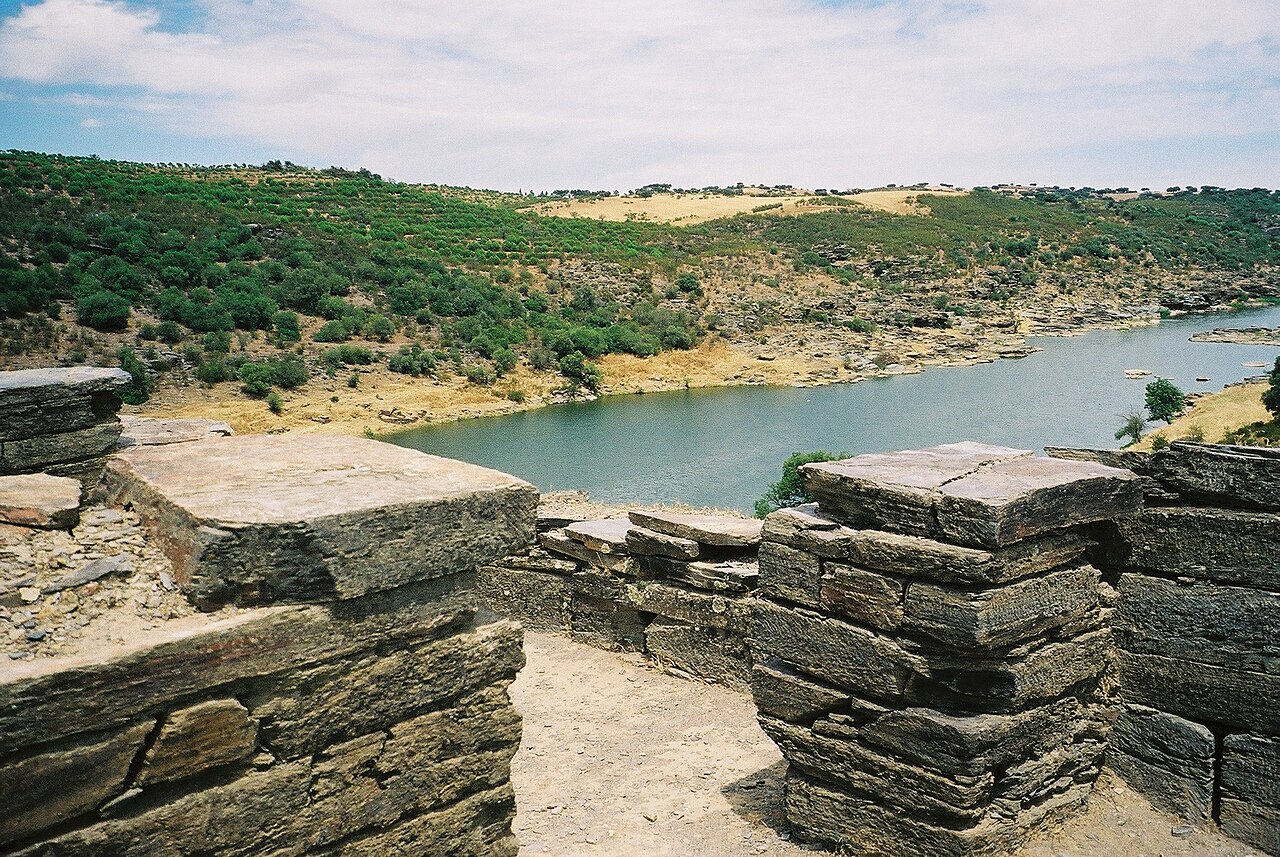
Castle of Avô
The Castle of Avô stands as a remarkable historic fortress located in the municipality of Oliveira do Hospital, in Portugal. Its strategic hilltop position commands views over the confluence of the Alva and Moura rivers, emphasizing its military and territorial significance through various historical periods. The castle's origins trace back to an Iron Age settlement associated with the Castro culture, a pre-Roman fortified community known for its hillforts across the Iberian Peninsula.
Following the Iron Age, the site was incorporated into the Roman Empire network, serving as a key point along the road connecting the important Roman settlements of Lancia Oppidana and Conímbriga. This integration highlights the castle's early role in regional communication and defense. The Roman occupation left behind structural and infrastructural influences that shaped the site's development.
Early medieval transitions and ownership
In the early 5th century, around 412 AD, the region fell under the control of the Alans, a Sarmatian group who settled parts of the Iberian Peninsula during the Migration Period. Subsequently, the territory experienced the wave of Muslim invasions around 716 AD, marking a significant shift in control and cultural influence. By the 11th century, the castle area was integrated into the holdings of Count Sesnando Davides, a prominent noble connected to the County of Coimbra, reflecting the Christian reconquest and territorial reorganization in northern Portugal.
During the 12th century, the castle and its lands were granted by Count D. Henrique to the Bishop of Coimbra, establishing ecclesiastical authority over the region. The earliest medieval fortress construction likely dates from this period, possibly commissioned by Count Henrique's son, D. Afonso Henriques, the first King of Portugal. This phase marked the transformation of the site into a fortified stronghold aligned with the emerging Portuguese kingdom.
Medieval fortification and political upheaval
By 1187, the castle was under the possession of D. Urraca Afonso, who exchanged it for Aveiro with her brother, King D. Sancho I. King Sancho I subsequently confirmed a foral (charter) for the town in favor of the Bishop of Coimbra, defining its administrative and legal status. This period solidified the castle's role as both a military and administrative center.
The castle endured destruction during the 13th century amidst the conflicts between King D. Sancho II and King Afonso III. These internal disputes led to significant damage, but the fortress was not abandoned. In the 14th century, under the reign of King D. Dinis, the castle was rebuilt, incorporating Gothic architectural elements and reinforcing its defenses. This reconstruction was a critical phase, restoring the castle's military functionality and adapting it to contemporary defensive needs.
Decline and preservation efforts
From the mid-19th century, the castle faced rapid decline. Starting in 1856, much of its stonework was quarried for public infrastructure projects, including a nearby bridge over the Ribeira de Moura. This dismantling led to the ruin of key structures such as the keep tower, drastically altering the castle's silhouette and integrity.
Preservation efforts began in 1942, initiating repairs and stabilization works that continued through the 1960s and 1970s. Restoration focused on the Chapel of São Miguel and paving within the castle grounds. The site's cultural importance was officially recognized in 1963 when it was declared a Property of Public Interest. Later, in 1992, management was transferred to the Portuguese Institute of Architectural Patrimony, ensuring ongoing conservation and protection.
Architectural features and remains
The Castle of Avô features an irregular plan shaped by its hilltop terrain and Gothic design principles introduced during the medieval reconstruction. The surviving defensive walls display polygonal merlons atop the curtain walls, characteristic of medieval fortifications designed for active defense.
The main gate is a prominent architectural element, showcasing a pointed ogive arch typical of Gothic military architecture. Measuring approximately 3.5 meters in height and 2.7 meters in width, the gate exemplifies the controlled access points vital for the fortress's defense. Its preservation offers valuable insight into medieval construction techniques and security measures.
Within the castle walls lies the Chapel of São Miguel, dedicated to the Archangel Michael. This chapel consists of a single nave culminating in a presbytery, with a vaulted ceiling featuring two lateral niches likely intended for religious statues or candles. The integration of the chapel within the fortress underscores the intertwined nature of military and religious functions during the Middle Ages.
Despite centuries of stone removal and structural loss, the castle's remaining walls and chapel provide a tangible link to its layered history—from Iron Age fortifications through Roman occupation to medieval Gothic reconstruction. The site embodies the evolution of defensive architecture and regional power dynamics in central Portugal.
Historical significance and cultural heritage
The Castle of Avô is a testament to the complex history of territorial control in Portugal, reflecting transitions from prehistoric communities through Roman, Islamic, and Christian dominions. Its association with key historical figures such as D. Afonso Henriques and King D. Dinis highlights its importance in the formation and consolidation of the Portuguese nation.
Today, the castle stands as a cultural landmark, attracting visitors interested in medieval architecture, Portuguese history, and archaeology. Its preservation allows for ongoing study and appreciation of the region's heritage, contributing to the understanding of medieval fortifications and their roles in defense, administration, and religious life.
Visitor experience and accessibility
Visitors to the Castle of Avô can explore the ruins and the restored chapel, enjoying panoramic views of the surrounding landscape. The site's hilltop location offers a unique vantage point over the confluence of the Alva and Moura rivers, enhancing the visitor experience with natural beauty alongside historical intrigue.
While the castle is in a ruinous state, pathways and signage help guide exploration. Preservation efforts have aimed to stabilize the remaining structures, ensuring safe access for tourists and scholars alike. The castle's designation as a Property of Public Interest underscores its value as a protected heritage site.
Frequently asked questions (FAQ)
- What is the best time to visit the Castle of Avô?
- The best time to visit the Castle of Avô is during spring and autumn when the weather is mild and the natural surroundings are particularly scenic. These seasons offer comfortable temperatures for exploring the hilltop ruins and enjoying panoramic views.
- Is the Castle of Avô accessible to visitors with mobility challenges?
- The castle's hilltop location and ruinous condition mean that some areas may be difficult to access for visitors with mobility challenges. However, efforts have been made to provide safe pathways and signage to facilitate exploration. Visitors should prepare for uneven terrain.
- Can I visit the Chapel of São Miguel inside the castle?
- Yes, the Chapel of São Miguel is one of the key preserved structures within the Castle of Avô and is accessible to visitors. It offers insight into the religious aspect of the medieval fortress and features Gothic architectural elements.
- Are guided tours available at the Castle of Avô?
- Guided tours may be available through local tourism offices or heritage organizations. These tours provide detailed historical and architectural information, enhancing the visitor experience by contextualizing the castle's significance.
- What are the opening hours and ticket prices for the Castle of Avô?
- The Castle of Avô is generally open during daylight hours, but specific opening times may vary seasonally or due to conservation work. Entry is often free or requires a modest fee; visitors should check with local tourism sources for current information.
Information
Current owner
Portuguese Institute of Architectural Patrimony
Loading map...
Visitor reviews
No reviews yet. Been here? Write the first review and help other travelers!
Write the first reviewVisited this castle? Share your experience
Your review helps other travelers and adds first-hand knowledge to our encyclopedia.