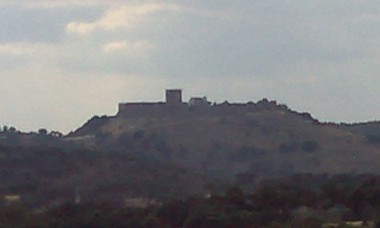
Castle of Aroche
The Castle of Aroche stands as a significant medieval hill castle located in the town of Aroche, Spain. Its origins trace back to the Almoravid period in the 11th century, marking it as a key example of Islamic military architecture in the Iberian Peninsula. The castle's construction continued through the Almohad era in the 12th and 13th centuries, reflecting the architectural evolution and strategic military needs of the time.
Following the Christian Reconquista, the fortress was incorporated into the Crown of Castile. A royal decree issued by King Sancho IV in 1293 authorized the city of Seville to reinforce its border defenses, which likely spurred major rebuilding efforts at the castle. Throughout the 14th and 15th centuries, numerous repairs and enhancements were documented, underscoring the castle's importance as a defensive stronghold along the volatile frontier with the Kingdom of Portugal.
During the 17th century, the castle underwent further modifications amid ongoing conflicts between Castile and Portugal. However, as military technology and strategies evolved, the castle's defensive role diminished. By the early 19th century, the fortress's enclosure had been repurposed for civilian uses, notably for public spectacles such as bullfighting, signaling a dramatic shift from its original martial function.
Architectural design and layout
Perched atop a small hill, the Castle of Aroche dominates the surrounding landscape, with the modern town having developed around its base. The fortress encloses an area of approximately 2,650 square meters within a fortified perimeter measuring 273 meters. Its layout follows a rectangular plan known as a "cuadribugium", a design characteristic of Islamic military architecture in the region.
The castle features ten strategically placed towers: four at the corners and six distributed along the curtain walls. This arrangement provided comprehensive defensive coverage and facilitated effective surveillance of the surrounding territory. The walls were primarily constructed using tapia, a traditional rammed earth technique common in Islamic fortifications, which offered both strength and insulation.
Running along the perimeter is an adarve—a raised walkway carved within the thickness of the walls. Although it lacks battlements or parapets, this path allowed defenders to move swiftly around the fortress's boundary, enhancing the castle's defensive capabilities.
The gates and entrances
The original main entrance, known as the Puerta de la Reina, is located on the southern side of the castle. It features a straight access passage secured by two horseshoe-shaped archways, emblematic of the castle's Islamic origins. In the 18th century, a new main entrance was established, reflecting changes in the castle's function and the evolving needs of its occupants.
Interior structures and towers
Inside the fortress, most of the towers have lost their internal chambers that once housed rooms for garrison troops and supplies. However, two towers near the current entrance retain their barrel-vaulted roofs, offering valuable insights into the castle's original interior architectural features. The absence of decorative inscriptions or elaborate ornamentation suggests a focus on practicality and military utility over aesthetic embellishment.
Historical significance and transformations
The Castle of Aroche played a pivotal role in the military and political landscape of the Iberian Peninsula during the Middle Ages. Initially constructed under Islamic rule, it served as a frontier fortress guarding against Christian advances. After the Reconquista, the castle became a vital component of Castilian border defenses against Portugal, enduring multiple sieges and conflicts.
The castle's strategic importance is highlighted by the extensive repairs and reinforcements carried out during the 14th and 15th centuries. Its military relevance persisted into the 17th century, during which time the fortress was adapted to meet the demands of new warfare technologies and ongoing border disputes.
By the 19th century, the castle's military function had largely ceased, and its spaces were repurposed for public and cultural uses, including bullfighting events. This transition reflects broader societal changes and the diminishing role of medieval fortresses in modern warfare.
Preservation and current condition
Today, the Castle of Aroche remains a significant historical monument, with much of its perimeter walls and towers still standing. The fortress is classified as a hill castle and retains its distinctive rectangular layout and tower distribution. While some structural elements have deteriorated over time, the castle's core architectural features continue to illustrate its multifaceted history from Islamic origins through Christian adaptation and eventual civilian reuse.
The use of rammed earth construction has contributed to the preservation challenges, as this material requires ongoing maintenance to prevent erosion. Nevertheless, the castle's enduring presence provides valuable insight into the military architecture and historical dynamics of medieval Spain.
Visiting the castle of aroche
Visitors to the Castle of Aroche can explore its imposing walls, towers, and the surrounding hilltop, which offers panoramic views of the town and the surrounding landscape. The castle's historical layers provide a tangible connection to the region's complex past, from Islamic rule to Christian reconquest and beyond.
While the castle lacks extensive visitor facilities, its open-air ruins invite exploration and study by history enthusiasts, architects, and tourists interested in medieval fortifications. The site serves as a cultural landmark within the town of Aroche and contributes to the broader appreciation of Spain's rich heritage of castle architecture.
Frequently asked questions (FAQ)
- How do I get to the Castle of Aroche?
- The Castle of Aroche is located on a hill within the town of Aroche in Andalusia, Spain. It is accessible by local roads and is a short walk from the town center.
- What is the historical significance of the Castle of Aroche?
- The Castle of Aroche is historically significant as a frontier fortress originally built during the Islamic Almoravid period and later adapted by Christian forces during the Reconquista. It played a key role in border defense against Portugal.
- Can I explore the interior of the Castle of Aroche?
- Visitors can walk along the castle's perimeter walls and explore the ruins of the towers and gates. However, many interior chambers are no longer intact, so access is mainly limited to external and partial interior areas.
- When is the best time to visit the Castle of Aroche?
- The best time to visit is during the spring and autumn months when the weather is mild, making it comfortable to explore the hilltop ruins and enjoy panoramic views.
- Are there any guided tours available at the Castle of Aroche?
- Guided tours may be available through local tourism offices or cultural organizations in Aroche. Visitors are encouraged to check locally for tour schedules and availability.
- Is the Castle of Aroche wheelchair accessible?
- Due to its hilltop location and uneven terrain, the Castle of Aroche has limited wheelchair accessibility. Visitors with mobility concerns should prepare accordingly.
Information
Sources & official resources
Verify the information above using these authoritative references.
Loading map...
Visitor reviews
No reviews yet. Been here? Write the first review and help other travelers!
Write the first reviewVisited this castle? Share your experience
Your review helps other travelers and adds first-hand knowledge to our encyclopedia.