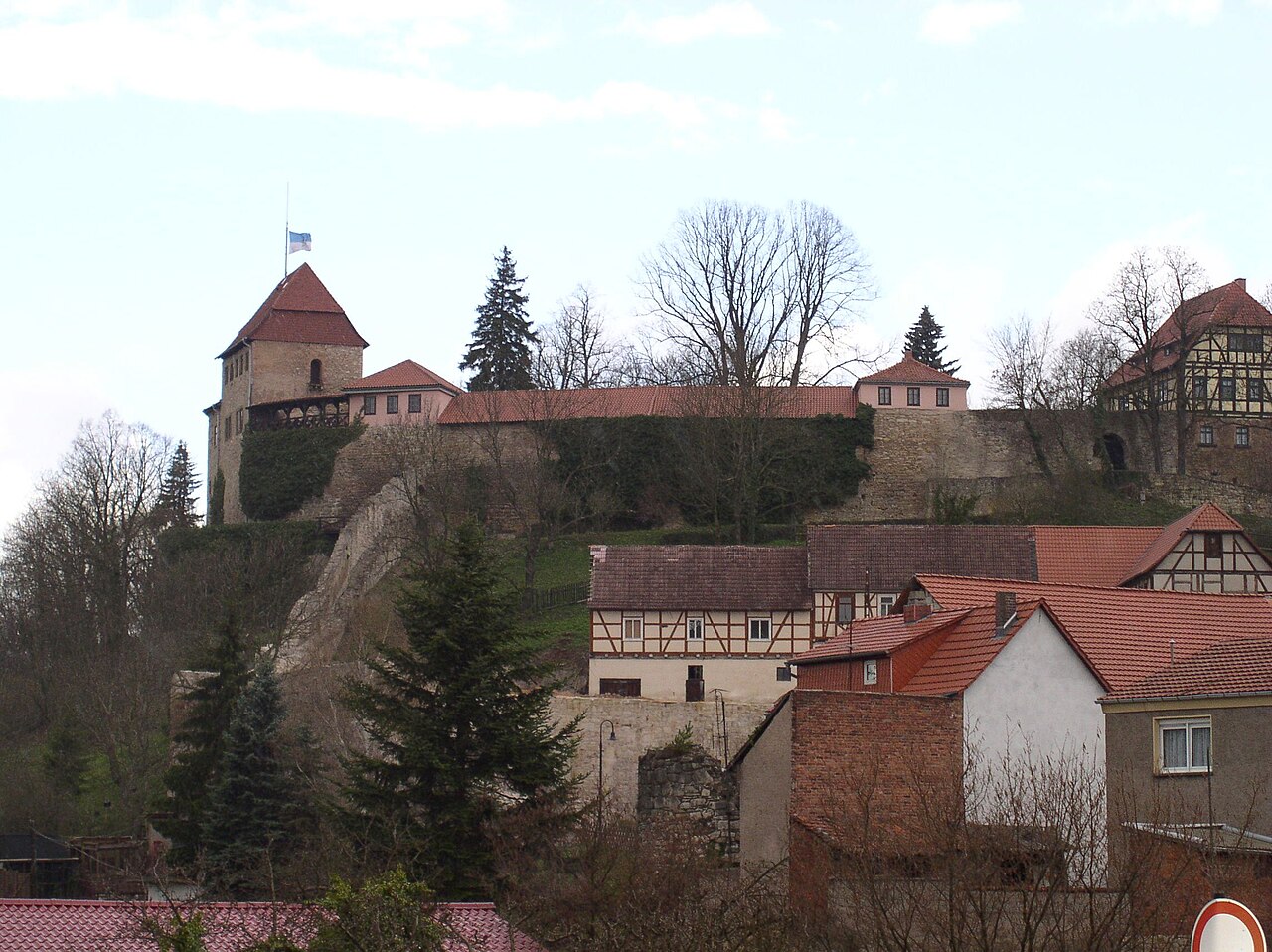
Castle Normannstein
Castle Normannstein stands prominently above the town of Treffurt in Germany, embodying a rich history that spans from the early medieval period to modern times. Originally established in the 9th century, the castle began as a strategic watch post designed to control and monitor the Werra valley, a crucial geographical corridor. The earliest surviving elements include a Romanesque bergfried, or round tower, and an enclosing inner ring wall, which showcase the castle's initial defensive purpose and architectural style.
Early origins and medieval transformation
The castle's foundation as a watch post was later transformed around the year 1200 by the noble Herren von Treffurt family. This transformation marked the evolution of the site from a simple lookout to a substantial fortress. The family added two rectangular towers, a gatehouse, and a residence for squires, known as the Knappenbau. These additions were complemented by a forecourt protected by a ring wall, enhancing the castle's defensive capabilities. The Knights of Treffurt established their residence here and exercised local governance on behalf of the Landgraves of Thuringia, whose seat was in Eisenach.
The knights’ era and conflicts
During the late 13th and early 14th centuries, the knights' role shifted dramatically as they began to act as robber barons, conducting raids along the border between Thuringia and Hesse. This aggressive behavior prompted military responses, including sieges led by the Archbishop of Mainz and the Landgraves of Thuringia and Hesse. The first siege in 1333 resulted in the knights' expulsion, but they returned shortly afterward, provoking a second siege that culminated in their final expulsion in 1336. These events marked a turning point in the castle's history, transitioning it from a noble stronghold to a jointly managed property.
Ganerbschaft period and architectural additions
Following the knights' departure, the castle entered a phase of Ganerbschaft, a form of shared ownership among officials from Mainz, Thuringia, and Hesse. These administrators resided within the castle and managed the surrounding region. A significant architectural addition during this period was the construction of a Gothic chapel in 1417, which stands separately outside the inner ring wall and remains the only residential-type building beyond the main fortifications.
Decline and 19th-century revival
By the late Middle Ages, the castle's administrators preferred urban residences in Treffurt, leading to the castle's abandonment and gradual decay. It became a source of building materials, and the name "Normannstein" first appeared in records during this time. The castle's fortunes revived in 1894 when Gustav Döring purchased the ruin and converted the chapel into a restaurant, sparking renewed interest and preservation efforts.
20th-century history and restoration efforts
In the 20th century, the castle grounds hosted events for the Bund Neudeutschland youth organization between 1921 and 1933, including the formation of the Normannsteiner faction in 1924. The restaurant operated until 1971 but closed due to restrictions from the nearby inner-German border. From 1975, the local Treffurt youth club took responsibility for preserving the site, conducting repairs to halt further deterioration. After German reunification, a comprehensive restoration from 1995 to 2006 stabilized the castle. Today, the large rectangular tower serves as a museum showcasing the history of local castles along the Werra river. The castle is a protected historic monument owned by the town of Treffurt. Since 2008, the restaurant has reopened, and an annual festival celebrates the castle's heritage and community ties.
Architectural features and surviving structures
The romanesc round tower (bergfried)
The castle's oldest surviving structure is the Romanesque bergfried, a round tower notable for its finely crafted ashlar masonry made of dressed stone blocks. The tower is windowless, with a former entrance located on the south side approximately eight meters above ground level. Its walls at the base are about three meters thick, and the basement likely housed a prison cell. This tower functioned as a last refuge during sieges and a secure storage space.
The rectangular towers: saxon and mainz towers
Attached to the steep hilltop are two rectangular towers from the early 13th century. The larger, known as the Saxon Tower, rises to 21.4 meters and includes several floors. It is distinguished by two elaborate triforium windows on its south façade, featuring triple-arched gallery openings typically found in religious buildings but adapted here to signify status and sophistication. The tower also contains remains of a garderobe on the west side above the moat and a fireplace ruin on the first floor, indicating the comfort of its original inhabitants. The top floor has a covered viewing platform offering extensive views of the surrounding valley. This tower currently houses the castle museum and hosts occasional ceremonies.
The smaller Mainz Tower likely dates from the same period and was primarily defensive. It is a fully enclosed structure near accessible battlements, which retain visible arrow slits for archers. An external iron spiral staircase was added during modern restoration to improve access.
Residential and defensive structures
Near the towers lie the ruins of the Knappenbau, or squires' building, which preserves a fireplace installation indicating its use as a residential and cooking space. This building may have served as the castle's main living hall, or palas, in medieval architectural terms. The castle's defensive perimeter included an outer ring wall protecting the southern section, parts of which have been preserved and reconstructed.
The original gatehouse from around 1200 no longer survives except for a distinctive pointed arch doorway embedded in the ring wall. Excavations since 1994 have uncovered foundations and cellar remains of several outbuildings within the courtyard.
Defensive earthworks and landscape features
The castle is surrounded by defensive earthworks, including a deep neck ditch about ten meters wide on the northern side and a large crescent-shaped earthwork. The town's city wall extended from the south to the castle, guarding the steep route connecting the Normannstein spring to the burgmen's farms within Treffurt. The principal entrance was located to the east, where historic hollow ways—sunken paths formed by centuries of use—are still visible.
Modern preservation and public access
Following its 19th-century acquisition, a building was constructed over the gatehouse ruins, serving variously as a residence, hostel, museum, and restaurant. Recent restoration efforts in the early 21st century have renewed courtyard paving, staircases, sanitary facilities, and parts of the inner ring wall. Improvements to the access road, including asphalt surfacing, have eased visitor approach. Today, Castle Normannstein stands as a well-preserved hill castle that offers visitors a unique glimpse into medieval fortifications and regional history, combining architectural grandeur with cultural heritage.
Frequently asked questions (FAQ)
- How do I get to Castle Normannstein?
- Castle Normannstein is located on a hill above Treffurt in Thuringia, Germany. Visitors can reach it by car or on foot via marked trails from the town center.
- What is the historical significance of Castle Normannstein?
- Castle Normannstein served as a strategic watch post and later a fortress controlling the Werra valley. It played a key role in regional power struggles during the Middle Ages, including conflicts involving robber barons and sieges.
- Is Castle Normannstein accessible to visitors year-round?
- The castle is generally open to visitors throughout the year, though opening times for the museum and restaurant may vary seasonally. It is advisable to check local information before planning a visit.
- Can I visit the museum inside the castle?
- Yes, the large rectangular Saxon Tower houses a museum that exhibits the history of local castles along the Werra river. The museum is open during regular visiting hours and offers insights into medieval life and architecture.
- Are there guided tours available at Castle Normannstein?
- Guided tours may be available seasonally or by appointment, providing detailed information on the castle's history, architecture, and restoration efforts. Visitors should inquire locally for tour schedules.
Information
Sources & official resources
Verify the information above using these authoritative references.
Loading map...
Visitor reviews
No reviews yet. Been here? Write the first review and help other travelers!
Write the first reviewVisited this castle? Share your experience
Your review helps other travelers and adds first-hand knowledge to our encyclopedia.