Castle House

Castle house in palmer, alaska

Castle House in Palmer, Alaska, stands as a unique example of a residential building that embraces castle-like architectural elements in a modern domestic setting. While its interior is comfortably furnished with typical home features such as carpet, vinyl flooring, couches, and recreational amenities like a ping-pong table, the exterior unmistakably asserts its identity as a castle. This is evident from the square battlements that ring the second-floor deck and the distinctive door leading to a tall tower, visible even from a distance along Palmer-Fishhook Road.

Architectural features and design

The structure is built upon a small knoll, enhancing its prominence and offering commanding views of the surrounding Alaskan landscape. The tower is a defining feature, rising above the rest of the building and providing visitors with panoramic vistas that extend as far as the knik glacier. This elevated position creates a sense of a vast "kingdom," with the wide expanse of wilderness visible in every direction.

The castle's battlements, a classic defensive architectural element historically used in medieval fortifications, are adapted here more for aesthetic effect than for defense. These crenellated parapets contribute to the building's castle-like silhouette and reinforce its thematic identity.

Location and setting

Situated in Palmer, a city within the United States Minor Outlying Islands territory of Alaska, the castle benefits from a scenic and somewhat remote setting. The location near Palmer-Fishhook Road makes the castle accessible while allowing it to stand out as a landmark in the area. The natural environment surrounding the site includes mountainous terrain and glacial features, which add to the dramatic backdrop for the castle.

Visitor experience and significance

Visitors to Castle House can enjoy both the comforts of a modern home and the romantic allure of castle architecture. The interior spaces are designed for everyday living and leisure, while the exterior elements provide a distinctive visual experience. The tower deck is a favored spot for taking in the expansive views, particularly of the nearby knik glacier, which remains visible even on cloudy days due to its elevated vantage point.

Although not a historical fortress, Castle House represents a creative interpretation of castle architecture in a contemporary residential context. It serves as a cultural curiosity and a point of interest for those fascinated by castles and unique architectural hybrids.

Frequently asked questions (FAQ)

How do I get to Castle House in Palmer, Alaska?
Castle House is located off Palmer-Fishhook Road in Palmer, Alaska. It is accessible by car and visible from the road, making it easy to find for visitors.
What can I see from the tower of Castle House?
From the tower, visitors can enjoy panoramic views extending to the Knik Glacier and the surrounding Alaskan wilderness, even on cloudy days.
Is Castle House a historical castle?
No, Castle House is a modern residence designed with castle-like architectural features rather than a historical fortress.
Can visitors enter the tower and deck area?
Yes, visitors can access the tower and the second-floor deck, which is ringed with square battlements, to enjoy the views and the castle atmosphere.
What makes Castle House unique compared to other castles?
Castle House uniquely blends modern residential comforts with traditional castle architectural elements, such as battlements and a tower, creating a distinctive hybrid structure.

Information

Hill Castle

Loading map...

Visitor reviews

No reviews yet. Been here? Write the first review and help other travelers!

Write the first review

Visited this castle? Share your experience

Your review helps other travelers and adds first-hand knowledge to our encyclopedia.

Write a review

(5/5)

0/2000 characters

Your review will be visible after admin approval

Nearby castles

6.2 km

Castellated House in Palmer

Palmer, United States of America

The castellated house in Palmer, Alaska stands as a unique example of modern residential architecture inspired by medieval castle design. Although not a true castle constructed from stone, this large home incorporates key castle-like architectural features such as a prominent turret and crenellations along its roofline, lending it a distinctive silhouette reminiscent of historic fortifications. Situated on an elevated site, the house benefits from commanding views of the surrounding landscape, enhancing its imposing presence. The exterior is finished in a dark grey color, which accentuates the fortress-like aesthetic and contrasts with the natural environment of Palmer, Alaska. Despite its modern construction materials, the design successfully evokes the atmosphere of a medieval hill castle through its form and detailing. Architectural features and design elements The defining feature of this residence is its turret, a cylindrical tower structure that rises above the main building and serves as a visual focal point. Turrets are traditionally associated with defensive purposes in castles, but here it functions primarily as an architectural statement and possibly as a lookout or observation space. Crenellations—the alternating high and low sections along the parapet—are another hallmark of castle architecture incorporated into the house's design. These battlement-like elements reinforce the medieval theme and provide a rhythmic pattern along the roofline. The house's construction departs from traditional stone masonry, instead utilizing modern building techniques and materials suitable for residential comfort and energy efficiency in Alaska's climate. The choice of a dark grey exterior finish complements the rugged setting and gives the home a contemporary yet historic appearance. Context and location Located in Palmer, Alaska, this castellated house is a private residence nestled in a region known for its scenic beauty and outdoor recreational opportunities. Palmer's landscape, characterized by rolling hills and mountainous backdrops, provides a fitting setting for a home that visually references the defensive hill castles of Europe. While the property is privately owned and not open to the public, its distinctive design has attracted attention as a notable example of castle-inspired architecture in a modern American context. The absence of a specific street address reflects respect for the owners' privacy. Cultural significance and modern interpretation This home exemplifies how castle architecture continues to inspire contemporary design, even outside traditional European contexts. By adopting elements such as turrets and crenellations, the house pays homage to the symbolism of strength, protection, and historical grandeur associated with castles. The modern castellated house in Palmer demonstrates the adaptability of castle motifs to residential architecture, blending aesthetic appeal with functional living spaces. It stands as a testament to the enduring fascination with medieval forms and their reinterpretation in diverse cultural and geographic settings. Privacy and visitor information As a private residence, the castellated house in Palmer is not accessible to the public. Visitors and enthusiasts are encouraged to appreciate the home from a distance and respect the privacy of its occupants. No public tours or visiting hours are available, and the exact location is withheld to maintain the owners' privacy.

Details
881.1 km

Baranof Castle

Sitka, United States of America

Baranof Castle, commonly known as Castle Hill, is a site of profound historical importance located in downtown Sitka, Alaska. This location stands as a testament to the complex history of Alaska, especially its indigenous heritage and colonial transformations. Originally inhabited and fortified by the Tlingit natives, the hill served as a strategic stronghold long before European contact. Historical significance and early use The site of Baranof Castle was initially a Tlingit fortification, reflecting the native peoples' sophisticated understanding of defensive architecture and the importance of controlling the surrounding waterways and land routes. The Tlingit used the hill to monitor and protect their territory, which was vital for trade, fishing, and cultural activities. Russian occupation and construction Between 1804 and 1867, the hill was occupied by the Russian-American Company and served as the administrative and military center of Russian Alaska. The Russians constructed a fortified structure on the hill, which came to be known as Baranof Castle, named after Alexander Baranov, the first governor of Russian America. This fortification was modest compared to European castles but was strategically important for controlling the region and defending against native uprisings and foreign powers. Architectural features Baranof Castle was primarily a wooden fortification, typical of frontier outposts in North America during the early 19th century. It included palisades, blockhouses, and a central building that functioned as the governor's residence and administrative headquarters. The fortifications were designed to provide defense against small-scale attacks rather than large sieges. Transfer of Alaska to the United States On October 18, 1867, Baranof Castle's hilltop was the symbolic site where the transfer of Alaska from Russia to the United States took place. This event marked a significant geopolitical shift and the beginning of American governance in the region. The ceremony was attended by Russian and American officials, and it remains a key moment in Alaskan history. Baranof Castle today Currently, Baranof Castle itself no longer stands, but the site is preserved as a state historic site and is designated a National Historic Landmark. Visitors to Castle Hill Park can access a fully accessible walkway leading to the summit, where panoramic views of downtown Sitka and the waterfront are available. Interpretive panels provide detailed information about the site's rich history, including the Tlingit heritage, Russian occupation, and the American acquisition of Alaska. Visitor experience and accessibility The park is easily accessible from downtown Sitka, located at the corner of Harbor Road and Lincoln Street. Visitors can reach Sitka by boat or plane, making it a unique destination combining natural beauty and historical depth. The site offers educational opportunities for those interested in the cultural and colonial history of Alaska. Geographical and cultural context Baranof Castle is situated in the Alaska Region, within the city of Sitka, a location known for its rich indigenous culture and Russian colonial history. The site overlooks Sitka Sound, providing strategic views that were crucial for defense and trade. The cultural layers present at Baranof Castle reflect the intersection of native traditions and European imperial ambitions. Preservation and management The site is managed by the Division of Parks & Outdoor Recreation of Alaska, ensuring its preservation and accessibility to the public. Efforts focus on maintaining the historical integrity of Castle Hill and providing interpretive resources that educate visitors about the site's significance. Baranof Castle remains a symbol of Alaska's diverse history, from indigenous fortifications to colonial administration and American statehood. Its story is essential for understanding the broader narratives of North American history and the cultural exchanges that shaped the region.

Early Medieval (5th–10th c.)
Details
1932.6 km
Fort San Miguel — Canada castle

Fort San Miguel

Yuquot, Canada

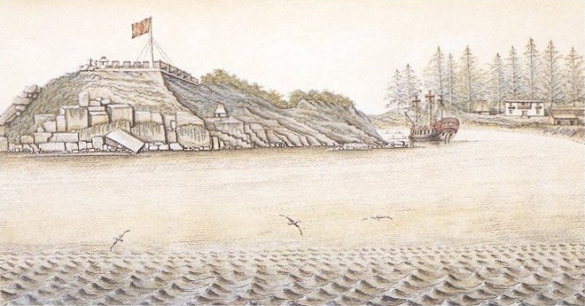
Fort San Miguel is a historic Spanish fortification located at Yuquot (formerly known as Friendly Cove) on Nootka Island, situated just west of north-central Vancouver Island in Canada. This fort played a significant role in the colonial history of the Pacific Northwest as it served to protect the Spanish settlement of Santa Cruz de Nuca, which was the first European colony established in what is now British Columbia. Historical context and significance Constructed in the 18th century during the post-Renaissance period, Fort San Miguel was part of Spain's efforts to assert sovereignty over the Pacific Northwest amid increasing competition from British and Russian explorers and traders. The fortification was established following the 1789 Nootka Crisis, a dispute between Spain and Britain over territorial claims and trade rights in the region. The presence of Fort San Miguel underscored Spain's strategic intentions to maintain a foothold in the area, particularly to protect the valuable fur trade and maritime routes. Architecture and fortification features The fort was built as a coastal fortress designed to defend the Spanish settlement and its harbor. While much of the original structure has not survived, historical accounts and archaeological evidence indicate that Fort San Miguel featured typical elements of 18th-century Spanish military architecture. These included wooden palisades, defensive bastions, and a strategic placement overlooking the harbor to monitor naval activity and potential threats. The fort's location at Yuquot allowed it to control access to Friendly Cove, a natural harbor that was critical for resupply and trade. The fortification likely included gun emplacements and lookout posts to guard against incursions by rival European powers and Indigenous groups. Santa Cruz de Nuca: the first colony in British Columbia Santa Cruz de Nuca was established as the Spanish colonial settlement adjacent to Fort San Miguel. It served as the administrative and military center for Spain's claims in the region. The settlement included living quarters, supply depots, and facilities to support the naval presence. Although the colony was relatively short-lived, it marked the beginning of European settlement in what would become British Columbia. The interactions between Spanish colonists and the Indigenous Nuu-chah-nulth people were complex, involving trade, alliances, and occasional conflicts. Archaeological remains and preservation Today, Fort San Miguel exists primarily as archaeological ruins. Excavations and studies have uncovered remnants of the fort's foundations and artifacts that provide insight into the daily life and military operations of the Spanish colony. The site is of considerable historical and cultural importance, reflecting early European colonial ambitions and Indigenous relations on the Pacific coast. Preservation efforts focus on protecting the ruins and interpreting the site for visitors and scholars interested in the colonial history of the Pacific Northwest. Visiting Fort San Miguel Fort San Miguel is accessible to visitors interested in Canadian and Spanish colonial history. The site offers a glimpse into the 18th-century Spanish military presence in North America and the early European colonization of British Columbia. Interpretive signage and guided tours help contextualize the fort's role and the broader historical events surrounding its establishment.

Post-Renaissance (17th–18th c.)
Details