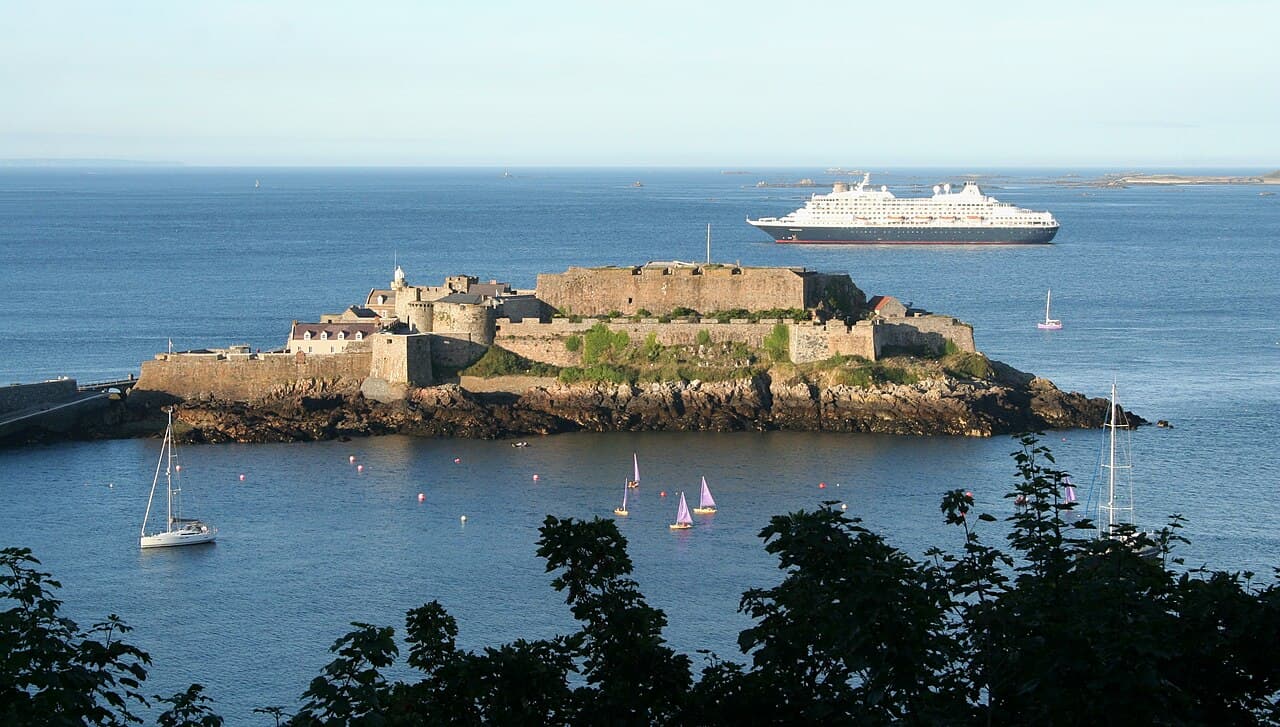
Castle Cornet — Guernsey castle

Castle Cornet

Castle cornet: historic fortress in saint peter port, guernsey
Saint Peter Port, Guernsey
High Medieval (11th–13th c.)
Well Preserved

Castle Cornet stands as a remarkable historic fortress in Saint Peter Port, Guernsey, with a legacy spanning over 800 years. This imposing hill castle offers commanding views of the entire east coast of Guernsey and extends across the sea to the neighboring islands of Herm, Sark, and Alderney. Its strategic location has made it a vital military stronghold through centuries of conflict, including pivotal roles during the English Civil War and the German occupation in World War II.

Originally constructed in the early 13th century, Castle Cornet began as a tidal island fortress, designed primarily for defense and control of the surrounding waters. The initial fortification included a keep, a chapel, two courtyards, and curtain walls. Over the centuries, the castle expanded and evolved architecturally to meet changing military needs, incorporating additional defensive structures and adapting to advances in siege technology.

Architectural evolution and defensive features

The castle's original medieval design featured a classic keep or donjon as the central stronghold, surrounded by protective curtain walls and fortified gatehouses. The chapel within the castle grounds served the spiritual needs of its garrison and residents. The two courtyards provided space for military drills, storage, and daily activities of the castle's inhabitants.

As artillery technology progressed, Castle Cornet was modified to withstand cannon fire and naval attacks. The castle's walls were thickened and reinforced, and new bastions and gun platforms were added to accommodate heavy artillery. The castle's position on a tidal island allowed it to control access to Saint Peter Port harbor effectively, making it a critical maritime fortress.

The castle during the english civil war

Castle Cornet played a significant role during the English Civil War in the mid-17th century. Guernsey was largely Parliamentarian, but the castle remained a Royalist stronghold, leading to a prolonged siege. The castle held out for several years, resisting Parliamentary forces until the conflict ended. This period highlighted the fortress's strategic importance and robust defensive capabilities.

World war ii and german occupation

During World War II, the castle was occupied by German forces as part of the wider occupation of the Channel Islands. The Germans fortified the castle further, installing modern artillery and defensive structures to repel Allied attacks. Remnants of these fortifications remain visible today, adding a modern layer to the castle's rich military history.

Modern use and visitor experience

Today, Castle Cornet serves as a cultural and historical hub, housing four distinct museums that explore various aspects of military history. These include exhibits dedicated to the castle's own story, the Royal Air Force, and maritime history, offering visitors a comprehensive understanding of the fortress's multifaceted past.

The castle grounds are meticulously maintained by a full-time keeper who preserves the historic gardens, enhancing the visitor experience with beautifully tended landscapes. A unique and popular attraction is the daily firing of a 32-pound cannon at noon, performed by a gunner dressed in traditional 19th-century uniform. This ceremony is a highlight for visitors and brings history vividly to life.

Visitors can enjoy guided tours in the morning to explore the castle's extensive fortifications, followed by refreshments in the on-site café. The combination of historical education, scenic views, and leisure opportunities makes Castle Cornet a must-visit destination in Guernsey.

Architectural significance and preservation

Castle Cornet is an outstanding example of a medieval tidal island fortress that has adapted through centuries of military innovation. Its preservation as a well-preserved historic site allows insight into medieval defensive architecture as well as later military enhancements from the 17th century through the 20th century.

The castle's curtain walls, battlements, towers, and gatehouses illustrate the evolution of fortification techniques. The integration of gun batteries and modern artillery emplacements from World War II adds to its architectural complexity, making it a rare example of continuous military use over eight centuries.

Efforts to maintain and restore the castle ensure its survival as a cultural landmark and educational resource. The site is managed to balance historical integrity with public accessibility, enabling visitors to experience a tangible connection to Guernsey's strategic past.

Frequently asked questions (FAQ)

How do I get to Castle Cornet in Saint Peter Port?
Castle Cornet is located just off the coast of Saint Peter Port and is accessible by a short ferry ride from the town's harbor. Regular ferry services operate daily, making it easy for visitors to reach the castle.
What can I see inside Castle Cornet?
Inside Castle Cornet, visitors can explore four museums focused on military history, including exhibits on the castle's own history, the Royal Air Force, and maritime heritage. The castle's architecture and historic gardens are also highlights.
When is the best time to visit Castle Cornet?
The castle is open daily from 10:00 to 17:00, with the daily firing of the 32-pound cannon at noon being a popular event. Visiting during the morning allows time for guided tours and enjoying the castle grounds before the cannon firing.
Is Castle Cornet wheelchair accessible?
Due to its historic nature and fortifications, some areas of Castle Cornet may be challenging for wheelchair users. However, efforts have been made to improve accessibility, and visitors are advised to contact the castle in advance for specific information.
Are there facilities like cafes or rest areas at Castle Cornet?
Yes, Castle Cornet has a café where visitors can enjoy refreshments. There are also well-maintained gardens and seating areas throughout the grounds for relaxation.

Photo gallery

Castle Cornet
Click to view

Photo by TheKaphox•CC0

1 photo • Click any image to view in full screen

Information

Hill Castle

Opening hours

10:00-17:00, daily

Ticket prices

£8 adult, £4 child

Current owner

State museum

Sources & official resources

Verify the information above using these authoritative references.

Loading map...

Visitor reviews

No reviews yet. Been here? Write the first review and help other travelers!

Write the first review

Visited this castle? Share your experience

Your review helps other travelers and adds first-hand knowledge to our encyclopedia.

Write a review

(5/5)

0/2000 characters

Your review will be visible after admin approval

Nearby castles

0 km

Castle Cornet

Guernsey, United Kingdom

Castle Cornet stands as a remarkable historic fortress located on a former tidal island off the coast of Guernsey, part of the United Kingdom. Originally constructed between 1206 and 1256, this high medieval hill castle was built following the division of the Duchy of Normandy in 1204, to assert control over the strategically vital waters surrounding Guernsey. Its unique position on the rock made it a formidable defensive structure, guarding the island through centuries of conflict and change. The castle’s early history is marked by its capture in 1339 during the Hundred Years' War, when a French force seized the island. The siege and subsequent massacre of the garrison underscored the castle's military importance. Over the centuries, Castle Cornet evolved architecturally to meet the demands of advancing military technology, particularly with the introduction of cannon and gunpowder in the mid-16th century. Between 1545 and 1548, extensive remodeling transformed its defenses, incorporating bastions and artillery platforms to withstand contemporary siege warfare. Architectural evolution and military significance Medieval origins and fortifications The initial construction phase of Castle Cornet established a classic hill castle layout, with robust stone walls, a central keep, and defensive towers positioned to maximize surveillance and protection. The castle’s location on Cornet Rock, initially a tidal island, provided natural moat-like defenses, making direct assault difficult. Early structures included a keep or donjon, curtain walls, and a gatehouse, all designed to repel invaders and serve as a stronghold for the island’s governors. 16th-century modernization By the mid-1500s, the advent of gunpowder weaponry necessitated significant upgrades. The castle was remodeled with thicker walls and angled bastions to deflect cannon fire, reflecting the principles of Renaissance military architecture. Notably, iron and stone were quarried from nearby Crevichon Island to support these enhancements, as documented in historical records from 1566. The castle’s artillery emplacements were strategically positioned to command the approaches to Guernsey’s harbor. Disasters and resilience The 1672 lightning strike and explosion One of the most dramatic events in Castle Cornet’s history occurred in 1672, when a lightning bolt struck the castle’s magazine, causing a catastrophic explosion. This disaster destroyed the keep and several living quarters, resulting in the deaths of the Governor’s mother, wife, and several staff members. At the time, the Governor was Lord Hatton. Despite this tragedy, the castle remained a vital military and administrative center. Integration into maritime infrastructure Following its military role, Castle Cornet was integrated into the construction of the breakwater during the Napoleonic Wars, enhancing the island’s harbor defenses. The breakwater also featured a pond constructed in 1887 to celebrate Queen Victoria’s Diamond Jubilee, which later served as a seaplane base during World War I. These adaptations illustrate the castle’s ongoing strategic relevance beyond traditional fortifications. 20th-century history and cultural legacy World war ii occupation During World War II, Castle Cornet was occupied by a small contingent of German troops as part of the occupation of the Channel Islands. Its fortifications were utilized for coastal defense, and the castle endured the challenges of wartime occupation while preserving its historical fabric. Post-war restoration and public heritage In 1945, the castle was formally presented to the people of Guernsey by the Crown, marking its transition from a military fortress to a cultural and historical monument. Today, Castle Cornet is restored and open to the public, housing several museums including the Castle Museum, Maritime Museum, and the Royal Guernsey Militia Museum. These institutions preserve and interpret the castle’s rich history, architecture, and its role in the island’s defense across centuries. Architectural features and visitor experience Defensive structures Visitors to Castle Cornet can explore its extensive battlements, curtain walls, and surviving towers, which vividly demonstrate medieval and Renaissance military architecture. The castle’s layout includes fortified gatehouses, artillery platforms, and remnants of the original keep prior to its destruction in 1672. Museums and exhibitions The museums within Castle Cornet offer in-depth insights into the island’s maritime history, military heritage, and the daily life of the castle’s occupants. Exhibits include weaponry, uniforms, historical documents, and artifacts recovered from the castle and surrounding waters. The castle’s scenic location and well-preserved structures provide a unique educational and cultural experience for visitors. Significance and preservation Castle Cornet is a cultural landmark of Guernsey, symbolizing the island’s resilience and strategic importance through turbulent historical periods. Its preservation as a restored high medieval hill castle ensures that future generations can appreciate its architectural grandeur and historical narratives. The castle’s integration into local heritage tourism highlights its ongoing relevance and vitality as a monument of British and Norman history.

High Medieval (11th–13th c.)
Details
3.4 km

Castel Church

Guernsey, United Kingdom

Castel Church, located in Guernsey, United Kingdom, stands as a remarkable monument intertwining medieval architecture with traces of much earlier human activity. The site has associations with pagans, pirates, and Romans, reflecting its long-standing significance before the church's construction. A notable prehistoric artifact, the Neolithic Statue Menhir, was discovered beneath the church floor in the 19th century and now stands outside the main entrance, symbolizing the deep historical layers present at the location.The church is known by its ancient title, Our Lady of Deliverance, and was first documented in a papal record dated 1155. This places the building firmly within the high medieval period. The earliest surviving architectural element is the western half of the north aisle, which dates from the late 11th century or the early 12th century, making it one of the oldest parts of the structure. This early phase of construction reflects the transitional period between Romanesque and early Gothic styles in ecclesiastical architecture.Architectural features and medieval additionsThe church presents a complex architectural evolution visible both inside and out. Internally, the north chancel houses 13th-century frescoes that provide rare examples of medieval religious art, alongside a medieval stone credence used for holding sacred vessels during mass. One of the more unusual features is an hagioscope or squint, a small opening piercing one of the tower pillars, allowing a view of the altar from a side chapel or other area.In the south chancel, visitors can observe an ancient piscine—a basin used for washing liturgical vessels—and a blocked-up priest’s door, which once provided direct access to the chancel. Nearby is a curious “hole in the wall,” believed to be the remains of a cupboard where altar vessels were stored, highlighting the practical aspects of medieval church design.External evidence of growth and changeThe church's exterior reveals a history of adaptation and enlargement over centuries. Several blocked doorways and reconstructed windows mark phases of renovation and extension, reflecting changing liturgical needs and architectural fashions. These modifications correspond with shifts in the religious and social functions of the building.Historical context and religious significanceThe site’s long history is further emphasized by the presence of stone seats outside the church, which were used by the official of the medieval court of Fief St Michel. This illustrates the church’s role not only as a place of worship but also as a center of local governance and justice during the medieval period.Church registers from 1674 provide valuable records of the parish community, documenting baptisms, marriages, and burials over several centuries. The list of rectors beginning in 1262 reflects the religious transformations endured by the church, including periods under Roman Catholic, Presbyterian, Calvinist, and Anglican clergy, mirroring the broader religious shifts in Guernsey and the British Isles.Preservation and current statusToday, Castel Church remains a well-preserved example of medieval ecclesiastical architecture, retaining many original features despite centuries of alterations. The church continues to serve as a place of worship and a historical landmark, attracting visitors interested in its layered history and architectural details.The presence of ancient artifacts like the Neolithic Statue Menhir and the medieval court seats provides a tangible connection to the past, making Castel Church a unique site where prehistoric, medieval, and early modern histories converge.Visiting Castel ChurchVisitors to Castel Church can explore its rich architectural features, including the frescoes, hagioscope, and medieval stonework. The churchyard and exterior also offer insights into the site's multifaceted history. The church's location in Guernsey makes it accessible as part of broader tours of the island's historical and cultural sites.

High Medieval (11th–13th c.)
Details
6.6 km

Fort Hommet

Guernsey, United Kingdom

Fort Hommet, also known as Fort Houmet, is a significant coastal fortification located on the island of Guernsey in the United Kingdom of Great Britain and Northern Ireland. The site has a layered military history, with fortifications originally dating back to 1680. The most prominent structure at Fort Hommet is the Martello tower, constructed in 1804 during the early years of the Napoleonic Wars. This tower was built under the direction of Lieutenant Governor-General Sir John Doyle, who bypassed the traditional Ordnance Corps by commissioning a local builder named Gray to erect the tower and two others on Guernsey as part of a series of defensive 'fieldworks'. The Martello towers on Guernsey, including Fort Hommet, Fort Grey, and Fort Saumarez, are smaller than their British counterparts. The Fort Hommet tower, in particular, features an exterior staircase leading to the second floor, a design shared only with Fort Saumarez among the Guernsey towers. Each tower was armed with a 24-pounder carronade mounted on the roof, intended to provide artillery support to the adjacent batteries and serve as a defensible keep. Architectural features and Victorian enhancements During the Victorian Era, Fort Hommet underwent significant enhancements to its artillery and barracks. By 1852, the original 24-pounder guns were partially replaced by more powerful 68-pounder and 8-inch shell guns in the coastal batteries, reflecting advancements in artillery technology and the ongoing need to strengthen coastal defenses. These upgrades expanded the fort's capacity to defend against naval threats and enhanced its strategic importance on the island. Martello tower design and structure The Martello tower at Fort Hommet is a circular stone structure designed for both offense and defense. Its thick walls provided protection against cannon fire, while its elevated platform allowed for a wide field of fire. The tower's interior included storage rooms and living quarters for the garrison, making it a self-contained defensive position. The exterior staircase provided access to the upper levels, which was somewhat unusual compared to other Martello towers that typically had internal staircases. World War II German fortifications The most extensive modifications to Fort Hommet occurred during World War II when the German occupation of the Channel Islands led to the construction of a complex of bunkers and casemates. The Germans recognized the strategic value of the site and developed it into Stützpunkt (Strongpoint) Rotenstein, a heavily fortified position designed to resist Allied invasion and control the surrounding coastal area. The German fortifications included reinforced concrete bunkers, gun casemates, and underground shelters. These structures were built to withstand heavy bombardment and to house modern artillery pieces, observation posts, and personnel quarters. The integration of these fortifications with the existing Martello tower and Victorian batteries illustrates the evolution of military architecture at Fort Hommet across centuries. Post-war dismantling and restoration efforts Following the liberation of Guernsey in 1945, the British Army and local residents undertook extensive efforts to dismantle the German fortifications. All metal fittings, including guns and blast doors, were removed and scrapped by the late 1940s. Many bunkers, including the prominent 10.5 cm coastal defence gun casemate bunker, were buried to restore the coastal landscape to its pre-war appearance. In recent decades, the States of Guernsey have initiated restoration projects to preserve and interpret the fort's historical features. The Fort Hommet 10.5 cm Coastal Defence Gun Casement Bunker has been restored and is now open to visitors, albeit with limited opening hours. This restoration allows the public to explore and understand the site's layered military history, from its 17th-century origins through Napoleonic, Victorian, and World War II periods. Strategic importance and historical context Fort Hommet's location on the western coast of Guernsey provided a commanding view over the English Channel and the approaches to the island. This vantage point made it a critical element in the island's coastal defense system, especially during periods of conflict such as the Napoleonic Wars and the German occupation in World War II. The fort's construction and subsequent upgrades reflect broader trends in military technology and strategy. The initial Martello tower construction was part of a British response to the threat posed by Napoleonic France, emphasizing small, robust coastal defenses. The Victorian enhancements corresponded with the era's rapid artillery advancements, while the German fortifications demonstrate 20th-century defensive engineering adapted to modern warfare. Comparisons with other Guernsey fortifications Alongside Fort Hommet, Fort Grey and Fort Saumarez form a trio of Martello towers on Guernsey, each with unique characteristics. Fort Grey is the largest and most robust, while Fort Hommet and Fort Saumarez are smaller but feature distinctive exterior staircases. These towers collectively illustrate the island's strategic military planning and adaptation over time. Visiting Fort Hommet today Visitors to Fort Hommet can explore the restored 10.5 cm coastal defence gun casement bunker and view the Martello tower and Victorian batteries from the outside. The site offers insight into centuries of military architecture and the island's role in broader European conflicts. Due to preservation efforts, access to some areas is restricted, and visiting hours are limited. The fort's location also provides scenic views of the surrounding coastline and the English Channel, making it a site of both historical and natural interest. Informational displays and guided tours help contextualize the fort's significance and the lives of those who served there.

Modern (19th–20th c.)
Details

