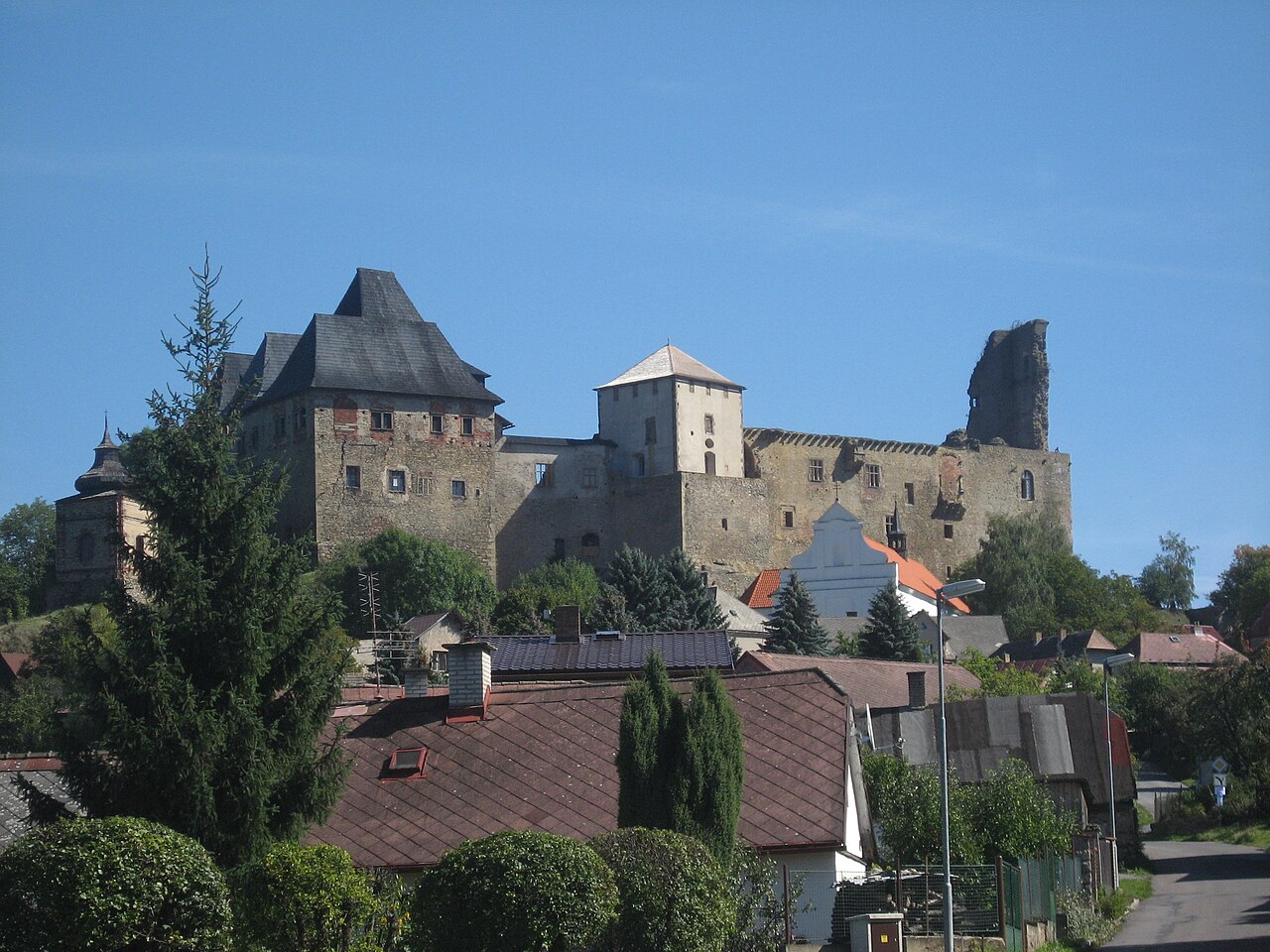
Castle Červená Řečice
Castle Červená Řečice stands as a remarkable example of medieval and Renaissance fortification architecture in the heart of the Czech Republic. Located in the municipality of Červená Řečice, this hill castle has a rich history that spans several centuries, reflecting the complex political and religious landscape of the region. Its origins date back to the medieval period, with the first fortress constructed under the auspices of the bishops of Prague in the 13th century.
Medieval origins and ecclesiastical ownership
The estate of Červená Řečice was initially under the control of the bishops of Prague beginning in the 12th century. The earliest fortress was built during the latter half of the 13th century as a military stronghold to protect ecclesiastical interests and local territories. This initial construction phase was marked by efforts from Bishop Tobiáš of Bechyně, who reinforced the fortress and a nearby church to withstand attacks from external forces such as Otto of Brandenburg and the influential Vítkovci noble family. These fortifications were primarily defensive, designed to secure the estate within a volatile regional environment.
Gothic rebuilding and administrative role
In the early 14th century, the fortress underwent a significant transformation under the direction of Archbishop Arnošt of Pardubice. The castle was rebuilt in the Gothic style, reflecting both the need for enhanced defense and the growing administrative functions of the estate. This period saw the castle becoming a center of ecclesiastical authority, with notable residents such as Archbishop Jan of Jenštejn, who resided there with his court during the late 14th century. The Gothic castle featured characteristic elements such as pointed arches, fortified walls, and defensive towers, which underscored its dual role as both a military fortress and an administrative hub.
Ownership changes and conflicts in the 15th and 16th centuries
The castle's history during the 15th and 16th centuries was marked by frequent changes in ownership and involvement in regional conflicts. Prominent noble families such as Jan Svídnický of Chotěmic, Mikuláš Sokol of Lamberk, the Trčka family, and the Leskovec family held the castle at various times. The castle endured the turbulence of the Hussite Wars and resisted pressures from rulers like King George of Poděbrady. Throughout these centuries, the castle maintained its military defensive functions while also serving as a noble residence.
Renaissance transformation and later history
By the 1560s, the castle began a significant transformation from a medieval fortress into a Renaissance chateau under the initiative of Šebestián Leskovec. This renovation updated the castle's appearance and functionality, incorporating Renaissance architectural elements such as sgraffito decorations and bastioned fortifications. Subsequent owners continued to enhance the castle until the end of the 16th century. In 1597, ownership passed to Heřman of Říčany, but the estate was confiscated following the Battle of White Mountain in 1620, a pivotal event that marked the beginning of Habsburg dominance in the region. In 1623, the castle was acquired by Archbishop Arnošt Vojtěch of Harrach.
Role during the thirty years’ war and later renovations
Throughout the Thirty Years’ War, Castle Červená Řečice served as a refuge and maintained its defensive capabilities despite the widespread conflict. Repairs and improvements were carried out under the stewardship of Archbishop Matouš Ferdinand Sobek of Bílenberk. The castle underwent further renovations in the 19th and early 20th centuries during the tenures of František Kordač and Karel Kašpar, ensuring the preservation of its historical and architectural integrity.
Architectural features and layout
Fortifications and ground plan
The castle is distinguished by its hexagonal ground plan which encloses two courtyards. The fortifications consist of polygonal bastions designed to provide optimal defensive angles, surrounded by a water-filled moat that is supported externally by a high earthen rampart. This combination reflects an evolution from medieval defensive architecture to Renaissance military engineering.
Castle wings and towers
Two-story wings surround the first courtyard, including a prominent prism-shaped clock tower projecting from the southern side. The oldest part of the castle is the central wing, which extends eastward to connect with a circular defensive tower known as the Watchtower (Hláska). This round tower likely functioned as an observation post and signaling point within the castle's defensive system.
Second courtyard and decorative elements
Access to the second courtyard is through a passage beneath a corridor that links the wings. The exterior of this corridor was once adorned with Renaissance sgraffito, a decorative plaster technique that involved scratching layers to reveal contrasting colors beneath. Although much of this decoration was damaged in the 20th century, it remains a testament to the castle's Renaissance artistic heritage.
Bastions and ancillary structures
The western side of the second courtyard features the remains of a large granary flanked by two two-story bastions dating from the Renaissance period. These bastions reinforced the curtain wall, enhancing the castle's defensive capabilities. Another bastion on the southern side, known as the Hunger Tower (Hladomorna), suggests its historical use as a prison or detention facility.
Surroundings and modern status
The entire castle complex is encircled by the moat, which is notable for its water coverage and the presence of ancient trees within its bounds. Historically, the castle was complemented by an English-style park, though this landscaped area has since reverted to secondary vegetation. The castle's location at the center of the town places it in close proximity to roads and cycling routes, with public transport stops conveniently located near the entrance.
In recent years, since its privatization in 2011, Castle Červená Řečice has undergone extensive restoration efforts to preserve its architectural heritage. A fire incident in May 2014 caused damage limited to the roof of a northern turret, which was quickly contained to prevent further harm. The castle is recognized as a cultural monument since 1963 and was elevated to national cultural monument status in 2014, underscoring its importance in Czech cultural heritage.
Frequently asked questions (FAQ)
- When was Castle Červená Řečice originally built?
- Castle Červená Řečice was originally constructed in the latter half of the 13th century by the bishops of Prague as a fortified medieval stronghold.
- What architectural styles are represented in Castle Červená Řečice?
- The castle showcases a blend of Gothic and Renaissance architectural styles, reflecting its evolution from a medieval fortress to a Renaissance chateau.
- Is Castle Červená Řečice open to visitors?
- Yes, the castle is privately owned but allows public visits. It is advisable to check the current visiting hours and any tour arrangements before planning a visit.
- What significant historical events affected Castle Červená Řečice?
- The castle was involved in regional conflicts such as the Hussite Wars and the Thirty Years’ War, and its ownership changed following the Battle of White Mountain in 1620.
- What are the notable defensive features of Castle Červená Řečice?
- Notable defensive features include its hexagonal layout, polygonal bastions, a water-filled moat, and fortified towers like the Watchtower and Hunger Tower.
Information
Sources & official resources
Verify the information above using these authoritative references.
Loading map...
Visitor reviews
No reviews yet. Been here? Write the first review and help other travelers!
Write the first reviewVisited this castle? Share your experience
Your review helps other travelers and adds first-hand knowledge to our encyclopedia.