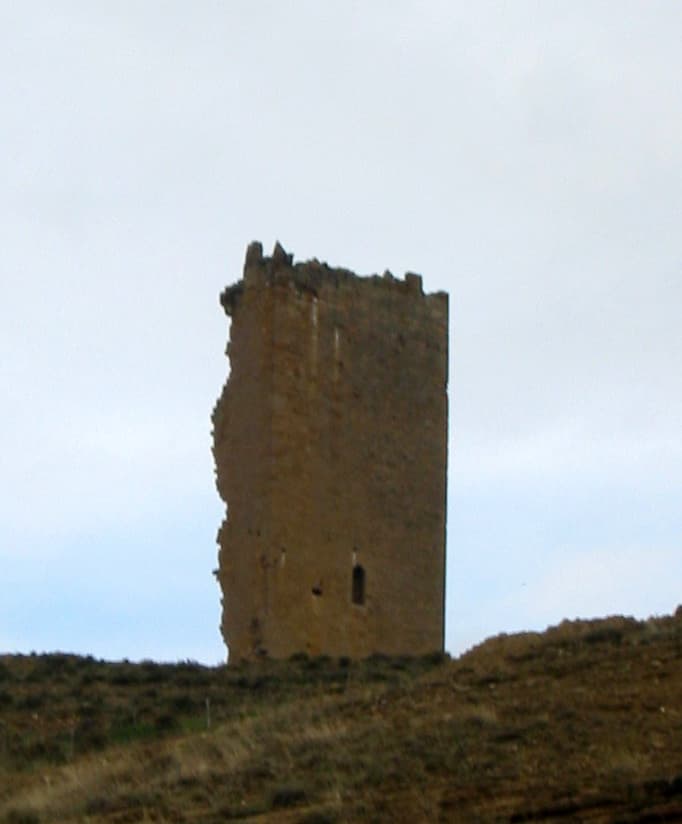
Castillo de Santacara
The Castillo de Santacara stands as a significant medieval fortress located in the town of Santacara within the autonomous community of Navarre, Spain. Constructed in the 13th century, this hill castle was strategically established under the authority of the Aragonese Navarrese kingdom, which governed the region during a period marked by territorial disputes and shifting political alliances. The castle's position atop a prominent hill provided a commanding view of the surrounding landscape, serving both defensive and administrative functions.
Historical context and political significance
During the 13th and 14th centuries, Castillo de Santacara was a central seat of local power, managed by a series of castellans and alcaides appointed by the Navarrese crown. These military governors were responsible for the defense of the fortress and the enforcement of royal authority in the surrounding territories. Among the notable figures associated with the castle was Semeno Martinitz Uritzekoa, a lord who held command in this era, reflecting the castle's role as a noble residence and military stronghold.
In the early 15th century, the castle's political importance was underscored when it was pledged in 1404 as part of a marriage agreement involving the Infante of Aragon. This alliance highlighted the fortress's strategic value in the complex dynastic and territorial negotiations between the kingdoms of Navarre and Aragon.
Throughout the late Middle Ages, the castle remained embroiled in regional conflicts, including the civil struggles associated with the ambitions of the Count of Lerín in the late 15th century. Its role as a contested stronghold during these turbulent times illustrates the ongoing military and political importance of the site.
Destruction and decline after the Castilian conquest
The fate of Castillo de Santacara changed dramatically following the 1512 Castilian conquest of Navarre. King Ferdinand the Catholic ordered the systematic destruction of key Navarrese fortresses to prevent their use by opposing forces. Under the supervision of Cardinal Cisneros, the fortress at Santacara was deliberately dismantled, marking the end of its military utility.
Despite the physical ruin, the administrative rights connected to the castle persisted into the 16th century. The Beaumonte family continued to collect tolls associated with the former castellanship, indicating that the site retained some local jurisdictional importance even after its military functions had ceased.
Architectural features and surviving remains
Today, the most prominent remnant of the castle is the Torre de Santacara, a solitary tower that stands on the hill adjacent to the town. Constructed from local stone, this tower embodies the 13th-century military architecture typical of the Navarrese frontier, designed to serve as a lookout and a final defensive refuge during sieges.
The original castle complex included extensive defensive walls and auxiliary buildings, but these have largely disappeared over the centuries. The stone materials were often repurposed for local construction, contributing to the gradual dismantling of the fortress. What remains today are fragments of walls and the tower itself, which is in a fragile condition due to prolonged neglect and material reuse.
The site is protected under Spanish heritage legislation, including the 1949 generic declaration and the Law 16/1985 on Spanish Historical Heritage, which aim to preserve the ruins as a cultural and historical asset. Recent preservation efforts initiated around 2010 focus on stabilizing the tower and preventing further deterioration, ensuring that this emblematic structure continues to mark the historical landscape of Navarre.
Cultural and historical legacy
While no specific inscriptions or decorative elements survive at the site, the Castillo de Santacara remains a powerful symbol of the medieval history of Navarre. Its role as a military bastion, administrative center, and political pawn in dynastic alliances reflects the broader historical dynamics of the region during the Middle Ages.
Current conservation projects emphasize the importance of the castle as a heritage site, promoting awareness of its historical significance and encouraging scholarly research. The tower's enduring presence offers visitors a tangible connection to the past, illustrating the architectural and strategic ingenuity of medieval fortress construction in northern Spain.
Frequently asked questions (FAQ)
- What is the historical significance of Castillo de Santacara?
- Castillo de Santacara was a key medieval fortress in Navarre, serving as a military stronghold and administrative center during the 13th to 15th centuries. It played a role in regional conflicts and dynastic alliances, particularly between the Navarrese and Aragonese kingdoms.
- Can visitors see the entire castle today?
- Today, only the Torre de Santacara, a solitary tower, and some fragments of walls remain. The rest of the castle has been dismantled over centuries, with stones repurposed for local buildings.
- Is Castillo de Santacara protected as a heritage site?
- Yes, the site is protected under Spanish heritage laws, including the 1949 generic declaration and Law 16/1985 on Spanish Historical Heritage, ensuring preservation efforts continue.
- When was Castillo de Santacara built?
- The castle was constructed in the 13th century during the High Medieval period under the Aragonese Navarrese kingdom's rule.
- Why was Castillo de Santacara destroyed?
- Following the 1512 Castilian conquest of Navarre, King Ferdinand the Catholic ordered the destruction of key Navarrese fortresses, including Santacara, to prevent their military use by hostile forces.

Information
Loading map...
Visitor reviews
No reviews yet. Been here? Write the first review and help other travelers!
Write the first reviewVisited this castle? Share your experience
Your review helps other travelers and adds first-hand knowledge to our encyclopedia.


