Castillo de San Marcos
Castillo de San Marcos stands as a monumental testament to colonial military architecture in the United States. Located in St. Augustine, Florida, this historic fortress is renowned as the oldest masonry fort in the continental United States, with its construction commencing in 1672 under Spanish rule. Its primary purpose was to defend the strategic port of St. Augustine and protect the vital Atlantic trade routes from rival European powers and pirates.
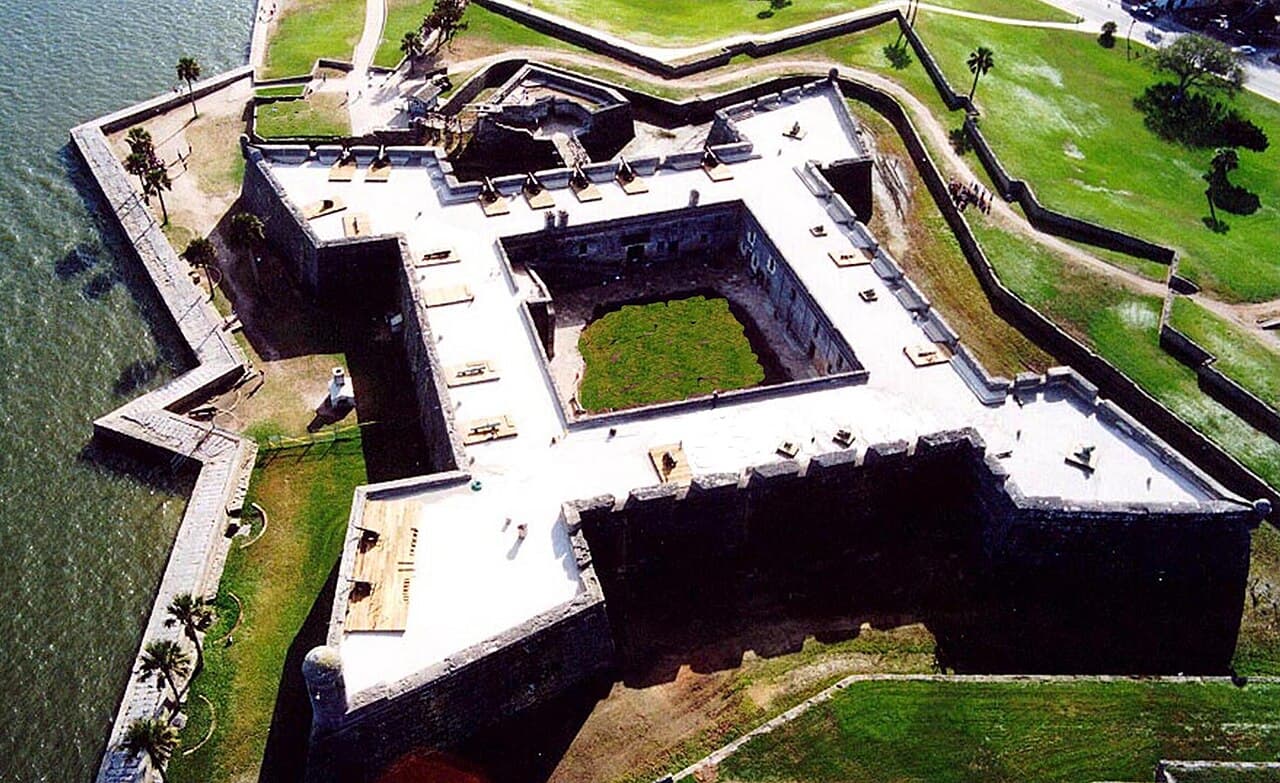
The fort's design reflects the Spanish colonial military engineering principles of the 17th century, featuring a distinctive star-shaped layout known as a bastioned fortress. This design allowed for overlapping fields of cannon fire and enhanced defensive capability against siege warfare. Constructed predominantly from coquina stone, a locally quarried shell-based limestone, the fort's walls have proven remarkably resilient to cannon fire, absorbing impacts rather than shattering.
Architectural features and construction details
The Castillo de San Marcos is characterized by its massive walls that rise up to 30 feet in height and are up to 12 feet thick in some places. The fort encompasses four bastions named San Pedro, San Agustin, San Carlos, and San Pablo, each designed to cover the adjacent walls with defensive artillery. Its moat, originally filled with water, further enhanced the fort's defenses.
Inside, the fort contains a variety of functional spaces including casemates—vaulted chambers used to house troops and store munitions—that also served as protected firing positions. The fort's layout includes a central parade ground and barracks, a chapel, powder magazines, and storerooms, all arranged to support prolonged defense and garrison life.
Historical significance and ownership changes
The history of Castillo de San Marcos mirrors the turbulent colonial struggles of the southeastern United States. Initially built by the Spanish Empire to secure Florida, the fort changed hands multiple times due to European conflicts and treaties. It was captured by the British in 1763 following the Seven Years' War and renamed Fort St. Mark. The British made modifications but retained much of the original structure.
In 1783, the fort was returned to Spain as part of the peace settlements concluding the American Revolutionary War. Spain maintained control until 1821 when Florida was ceded to the United States. The fort was then renamed Fort Marion and served various military functions, including as a prison for Native American captives during the Seminole Wars.
Throughout its history, the fort was a focal point in conflicts involving European powers, Native American tribes, and later the United States military. Its use as a prison highlights its role in the complex and often tragic interactions between the U.S. government and indigenous peoples.
Cultural heritage and preservation
Today, Castillo de San Marcos is managed by the National Park Service and designated as a National Monument. It is open to the public for tours, educational programs, and historical reenactments that bring to life its rich past. The fort's preservation is a priority given its status as a rare surviving example of 17th-century Spanish colonial fortifications in North America.
The fort's unique construction from coquina stone and its star-shaped bastioned design have made it a subject of study for historians and architects alike. Visitors can explore the extensive ramparts, casemates, and bastions, gaining insight into the defensive strategies of the colonial era.
The role of enslaved labor and diverse histories
An important aspect of the fort's history is the role of Black Spanish slaves and indigenous peoples in its construction and operation. The fort's history is intertwined with the broader narrative of slavery, colonialism, and cultural exchange in the Americas. The Spanish policy of offering freedom to enslaved Africans who escaped British colonies and sought refuge in Florida adds a significant human dimension to the site.
Modern visitor experience
Visitors to Castillo de San Marcos can enjoy guided tours that explain the fort's architectural features and historical context. Demonstrations of cannon firing and living history events provide immersive experiences. The fort also offers educational exhibits on the colonial history of Florida and its diverse cultural heritage.
Located at 1 South Castillo Drive, St. Augustine, FL 32084, the site is accessible year-round with visitor facilities including a museum shop and information center. The fort's commanding position overlooking Matanzas Bay continues to attract history enthusiasts, scholars, and tourists alike.
Ripley's castle warden: a nearby curiosity
In close proximity to Castillo de San Marcos is Ripley's Castle Warden, a Moorish-style castle that serves as a museum for the Ripley's Believe It or Not collection. This attraction, founded by Robert Ripley in the 1940s, showcases oddities and unusual artifacts from around the world. It also offers paranormal investigation experiences, adding a layer of modern cultural interest to the historic district of St. Augustine.
Ripley's Castle Warden is located at 19 San Marco Ave, St. Augustine, FL 32084 and complements visits to the historic fort with a unique blend of entertainment and curiosity.
Frequently asked questions (FAQ)
- What is the best time to visit Castillo de San Marcos?
- The fort is open daily from 9:00 to 17:00. Visiting in the spring or fall offers pleasant weather and fewer crowds, ideal for exploring the historic site.
- Can I take guided tours inside Castillo de San Marcos?
- Yes, guided tours are available daily and provide detailed insights into the fort's architecture, history, and role in colonial conflicts.
- Is Castillo de San Marcos wheelchair accessible?
- The fort has some accessibility limitations due to its historic structure, including uneven surfaces and stairs. However, efforts are made to accommodate visitors with mobility challenges where possible.
- Are there any special events held at Castillo de San Marcos?
- Yes, the National Park Service hosts living history events, cannon firing demonstrations, and educational programs throughout the year to engage visitors.
- Is there an admission fee to enter Castillo de San Marcos?
- Admission to Castillo de San Marcos is free, making it accessible to all visitors interested in exploring this important historic site.
Photo gallery

Photo by National Park Service•Public domain
Information
Opening hours
9:00-17:00, daily
Ticket prices
Free
Current owner
National Park Service
Address
1 South Castillo Drive, St Augustine, FL 32084
Loading map...
Visitor reviews
No reviews yet. Been here? Write the first review and help other travelers!
Write the first reviewVisited this castle? Share your experience
Your review helps other travelers and adds first-hand knowledge to our encyclopedia.