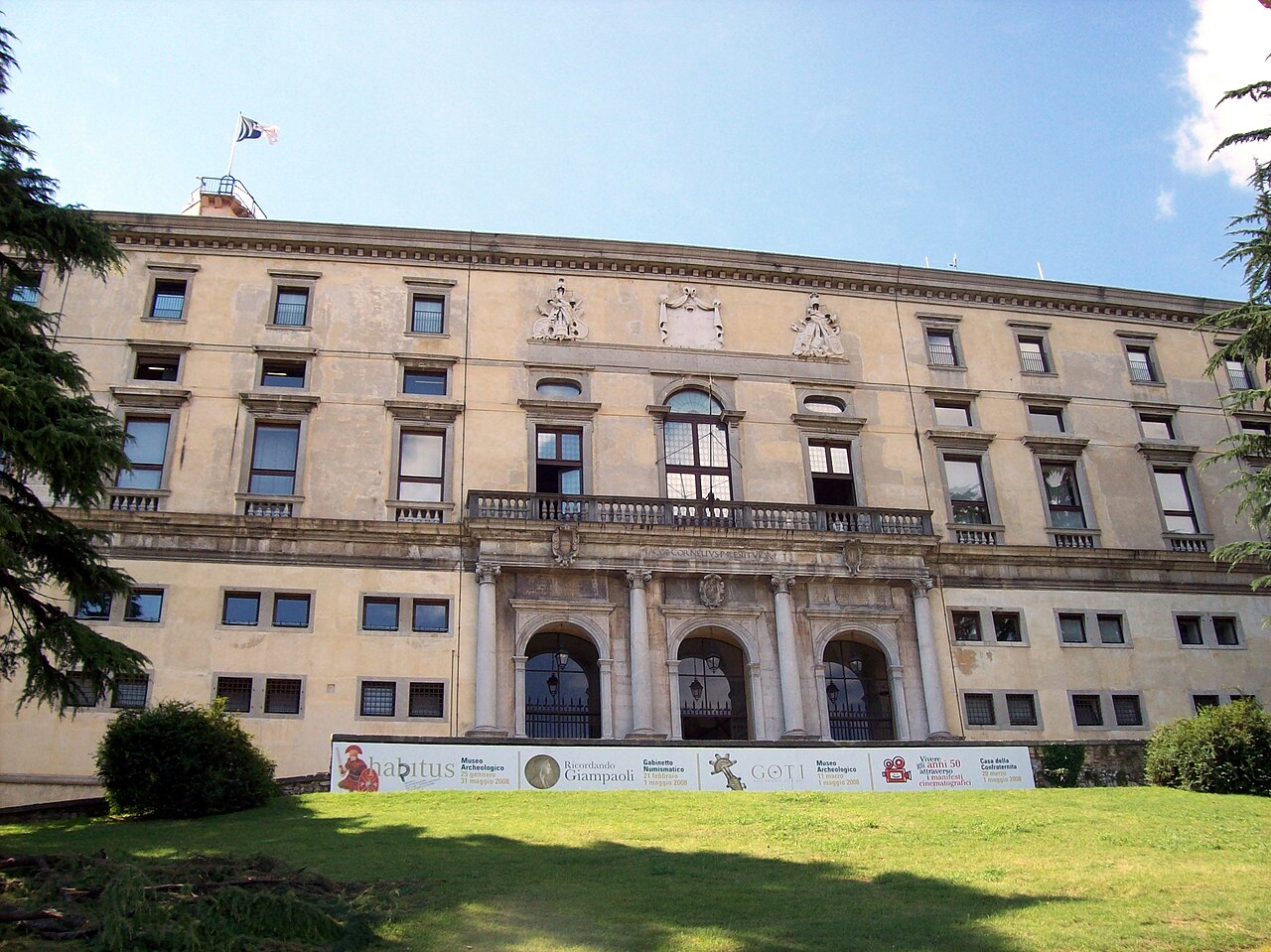
Castello Partistagno is a remarkable example of a medieval hill castle located above the village of Borgo Faris within the municipality of Attimis, in the historic region of Friuli, Italy. Constructed around the year 1000, this fortress stands as a testament to the early medieval defensive architecture that shaped the landscape of northeastern Italy. Built initially by local rulers overseeing Friuli during the early Middle Ages, the castle's strategic position on a hilltop provided commanding views of the surrounding territory, essential for surveillance and defense.
The castle's origins are closely tied to the Counts of Attems, a noble family that controlled the area and used the fortress as a stronghold to assert their regional influence. Over the centuries, ownership of Castello Partistagno shifted to other aristocratic families, including the Lords of Faedis and, by 1273, the Cucagna di Partistagno family, who maintained control for several hundred years. In the 17th century, the castle passed to the Fullini family from Polcenigo, marking the last major noble lineage associated with the site.
From the 16th century onward, Castello Partistagno gradually lost its military and residential importance, reflecting broader changes in warfare and noble lifestyles. The fortress was slowly abandoned, leading to significant decay. Despite this decline, the castle achieved cultural recognition through its mention in Ippolito Nievo’s historical novel, Le Confessioni d’un Italiano, underscoring its place in Italian literary and cultural heritage. The 1976 Friuli earthquake inflicted serious damage on the ruins, prompting restoration efforts focused on preserving the core summit structures and stabilizing the remains for posterity.
Architectural features and ruins
The surviving ruins of Castello Partistagno reveal a complex architectural history, with construction phases spanning from the early medieval period through the 16th century. At the highest point of the site is the original core, dominated by a bergfried—a tall, freestanding defensive tower typical of medieval castles in this region. This tower served as the last refuge during sieges and symbolized the lordly power of the castle's owners.
Adjacent to the bergfried is a noble chapel dedicated to Saint Oswald, a significant religious and artistic feature of the castle. The chapel preserves a 13th-century apse that was built atop the remains of an earlier 11th-century proto-Romanesque religious structure. Archaeological excavations have uncovered a pointed-arch apse on the chapel’s south side, confirming the continuity of sacred use at the site. The chapel's interior is adorned with frescoes spanning several centuries: late 13th-century depictions of Saint Christopher, a late 14th-century apse fresco illustrating Christ Pantocrator flanked by the Twelve Apostles, and an early 15th-century Crucifixion fresco above the entrance tympanum. These artworks reflect evolving devotional practices and regional artistic influences over time. The chapel was enlarged during the 16th century, resulting in its current architectural form.
The palatium inferiore
Below the summit lies the Palatium inferiore, a substantial palace structure dating to the early 14th century. This elongated building measures approximately 41 meters in length and 11 meters in width, rising across four floors: a basement, a noble floor featuring two projecting latrines, a residential floor with niche washbasins, and an attic level. The palace's walls were originally plastered both inside and out, and the floors were made of opus signinum, a waterproof mortar composed of crushed pottery laid over wooden boards. Over time, the interior was subdivided by three walls and underwent floor renovations. Restoration efforts beginning in the 1980s removed these partitions, rebuilt some of the original bifore windows (double-arched windows typical of medieval architecture), and renewed the roof covering. Later adaptations have repurposed the palace while preserving its historic character.
Water management and additional structures
Water supply was a critical concern for the castle’s inhabitants, especially during sieges. A large cistern near the main tower ensured a reliable water source. To the west of the bergfried stood an additional building that formed part of the summit compound. Both these structures were carefully restored after the 1976 earthquake to maintain the site’s structural integrity. These elements illustrate the castle’s evolution from a fortified residence to a complex with multiple functional buildings, reflecting changing needs over centuries.
Historical significance and cultural legacy
Castello Partistagno’s long history mirrors the broader political and social developments of the Friuli region. Its initial construction around the turn of the first millennium coincides with the consolidation of feudal power in northeastern Italy. The castle’s successive ownership by prominent noble families such as the Counts of Attems, Lords of Faedis, and Cucagna di Partistagno highlights its importance as a regional power center.
Despite its decline from the 16th century, the castle remained a potent symbol of medieval heritage. Its mention in Ippolito Nievo’s novel connects it to Italy’s literary renaissance and national identity formation in the 19th century. The post-earthquake restorations demonstrate contemporary commitment to preserving this cultural landmark, ensuring that Castello Partistagno continues to attract scholars, tourists, and history enthusiasts.
Visiting castello partistagno today
Today, Castello Partistagno stands as a partially preserved hill castle offering visitors a glimpse into medieval fortification architecture and noble life. The site’s ruins, including the bergfried, chapel, and palatial structures, provide valuable insights into construction techniques and artistic traditions from the early medieval through late medieval periods. Restoration efforts have stabilized the ruins, making exploration safe and informative.
Visitors can appreciate the castle’s scenic hilltop location, overlooking the Friuli countryside. The site’s historical and artistic features, particularly the chapel’s frescoes and the palatium’s architectural details, enrich the experience. While the castle does not function as a fully restored museum, interpretive signage and guided tours help contextualize its significance within the region’s medieval history.
Frequently asked questions (FAQ)
- What is the historical significance of Castello Partistagno?
- Castello Partistagno is a remarkable example of medieval architecture in Italy, dating back to the 12th century. It played a crucial role in the defense strategies of the region and reflects the rich history of feudal conflicts and alliances in Italy.
- When is the best time to visit Castello Partistagno?
- The best time to visit Castello Partistagno is during the spring and fall months, when the weather is mild and the surrounding landscapes are breathtaking. Additionally, visiting during these times allows you to enjoy fewer crowds and a more intimate experience of the castle.
- What are the opening hours for Castello Partistagno?
- Castello Partistagno is typically open from 10 AM to 6 PM, Wednesday through Sunday. It is advisable to check the official website for any seasonal changes in opening hours or special closures.
- Can I purchase tickets in advance for Castello Partistagno?
- Yes, tickets for Castello Partistagno can be purchased in advance through the official website. This is highly recommended to ensure entry during peak tourist seasons and to avoid long lines at the ticket counter.
- Is it possible to access Castello Partistagno with a wheelchair?
- While efforts have been made to improve accessibility at Castello Partistagno, some areas may be challenging to navigate for wheelchair users due to the castle's historic architecture. It is advisable to contact the castle administration in advance to inquire about specific accessibility options.
- What nearby attractions are there to visit when at Castello Partistagno?
- Nearby attractions include the picturesque town of Viterbo, known for its thermal baths and medieval architecture, and the beautiful Lake Bolsena. Exploring these sites can enhance your visit to the area and provide a deeper understanding of the region's history and culture.
- How do I get to Castello Partistagno from the nearest major city?
- Castello Partistagno is easily accessible from Rome, approximately a 90-minute drive away. You can also take a train to Viterbo and then use local transport or a taxi to reach the castle.
- What is the ticket price for visiting Castello Partistagno?
- The standard ticket price for adults is approximately €8, while discounts are available for students and seniors. Children under 12 can enter for free, making it an affordable option for families.
Information
Website
Visit websiteSources & official resources
Verify the information above using these authoritative references.
Loading map...
Visitor reviews
No reviews yet. Been here? Write the first review and help other travelers!
Write the first reviewVisited this castle? Share your experience
Your review helps other travelers and adds first-hand knowledge to our encyclopedia.