Castello Estense
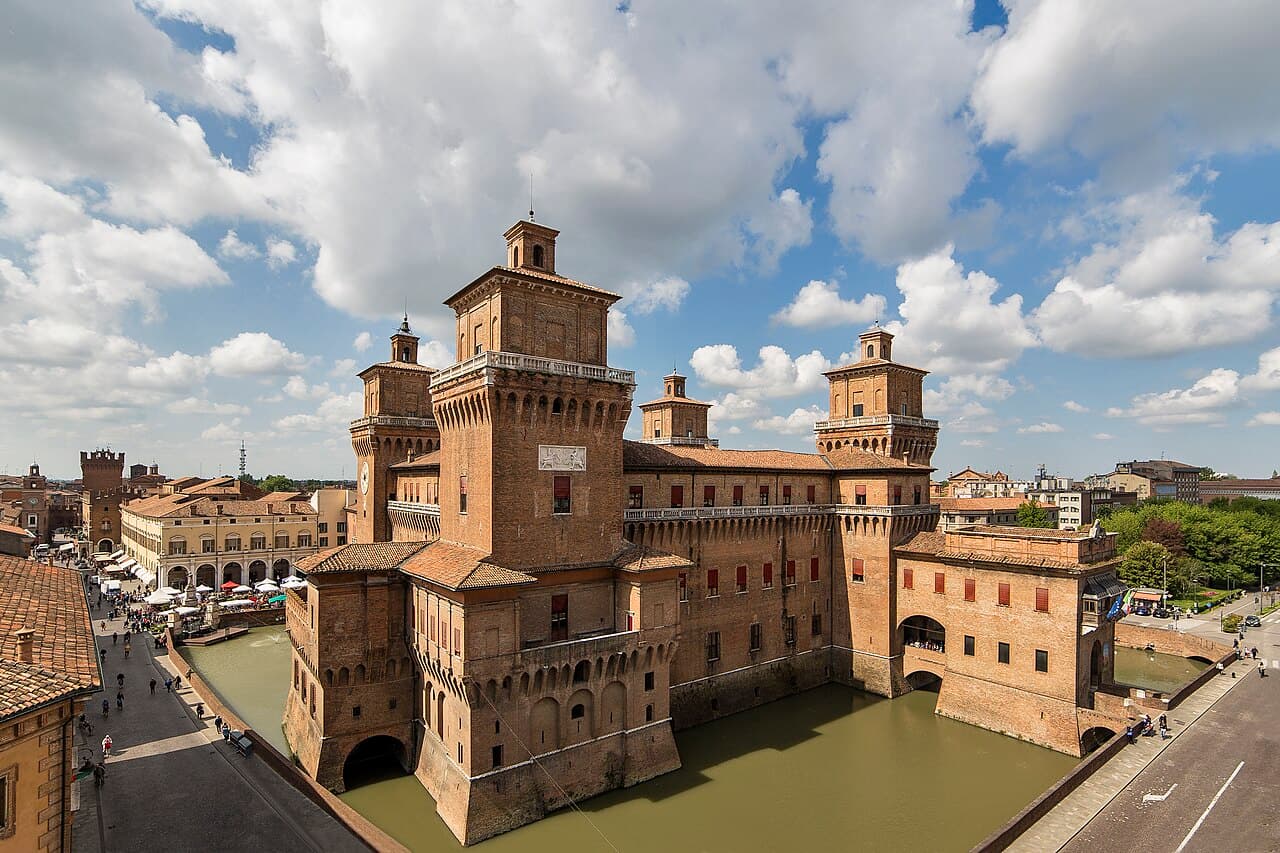
Castello Estense, also known as the Castle of St. Michael, stands as the iconic medieval fortress at the center of Ferrara, a city in the Emilia-Romagna region of northern Italy. This imposing moated castle is a testament to the power and prestige of the Este family, rulers of Ferrara for centuries. Constructed in the 14th century, it features a distinctive quadrilateral layout with four corner towers, surrounded by a water-filled moat and accessed by multiple drawbridges. The castle not only served as a military stronghold but also evolved into a luxurious ducal residence and a center of Renaissance art and culture.
Historical origins and construction
The genesis of Castello Estense dates back to 1385, when Niccolò II d'Este, the Marquis of Ferrara, commissioned its construction in response to a violent riot by the local populace. The uprising, fueled by widespread discontent over taxation and governance, underscored the vulnerability of the Este family's existing palace. To secure their hold on power and protect the nobility, Niccolò II ordered the erection of a formidable fortress on the northern side of the family palace.
The castle's design was entrusted to the architect Bartolino da Novara, who ingeniously incorporated an existing 13th-century watchtower, the Torre dei Leoni, into the new structure. The resulting fortress had a square plan with four massive corner towers—Torre dei Leoni (northeast), Torre Marchesana (southeast), Torre di San Paolo (southwest), and Torre di Santa Caterina (northwest)—linked by thick curtain walls. The entire complex was encircled by a deep moat, crossed by three drawbridges, with a fourth eastern entrance later removed to expand the kitchens. The castle was completed remarkably quickly, within two years, showcasing advanced military engineering for its time.
Architectural features and defensive elements
The Castello Estense exemplifies late medieval military architecture with its robust brick construction and defensive innovations. Originally, the battlements were crenellated with swallowtail merlons, a typical feature of Italian fortifications, designed to provide cover for archers and soldiers. These were replaced in the 16th century by marble parapets and terraces, known as altane, under the direction of the Renaissance architect Girolamo da Carpi. This transformation softened the fortress's martial appearance, reflecting its transition from a purely defensive stronghold to a noble residence.
The moat, filled with water from the nearby rivers, was a critical defensive feature, deterring siege engines and infantry assaults. The drawbridges controlled access and could be raised to isolate the castle. Inside, the basement of the Torre dei Leoni housed the castle prisons, infamous for their grim conditions and legendary tales, such as the tragic love story of Ugo and Parisina, members of the Este family who were imprisoned and executed for adultery.
Evolution from fortress to ducal palace
While initially built for military defense, the Castello Estense gradually assumed a more residential and administrative role, especially from the mid-15th century onward. Following a failed coup in 1476, Duchess Eleonora d’Aragona sought refuge within the castle, prompting the Este court to establish it as their permanent residence and seat of government. This shift marked the beginning of significant architectural and artistic enhancements.
During the Renaissance, under the patronage of rulers such as Ercole I d’Este and Alfonso I d’Este, the castle was embellished with elegant features and connected to the nearby Ducal Palace via the Via Coperta, a covered passageway allowing secure movement between the two buildings. The castle's interiors were richly decorated, including the Camerini d’Alabastro, a series of rooms designed to house prized art collections with works by masters like Titian and Dosso Dossi.
Notable interior spaces
- Ducal kitchens: Located on the ground floor, these large kitchens were built on the foundations of the ancient Porta del Leone gate. Equipped with ventilation windows and expansive fireplaces, they were managed by renowned stewards such as Cristoforo da Messisbugo.
- Loggia degli Aranci: A rooftop garden surrounded by merloned walls and adorned with painted decorations, reconstructed multiple times since the 16th century.
- Ducal chapel: Constructed between 1590 and 1591 by Alfonso II d’Este, featuring frescoes of the four Evangelists and the Este eagle, with original late 16th-century frescoes uncovered during recent restorations.
- Sala dell’Aurora: A ceiling fresco cycle depicting the four times of day and an allegory of human life, attributed to artists including Ludovico Settevecchi and Bastianino.
- Saletta dei Giochi and Salone dei Giochi: Rooms decorated with frescoes illustrating ancient Roman games and athletic competitions, designed by Pirro Ligorio and painted by prominent artists of the era.
- Appartamento della Pazienza: An apartment redecorated after a 1554 fire with frescoes celebrating patience, involving artists like Girolamo da Carpi and Camillo Filippi, though destroyed after 1598.
Political changes and later history
After the death of Alfonso II d’Este in 1597 without legitimate heirs, Ferrara was incorporated into the Papal States. The castle then served as the residence for papal legates governing the city, with only minor structural modifications during this period. In 1860, Ferrara became part of the Kingdom of Italy, and in 1874 the provincial administration acquired the castle. It was repurposed for governmental offices and the prefecture.
The castle suffered damage during World War II bombings and the 2012 Emilia earthquake. Restoration efforts have been ongoing, including a major project completed in 2006 that reopened previously inaccessible areas such as the Camerini d’Alabastro. Today, the castle hosts cultural events, exhibitions, and official ceremonies, maintaining its status as a symbol of Ferrara's rich heritage.
Architectural significance and cultural heritage
Castello Estense is a prime example of a late medieval fortified palace that successfully transitioned into a Renaissance ducal residence. Its combination of military and residential architecture, along with its rich artistic decorations, reflect the evolving needs and tastes of the Este dynasty over several centuries. The castle's moat, towers, and drawbridges illustrate advanced defensive strategies, while its interiors showcase the cultural patronage of the Este family.
The castle's preservation and restoration have allowed visitors to experience a wide range of architectural styles and historical layers. The panoramic terrace atop the Torre dei Leoni offers sweeping views of Ferrara, connecting the visitor with the city's historical landscape. The castle remains a focal point for understanding the political, social, and artistic history of Ferrara and the Emilia-Romagna region.
Visitor experience and accessibility
Today, the Castello Estense is open to the public, with many rooms accessible for tours. Visitors can explore the fortified courtyard, the richly decorated apartments, the ducal chapel, and the rooftop gardens. The castle also hosts temporary exhibitions and cultural events that highlight its historical and artistic significance.
Its central location in Ferrara makes it easily reachable, and the castle is a key attraction for those interested in medieval fortifications, Renaissance art, and Italian history. Guided tours provide detailed insights into the castle's architecture, the Este family legacy, and the legends associated with the prison towers.
Frequently asked questions (FAQ)
- What is the historical significance of Castello Estense?
- Castello Estense, also known as the Estense Castle, is a symbol of Ferrara's rich history and was built in the 14th century as a fortress for the ruling Este family. It played a crucial role in the political and cultural life of the city and has been a UNESCO World Heritage Site since 1995, reflecting the Renaissance architecture and urban planning of the time.
- When was Castello Estense built?
- Construction of Castello Estense began in 1385 under the direction of the Este family to protect themselves from external threats. Over the years, the castle underwent various modifications and expansions, with significant work completed in the 15th century, making it a prominent architectural landmark in Ferrara.
- Can I visit Castello Estense?
- Yes, visitors are welcome to explore Castello Estense. The castle offers guided tours and self-guided options, allowing guests to discover its fascinating history, stunning architecture, and beautiful gardens.
- What are the opening hours for Castello Estense?
- Castello Estense is typically open to visitors from 9:30 AM to 7:30 PM, with extended hours during the summer months. It is advisable to check the official website for any seasonal changes or special events that may affect these hours.
- Is it possible to access Castello Estense with a wheelchair?
- Yes, Castello Estense is equipped with facilities to accommodate visitors with mobility challenges. While some areas may have limited accessibility due to historical structure, the staff is available to assist and provide information on accessible routes within the castle.
- What are the ticket prices for visiting Castello Estense?
- The ticket prices for Castello Estense vary depending on age and ticket type, with discounts available for students and seniors. Typically, adult tickets are around €10, while reduced tickets are about €5; children under 18 may enter for free.
- When is the best time to visit Castello Estense?
- The best time to visit Castello Estense is during the spring (April to June) and fall (September to October) when the weather is mild and comfortable for exploring. Additionally, these seasons tend to attract fewer crowds, allowing for a more enjoyable experience.
- What nearby attractions can I visit after Castello Estense?
- After visiting Castello Estense, you can explore other nearby attractions such as the Palazzo dei Diamanti, known for its stunning Renaissance architecture, and the Ferrara Cathedral, which showcases beautiful Gothic design. The city itself offers charming streets and local eateries to enhance your visit.
Photo gallery

Information
Website
Visit websiteSources & official resources
Verify the information above using these authoritative references.
Loading map...
Visitor reviews
No reviews yet. Been here? Write the first review and help other travelers!
Write the first reviewVisited this castle? Share your experience
Your review helps other travelers and adds first-hand knowledge to our encyclopedia.