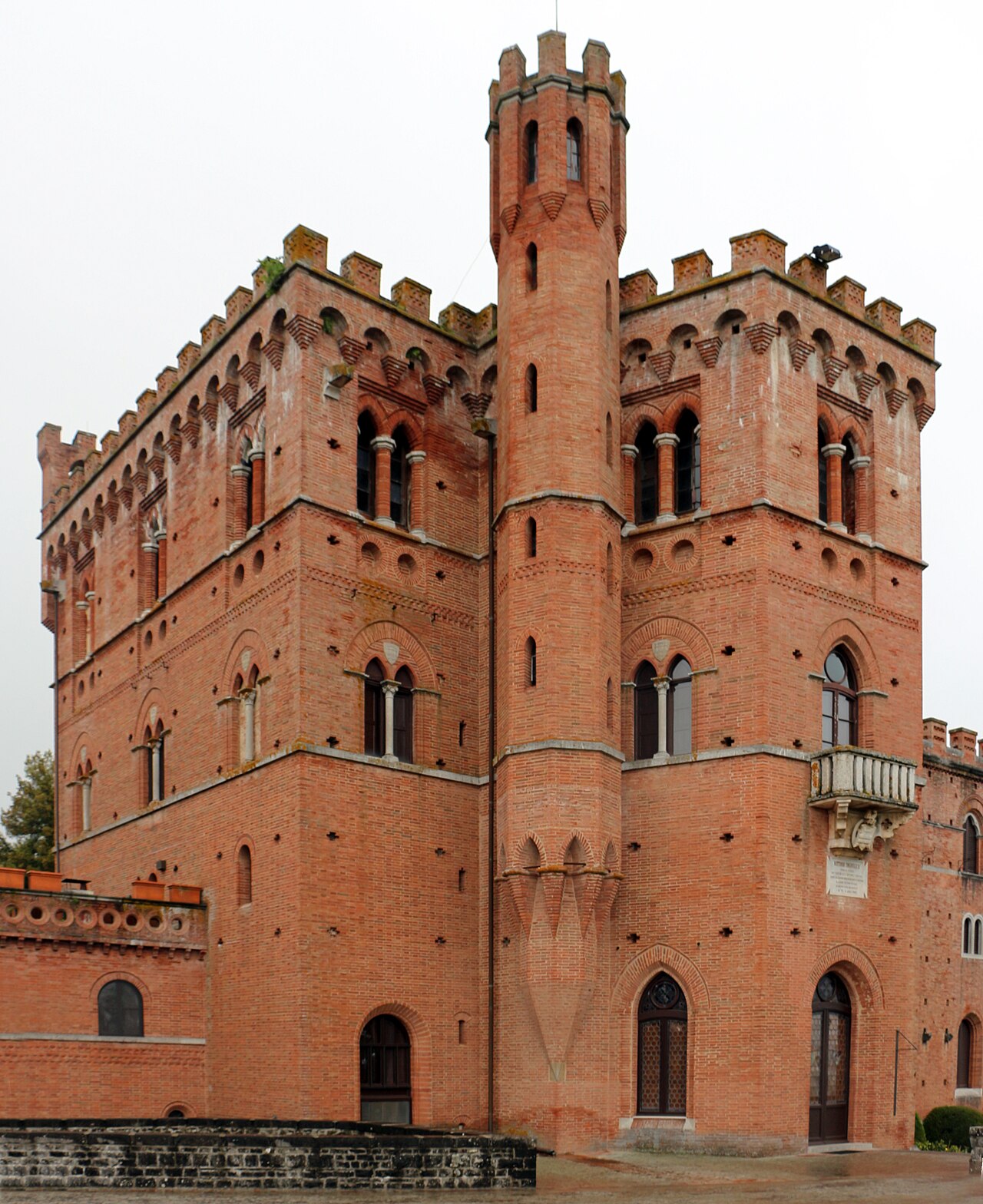
Castello di Tornano
The Castello di Tornano stands as a remarkable example of a medieval hill castle nestled in the picturesque Chianti countryside near Gaiole in Chianti, Italy. This fortress, originally established in the early medieval period, functioned as the center of a curtis—a rural estate combining agricultural and administrative roles. Its strategic location atop a hill overlooking the Torrente Marsellone stream provided natural defense and control over the surrounding lands, a common feature for fortifications of this era.
Early history and medieval significance
Documented references to the Castello di Tornano date back to around the year 1000, when it served as the seat of the curtis. These references appear in contracts preserved by the nearby Abbey of Coltibuono, highlighting the castle's importance in regional governance and economic activities during the early medieval period. The castle was a focal point for managing local agricultural estates and served as a symbol of feudal authority.
In the 12th century, ownership of the castle was held by Guarnellotto de’ Mezzolombardi, a nobleman from Siena. His rebellion against imperial authority led to the confiscation of the fortress by Emperor Frederick Barbarossa in 1167. The emperor subsequently granted the castle to Ranieri de’ Firidolfi Ricasoli, a prominent figure of the period. Despite this transfer, Guarnellotto retained actual control of Tornano with the support of Siena until a formal arbitration in 1203 at Poggibonsi definitively removed him from power.
The castle's control continued to fluctuate during the 13th century. In 1229, the city of Siena recaptured Tornano, only to lose it again in 1235. By the early 15th century, the influential Ricasoli family regained possession and undertook significant renovations around 1400. These improvements were crucial in strengthening the fortress's defenses during a turbulent period marked by frequent conflicts.
Architectural features and defensive elements
The Castello di Tornano showcases several key medieval architectural features that underline its defensive purpose. The most prominent is a trapezoidal tower, which was heightened in later periods to enhance its surveillance and defensive capabilities. This tower exemplifies the medieval approach to fortification, designed to provide vantage points for archers and to withstand sieges.
Fragments of the original castle walls remain intact, outlining the perimeter of the fortress and illustrating the scale of the enclosure that once protected the site. Surrounding the castle is a well-preserved defensive moat, a typical medieval feature intended to impede attackers by creating a water barrier around the walls. The moat's presence emphasizes the castle's role as a fortified stronghold in the region.
Within the complex, the castle's chapel has survived through centuries, though it has been repurposed as a wine cellar in modern times. This adaptive reuse demonstrates how historical spaces can retain their structural integrity while serving contemporary functions.
Historical conflicts and ownership changes
The castle's history is marked by significant military and political events. After the Ricasoli family's renovations, Castello di Tornano successfully repelled two attacks by Aragonese forces during the 15th century, underscoring its strategic importance and robust defenses. However, in 1530, imperial troops managed to capture the fortress, signaling another shift in control amid the complex political landscape of Renaissance Italy.
Modern restoration and current status
By the 20th century, the castle had fallen into ruins. In the 1970s, the property was carefully restored by Manfredo and Silvana Selvolini, who converted it into a hotel. This restoration was conducted with a strong emphasis on preserving the castle's historic character and architectural integrity, allowing visitors to experience its medieval ambiance while enjoying modern comforts.
Today, Castello di Tornano remains a well-preserved example of a hill castle that reflects the layered history of the Chianti region. Its surviving defensive structures, including the tower, walls, and moat, provide valuable insight into medieval military architecture. The castle's location, overlooking the rolling hills and vineyards of Chianti, continues to captivate visitors with its blend of historical significance and scenic beauty.
Location and accessibility
The castle is situated approximately five kilometers southwest of Gaiole in Chianti, perched on a hill near the Torrente Marsellone stream. Access to the site is via a gravel road, which preserves the castle's remote and elevated position originally chosen for defense. This setting offers panoramic views of the surrounding countryside, enhancing the visitor experience.
Frequently asked questions (FAQ)
- How do I reach Castello di Tornano?
- Castello di Tornano is located about five kilometers southwest of Gaiole in Chianti, Tuscany. Visitors can reach the castle via a gravel road that leads up the hill where the castle stands, offering scenic views along the way.
- What is the historical significance of Castello di Tornano?
- The castle was a key medieval stronghold and administrative center in the Chianti region, first established around the year 1000. It played important roles in regional governance, military defense, and local agriculture throughout the Middle Ages.
- Can I visit the interior of Castello di Tornano?
- Since the castle was restored and converted into a hotel in the 1970s, public access to the interior may be limited. Visitors should check with the current owners or local tourism offices for information on tours or accommodations.
- What architectural features are notable at Castello di Tornano?
- Notable features include the trapezoidal tower, medieval defensive walls, and the moat surrounding the castle. The chapel within the complex has been repurposed as a wine cellar, showcasing adaptive reuse of historic spaces.
- When was Castello di Tornano restored?
- The castle underwent significant restoration in the 1970s by Manfredo and Silvana Selvolini, who transformed it into a hotel while preserving its historic character.
Information
Sources & official resources
Verify the information above using these authoritative references.
Loading map...
Visitor reviews
No reviews yet. Been here? Write the first review and help other travelers!
Write the first reviewVisited this castle? Share your experience
Your review helps other travelers and adds first-hand knowledge to our encyclopedia.