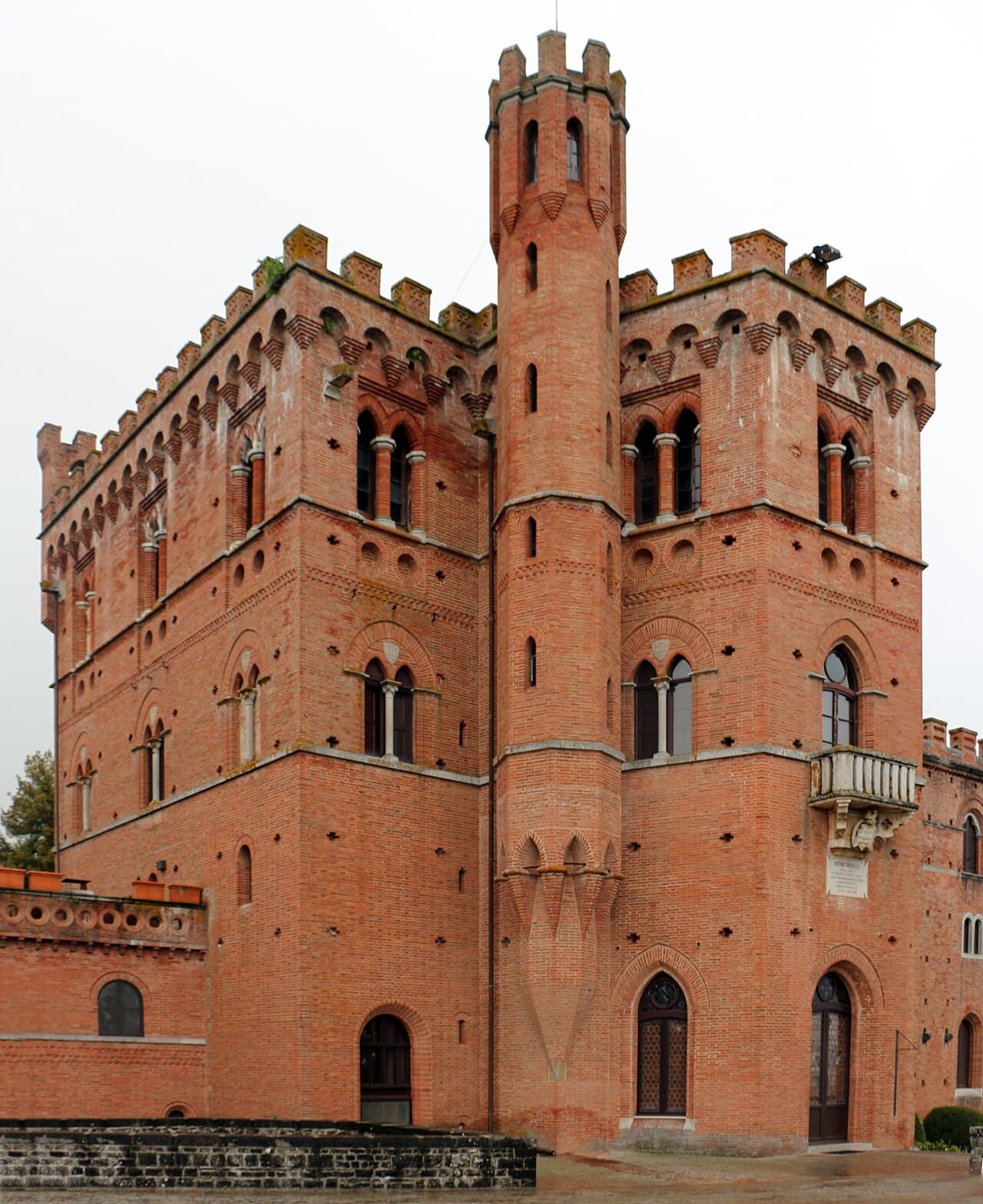
Castello di Brolio
The Castello di Brolio, located near San Regolo in the municipality of Gaiole in Chianti, Italy, is a remarkable example of a hill castle that has evolved through centuries from a medieval fortress to a noble residence and renowned wine estate. Its origins trace back to the early Middle Ages, with its name deriving from the Celtic word "Brogilo," meaning a small, wooded estate enclosed for a lord's residence. This etymology reflects the castle's longstanding role as a fortified seat of power and land management in the Tuscan countryside.
Documented history begins in the 10th century with Marquis Bonifazio, son of Count Alberto, who was lord of Brolio. In 1009, Bonifazio donated the estate and the parish church of San Regolo to the Badia of Florence, establishing early religious and administrative ties that were confirmed by Holy Roman Emperors Henry II and Henry IV in the 11th century. This association underscores the castle's importance within the ecclesiastical and feudal structures of medieval Tuscany.
Medieval origins and strategic importance
From at least 1141, the Ricasoli family, a noble Florentine lineage, held ownership of the castle and its lands. The castle's strategic location between Monte Fienali and Monte Luco Berardenga, overlooking streams feeding the Arbia river, made it a key defensive and territorial asset during the frequent conflicts between the Florentine Republic and the rival city of Siena.
The castle endured multiple military engagements, including capture by Sienese forces in 1252 and subsequent return to Florence in 1253. It also withstood a siege in 1452 by forces allied with Aragon and suffered damage from Sienese artillery in 1478, which led to partial destruction and looting. These events highlight the castle's role as a contested stronghold in the power struggles of medieval Tuscany.
Architectural features from the medieval period
The oldest surviving element of Castello di Brolio is the base of its medieval keep, or cassero, dating from the early 11th century. Constructed primarily from pietra serena, a local gray sandstone, the keep's walls are well preserved and showcase the robust defensive architecture typical of the period. The castle's pentagonal base supports this original medieval structure, which was designed to provide strong fortification and surveillance over the surrounding landscape.
Renaissance transformation and agricultural development
Following Florence's conquest of Siena, the castle underwent significant transformation under the direction of Giuliano da Sangallo, a prominent Renaissance architect. He reshaped the castle into an imposing noble residence, expanding its role beyond military defense to include agricultural management and wine production.
Viticulture at Brolio has deep roots, with records of wine exports dating back to the late 17th and early 18th centuries. The estate's wines were notably praised in the late 18th century by Pietro Leopoldo of Lorraine, reflecting the high quality and reputation of Brolio's production during this period.
Renaissance architectural elements
The Renaissance period introduced refined masonry and architectural details to the castle, visible in the use of pietra serena alongside brickwork. These enhancements balanced aesthetic elegance with the castle's defensive origins, integrating Renaissance ideals of harmony and proportion into the fortress's fabric.
19th-century gothic revival remodeling and viticultural innovation
In the 19th century, Bettino Ricasoli, known as the "Iron Baron," took personal control of the estate from 1829 and initiated extensive reforms. He conducted pioneering vine-growing experiments that culminated in the 1874 definition of the Chianti Classico blend, emphasizing native grape varieties such as Sangiovese. This innovation solidified Brolio's status as a leading wine producer in Tuscany and internationally.
Architect Pietro Marchetti remodeled the castle in a distinctive Gothic Revival style during this period, transforming it from a fortress into an English-style manor. The renovation introduced brick as the primary building material, Tudor-style windows, and battlemented turrets, creating a romanticized medieval aesthetic uncommon in traditional Tuscan architecture.
19th-century architectural features
The remodeling enveloped the medieval core with new structures that harmonized different architectural moods into a unified composition. The castle's pentagonal base now supports a larger brick-built palace, with decorative elements such as battlements and turrets enhancing its imposing silhouette.
Chapel and gardens
Within the castle grounds stands a chapel originally founded in 1348 and extensively renewed between 1867 and 1869. The chapel features a gabled façade accessed by a double stone staircase, with a mosaic lunette depicting the patron saint above the entrance. An inscription commemorates the chapel's original foundation date, linking it to the castle's medieval heritage.
The chapel's interior includes a nave divided into three sections with groin vaults, and a crypt housing the tombs of the Ricasoli family. Starting in 1874, the altar area was adorned with mosaics by the Compagnia Venezia Murano, designed by artist Alessandro Franchi. These mosaics blend religious iconography with exquisite craftsmanship, enhancing the chapel's spiritual and artistic significance.
The castle is surrounded by two distinct gardens: a 16th-century Italian formal garden with boxwood hedges and symmetrical walkways reflecting Renaissance landscape design, and a 19th-century romantic park planted by botanist Simone Ricasoli. The latter features a variety of imported tree species, including fir trees that have grown to heights of 30 to 40 meters, contributing to the estate's picturesque setting.
Modern legacy and preservation
Throughout the 20th century, the Ricasoli family expanded the international reach of Brolio wines, exporting to markets across the Americas, Asia, Africa, and the Middle East. After a period of foreign ownership, the estate returned to family management in 1993 under Francesco Ricasoli, the 32nd Baron of Brolio.
The castle has also served as a filming location for notable productions in 1995 and 2021, showcasing its enduring cultural significance. Today, Castello di Brolio stands in well-preserved condition, maintaining its medieval foundations alongside the distinctive 19th-century Gothic Revival additions. Extensive vineyards surround the estate, continuing the cultivation of native Sangiovese grape clones identified by Bettino Ricasoli, and supporting its prestigious reputation in the global wine industry.
Frequently asked questions (FAQ)
- How do I visit Castello di Brolio and its vineyards?
- Castello di Brolio offers guided tours of the castle, chapel, and vineyards. Visitors can book wine tastings and explore the estate's historical and viticultural heritage. It is recommended to check the official website for opening hours and tour availability.
- What is the historical significance of Castello di Brolio?
- Castello di Brolio is historically significant as a medieval fortress and noble residence that played a strategic role in Tuscan conflicts and contributed to the development of Chianti wine. Its continuous ownership by the Ricasoli family highlights its cultural and agricultural legacy.
- Can I see the medieval and Gothic Revival architectural features during a visit?
- Yes, visitors can observe the castle's medieval keep constructed from pietra serena and the 19th-century Gothic Revival additions such as brickwork, battlemented turrets, and Tudor-style windows. These contrasting styles illustrate the castle's architectural evolution.
- Is the castle accessible for visitors with limited mobility?
- While the castle grounds and some areas are accessible, the medieval keep and certain historic sections may have limited access due to stairs and uneven surfaces. It is advisable to inquire in advance about specific accessibility accommodations.
- When is the best time to visit Castello di Brolio?
- The best time to visit is during spring and autumn when the weather is mild, and the vineyards are particularly scenic. These seasons also coincide with special events and harvest activities that enhance the visitor experience.

Information
Current owner
Ricasoli family
Loading map...
Visitor reviews
No reviews yet. Been here? Write the first review and help other travelers!
Write the first reviewVisited this castle? Share your experience
Your review helps other travelers and adds first-hand knowledge to our encyclopedia.


