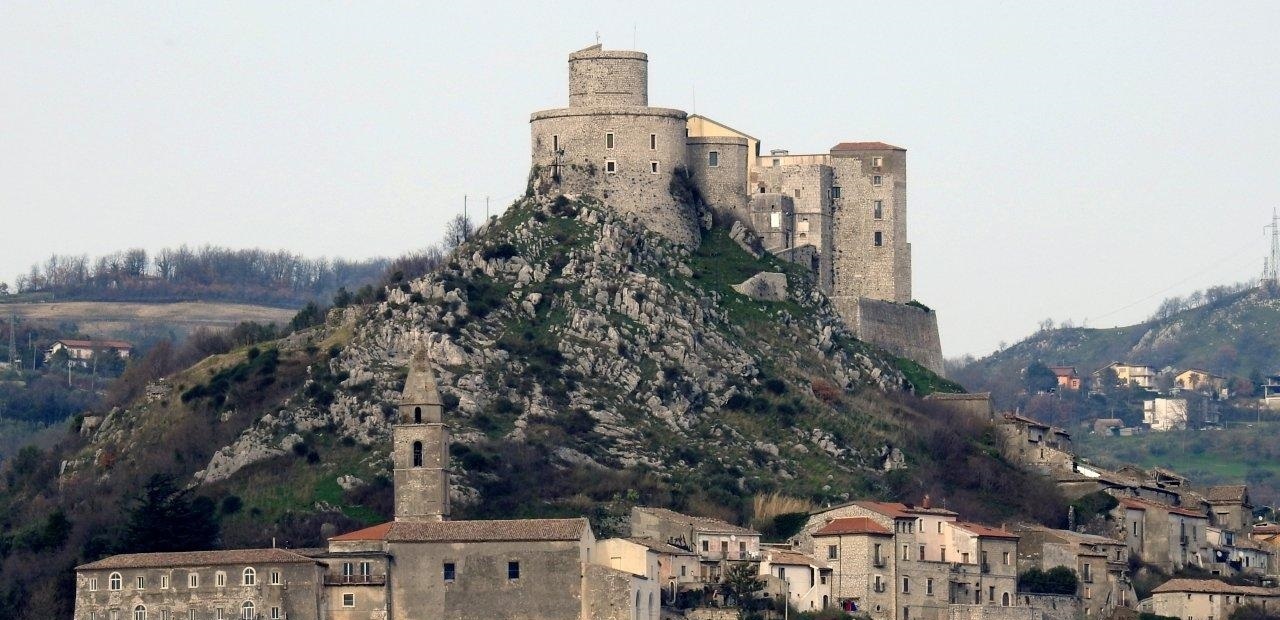
Castello di Sant’Agata de’ Goti
Castello di Sant’Agata de’ Goti stands as a significant hill castle located in the municipality of Sant’Agata de’ Goti in southern Italy. Its origins date back to the 6th century, when the Ostrogothic Kingdom established a fortification near the ancient Samnite settlement of Saticula following the fall of the Western Roman Empire. This early foundation laid the groundwork for a fortress that would play a prominent role in the region's military and administrative history for centuries.
During the early medieval period, particularly by the mid-8th century, the castle gained importance under the rule of the Lombards. It served as the residence of the princes of Benevento, who used it as the administrative center for their duchy. This period marked the castle’s emergence as a seat of local power within the fragmented political landscape of southern Italy.
Following the year 1000, the castle came under the possession of the Norman Drengot family. They transformed the existing Lombard tower and surrounding settlement into a fortified complex known as a fortellicium. The Normans used tuff stone as the primary building material, a volcanic rock characteristic of the region. They reinforced the southern entrance with strengthened buttresses and watchtowers, enhancing the castle’s defensive capabilities. Robert Drengot, a Norman count who ruled over Alife, Caiazzo, Airola, and Sant’Agata de’ Goti, established his main residence within the castle, situated opposite the chapel dedicated to the counts.
Medieval transformations and noble residence
During the Angevin period in the 14th century, the castle maintained its significance as a noble residence. Queen Joanna I of Naples, who also ruled Provence, was hosted at the castle, highlighting its role within the feudal network of the Artois branch lords. The castle changed hands several times in the 15th century after the extinction of the Artus family, passing to the De la Rath, Cossa, and Acquaviva families.
The 16th century brought important architectural modifications, including the construction of a new circular tower on the eastern side to strengthen the castle’s defenses. This tower later served as a prison for several centuries, reflecting the castle’s evolving function beyond military defense to include judicial and penal roles.
Baroque renovations and later ownership
In 1696, the castle was granted to the Carafa della Stadera family of Maddaloni as a royal reward for their loyalty. Domenico Marzio Carafa, the Duke of Maddaloni, acquired the castle at the end of the 17th century but died shortly after in 1703. His daughter, Duchess Caterina Carafa della Stadera di Maddaloni, inherited the property. Alongside her husband, Prince Domenico Carafa of Colubrano, she undertook renovations in the early 18th century, including fresco decorations by Tommaso Giaquinto. One notable fresco depicts the mythological scene of Diana and Actaeon, showcasing the aristocratic tastes and artistic patronage of the Carafa family.
Architectural features and layout
The castle covers an area exceeding 3,000 square meters and combines both defensive and residential functions. Its construction primarily consists of tuff stone, a durable volcanic rock that was favored in the region for its strength and availability. The castle’s layout is complex, reflecting its long history of adaptations and expansions.
Among the most prominent features are the square towers dating from the Norman period. These towers, along with rooms on the ground floor, retain elements from the early 2nd millennium, preserving the medieval character of the fortress. The imposing south gate once served as the main entrance and was historically used for military training exercises and soldier preparation. Today, this gate opens onto a parking area, but historically the space served as an equestrian training ground and later as a market square.
The 16th-century circular tower on the eastern side is another architectural highlight. Built to enhance the castle’s defensive capabilities, it also functioned as a prison well into modern times. This dual use underscores the castle’s multifaceted role within the region.
Interior decorations and frescoes
Inside the castle, the courtyard preserves 15th-century wall paintings characterized by geometric motifs, offering insight into the decorative styles of the late medieval period. These paintings reflect the artistic sensibilities of the time and add cultural value to the fortress.
On the first floor, a hall is adorned with grotesque frescoes, a decorative style known for whimsical and fantastical imagery. The early 18th-century fresco by Tommaso Giaquinto depicting the mythological chase of Diana and Actaeon is a standout feature, illustrating the castle’s transformation into a noble residence with refined artistic elements during the Baroque period.
19th-century adaptations and modern preservation
In the 19th century, the castle’s ownership became fragmented as portions were sold to local noble families and municipal authorities. This division led to changes in the castle’s use and maintenance. A notable 19th-century addition is a projecting structure that integrates a series of shops, reflecting the adaptation of the castle to commercial purposes during this period.
Restoration efforts began in earnest during the 1980s, aiming to preserve the castle’s architectural heritage and historical significance. Today, Castello di Sant’Agata de’ Goti remains a key cultural landmark, illustrating centuries of architectural evolution from its Ostrogothic origins through medieval fortification to Baroque aristocratic residence and modern adaptation.
Frequently asked questions (FAQ)
- What is the historical significance of Castello di Sant’Agata de’ Goti?
- Castello di Sant’Agata de’ Goti is a remarkable example of medieval architecture, dating back to the 10th century. It played a crucial role in the defense of the region and was a residence for various noble families throughout its history, reflecting the cultural and political changes of the time.
- When was Castello di Sant’Agata de’ Goti built?
- The castle was built in the 10th century, with significant renovations and expansions occurring over the centuries. Its strategic location and robust construction have allowed it to endure as a prominent landmark in the area.
- Can I visit Castello di Sant’Agata de’ Goti?
- Yes, visitors are welcome to explore Castello di Sant’Agata de’ Goti. The castle offers guided tours that provide insight into its rich history and architectural features, making it an enriching experience for history enthusiasts.
- What are the opening hours for Castello di Sant’Agata de’ Goti?
- The castle is typically open to visitors from 9 AM to 7 PM, but it’s advisable to check the official website for any seasonal changes or special events. This ensures you plan your visit accordingly and make the most of your time at the castle.
- Is it possible to access Castello di Sant’Agata de’ Goti with a wheelchair?
- The castle has made efforts to improve accessibility; however, some areas may still pose challenges due to uneven terrain and historical architecture. It is recommended to contact the castle administration in advance to inquire about specific accessibility options available during your visit.
- What is the best time to visit Castello di Sant’Agata de’ Goti?
- The best time to visit is during the spring and early fall when the weather is pleasant, and the surrounding landscape is at its most beautiful. Additionally, visiting during these seasons can help you avoid the summer crowds and enjoy a more relaxed experience.
- What are the ticket prices for visiting Castello di Sant’Agata de’ Goti?
- Ticket prices generally range from €5 to €10, with discounts available for students and seniors. Children under a certain age may enter for free, so it's best to check the official site for the latest pricing and any available promotions.
- Are there any nearby attractions to visit along with Castello di Sant’Agata de’ Goti?
- Yes, the surrounding area is rich in history and culture, with attractions like the charming old town of Sant’Agata de’ Goti and the nearby Church of Santa Maria del Carmine. These sites complement your visit to the castle and offer additional insights into the region's heritage.
Information
Loading map...
Visitor reviews
No reviews yet. Been here? Write the first review and help other travelers!
Write the first reviewVisited this castle? Share your experience
Your review helps other travelers and adds first-hand knowledge to our encyclopedia.