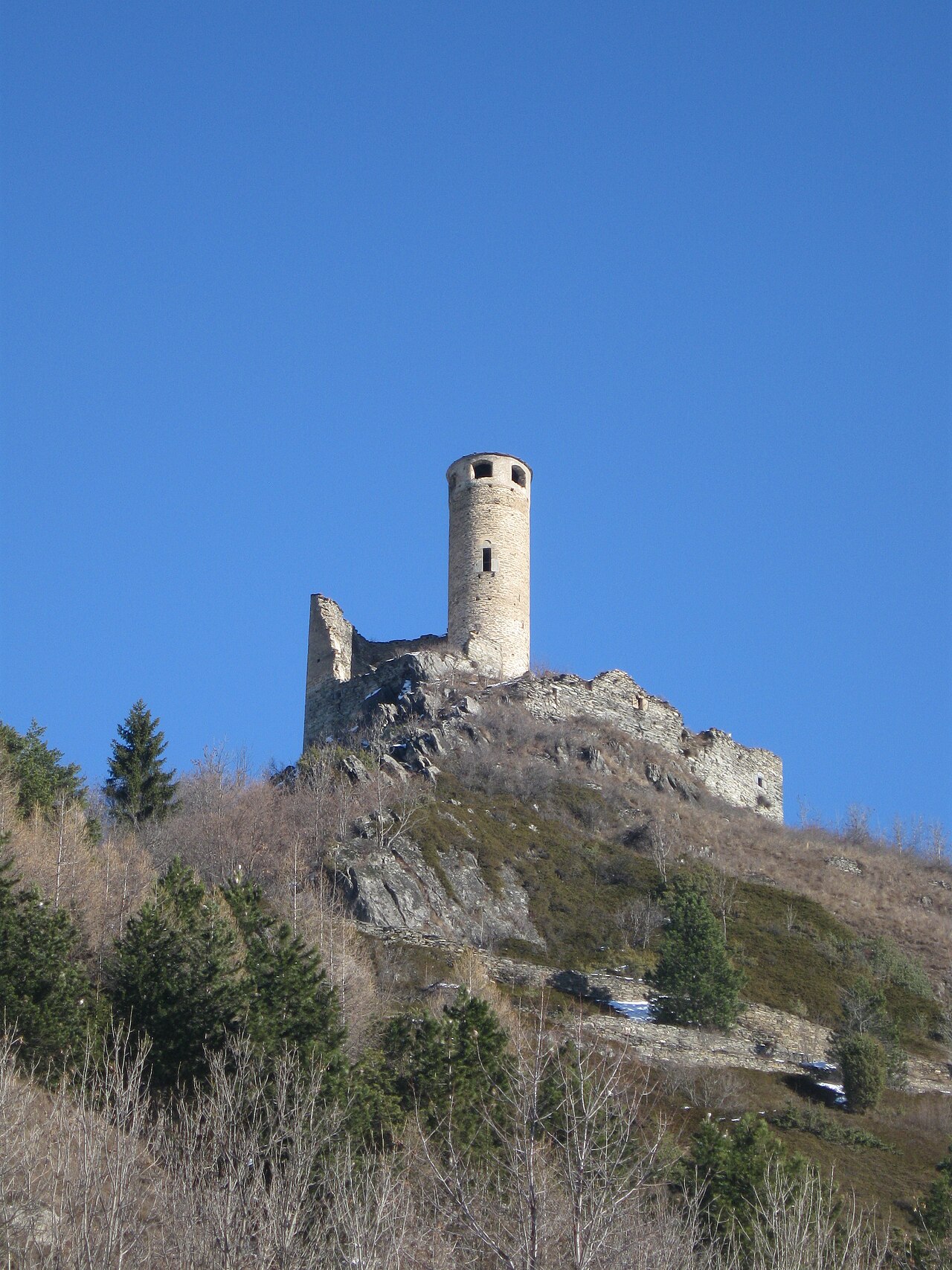
Castello di Bosses
Castello di Bosses stands as a remarkable example of medieval fortification nestled in the village of Saint-Léonard, within the municipality of Saint-Rhémy-en-Bosses in Italy's Aosta Valley. This hill castle traces its origins back to the 12th century, constructed by the noble Bosses family, also known as de Bocha, who were granted the land as a fief by the lords of Quart. The castle's strategic location on elevated terrain provided a commanding view of the surrounding valleys, crucial for defense and control during the medieval period.
Medieval origins and early history
The initial construction of Castello di Bosses reflected the architectural and defensive needs of the early medieval period. Its large square layout is characteristic of fortified homes in the Aosta Valley during the 12th century, designed to withstand local conflicts and assert feudal authority. The Bosses family established their dominion here, leveraging the castle not only as a residence but also as a symbol of their power and territorial control.
Throughout the late 13th century, the castle became a focal point of regional power struggles. The Bosses family clashed with the expanding influence of the Counts of Savoy. In 1288, Giacomino (or Jacques) di Bosses was compelled to recognize the Savoy counts' supremacy, surrendering the castle and its associated fief. This submission marked a significant shift in regional governance, with the castle transitioning from independent noble control to a vassalage under Savoy.
Conflict and partial destruction
Despite this forced allegiance, tensions remained high. Around ten years later, the Bosses family rebelled against Savoy authority once more. This insurrection prompted a decisive response: the bailiff of Aosta ordered the demolition of the castle's watchtower, a critical defensive structure. The partial destruction of this tower in the early 14th century was a clear message of dominance by the Savoy counts. Today, the ruins of this watchtower remain visible in the eastern section of the castle, offering tangible evidence of its turbulent past.
Further disputes culminated in 1320 when Tommaso di Bosses was forced to cede all possessions and toll rights within the fief to Count Amedeo V of Savoy. This transfer solidified Savoy's control over the area, diminishing the Bosses family's influence for a time.
Renaissance rebuilding and later ownership
By the end of the 15th century, the Bosses family regained ownership of the castle and undertook significant reconstruction efforts. This rebuilding transformed the castle into its present form, incorporating architectural elements typical of the late medieval to early Renaissance period. The restoration not only reinforced the castle's defensive capabilities but also adapted it for residential and administrative functions, reflecting changing needs and styles.
The castle remained under the Bosses family's control until 1742, after which it was sold to the Savin family. Following the extinction of the Savin line in 1861, ownership passed to the Massea family. In the 20th century, the Gallone family became custodians before transferring the property to the Aosta Valley Region in 1984.
Modern restoration and cultural adaptation
Recognizing the castle's historical and cultural value, the regional government initiated a major restoration project between 1998 and 1999. This comprehensive effort preserved the castle's medieval foundations while adapting its interior for modern uses. The restoration included structural stabilization, modernization of facilities, and the creation of spaces suitable for cultural events such as conferences and exhibitions.
The interior no longer retains its original medieval layout or decorations, having been extensively renovated to serve as a museum setting. This transformation allows visitors to engage with the castle's rich history while enjoying contemporary amenities. The castle now functions as a cultural hub, bridging its medieval heritage with present-day community activities.
Architectural features and materials
Castello di Bosses exhibits a blend of medieval and Renaissance architectural features. Its large square plan is typical of early fortified homes in the region, designed for both defense and habitation. The remnants of the demolished watchtower, constructed with local masonry techniques, highlight the castle's military past and the craftsmanship of the period.
The castle's walls and towers reflect the use of stone as the primary building material, sourced from nearby quarries. This choice ensured durability and integration with the natural landscape. The 15th-century rebuilding introduced modifications that enhanced both the castle's defensive posture and its residential comfort.
Historical significance and cultural heritage
Throughout its history, Castello di Bosses has been a witness to the shifting power dynamics of the Aosta Valley. Its association with the Bosses family and the Counts of Savoy illustrates the complex feudal relationships and conflicts that shaped the region. The castle's partial destruction and subsequent restoration embody the resilience and adaptation of medieval fortifications over centuries.
Today, as a well-preserved hill castle under regional ownership, it serves as a valuable cultural and historical resource. The castle's museum and event spaces contribute to the preservation and dissemination of local heritage, attracting visitors interested in medieval architecture, history, and the evolution of feudal societies.
Frequently asked questions (FAQ)
- How do I visit Castello di Bosses?
- Castello di Bosses is open to the public as a museum and cultural venue. Visitors should check the official Aosta Valley tourism website or contact the local tourist office for current opening hours and guided tour availability.
- What is the historical significance of Castello di Bosses?
- Castello di Bosses played a key role in the medieval power struggles between the Bosses family and the Counts of Savoy. Its partial destruction and later reconstruction reflect the region's turbulent feudal history.
- Can I attend events at Castello di Bosses?
- Yes, the castle has been adapted for cultural purposes including conferences and exhibitions. Visitors can attend various events hosted within its restored interiors.
- Is the castle accessible for visitors with mobility issues?
- Due to its medieval structure and hillside location, some areas of Castello di Bosses may be challenging for visitors with mobility issues. It is advisable to inquire in advance about accessibility options.
- When was the castle originally built?
- The castle was originally constructed in the 12th century by the Bosses family, marking it as a significant example of early medieval fortifications in the Aosta Valley.
Information
Sources & official resources
Verify the information above using these authoritative references.
Loading map...
Visitor reviews
No reviews yet. Been here? Write the first review and help other travelers!
Write the first reviewVisited this castle? Share your experience
Your review helps other travelers and adds first-hand knowledge to our encyclopedia.