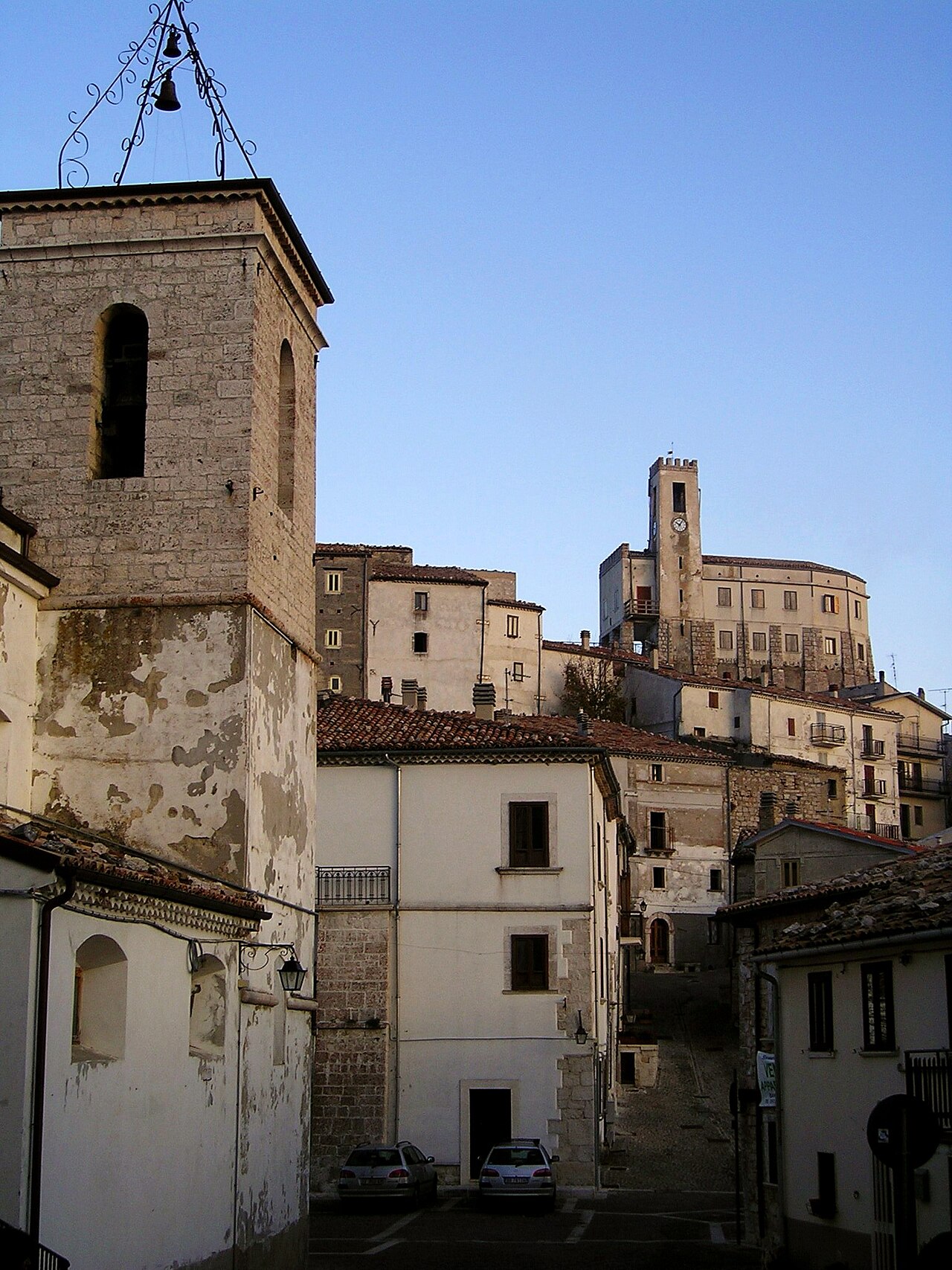
Castello D’Alessandro
Castello D’Alessandro stands prominently on a pentagonal-shaped rocky plateau overlooking the quaint town of Pescolanciano in the Molise region of Italy. This hill castle is steeped in centuries of history, evolving from ancient fortifications possibly dating back to the Samnite civilization, an ancient Italic people known for their resilience and military prowess. The castle's origins are debated among historians, with some attributing its foundation to the Lombards around 573 AD during King Alboin's reign, while others suggest a Carolingian establishment circa 810 AD under Charlemagne's rule. Despite this uncertainty, the earliest confirmed historical reference to the castle emerges in the 13th century, highlighting its strategic importance during the medieval period.
Early history and medieval significance
In the medieval era, Castello D’Alessandro served as a formidable military base. In 1224, it was notably used by Ruggero di Peschio Lanciano, a local lord under the authority of Emperor Frederick II, during his military campaigns. The castle's commanding position over the Molise-Abruzzo Apennines and the expansive Tavoliere plains made it a critical stronghold for controlling the surrounding territory. The castle's fortifications were continually adapted to meet evolving military needs, reflecting the turbulent political landscape of medieval Italy.
Architectural evolution and fortifications
Castello D’Alessandro originally comprised multiple defensive structures built across different periods, including a prominent tower dating back to the Angevin dynasty, perimeter walls, and a private chapel. The castle's layout was shaped by its strategic hilltop location, featuring solid stone foundations and narrow gunport windows designed for defense against invaders. The main entrance was initially accessible via a retractable ladder on the northeast side, later modified to include a drawbridge that allowed controlled access to the fortress.
During the late 16th century, under the stewardship of the noble families Carafa and Eboli, extensive perimeter walls were constructed to enclose both the castle and the adjacent medieval village. This expansion enhanced the defensive capabilities and allowed for better control over the surrounding lands.
In the 17th century, significant renovations unified the castle's disparate elements into a cohesive structure. This involved removing some original walls and leveling terraces to create a spacious courtyard, transforming the castle from a purely military fortress into a more habitable noble residence. The addition of a guardhouse with an ornamental balcony, adorned with intricate arabesque patterns, exemplifies the blend of functionality and aesthetic refinement introduced during this period.
Religious and noble influences
A key feature of the castle is its private chapel, completed in 1628 as part of the enhancements commissioned by Duke Fabio di Agapito d’Alessandro. The chapel was built to house relics of Saint Alexander, the patron saint of the castle, underscoring the site's religious significance. Although the chapel suffered destruction in the 1805 earthquake, it was rebuilt within the castle in a smaller form to maintain its sacred role.
The elevation of the barony to a duchy in 1654 by Duke Fabio di Agapito d’Alessandro marked a period of aristocratic prestige. The duke undertook various architectural improvements, including enlarging the entrance and adding decorative elements that reflected the castle’s transition from a defensive stronghold to a noble residence.
Impact of natural disasters and military use
The castle has endured several earthquakes, notably in 1456 and 1805, which caused significant damage and prompted reconstruction efforts. The 1849 reconstruction of the principal entrance façade gave the castle a more residential appearance, moving away from its original military character.
Throughout its history, Castello D’Alessandro maintained military relevance. During World War I, it housed troops overseeing Austrian prisoners of war. In World War II, the castle served as a German defensive headquarters along the Gustav Line before being repurposed as an Allied command post after 1945.
Modern era restoration and cultural significance
After the abolition of feudal domains in 1806, the castle transitioned fully into a noble residence, attracting notable visitors such as the historian Theodor Mommsen. However, from the 1960s onward, neglect led to the loss of furnishings and archives, threatening the castle's preservation.
Restoration efforts began in 1996, led by the d’Alessandro family in cooperation with public authorities. Recognized as a national monument since the 1980s, the castle now benefits from joint public-private initiatives aimed at preserving its historical legacy and promoting cultural activities. These include guided tours, exhibitions, and the revival of the annual Saint Alexander feast day celebrated every August 26, which draws visitors and honors the castle’s patron saint.
Architectural features and layout
The castle’s pentagonal plateau offers panoramic views of the surrounding landscape, emphasizing its strategic military origins. The courtyard, originally rocky and uneven, was transformed into a flat, functional space during 17th-century renovations. Adjacent outbuildings historically served as storerooms and stables, supporting the castle’s logistical needs.
The guardhouse near the main entrance remains one of the most striking features, with its ornamental balcony showcasing the artistic influences of the period. The castle’s stone walls, battlements, and gunports continue to testify to its defensive past, while the chapel and residential modifications reflect its evolution into a noble estate.
Visitor experience and cultural events
Today, Castello D’Alessandro is a cultural landmark managed jointly by the d’Alessandro family and public authorities. Visitors can explore the castle’s historical architecture, learn about its multifaceted history, and participate in cultural events such as the annual feast day celebrating Saint Alexander. The castle also hosts exhibitions and guided tours that highlight its architectural evolution and historical significance within the Molise region.
Frequently asked questions (FAQ)
- How do I visit Castello D’Alessandro?
- Castello D’Alessandro is open to the public with guided tours available, especially during cultural events like the annual Saint Alexander feast day on August 26. It is advisable to check with the local municipality or the castle’s management for current visiting hours and tour availability.
- What is the historical significance of Castello D’Alessandro?
- Castello D’Alessandro holds great historical significance as a medieval fortress that evolved from ancient fortifications, serving strategic military roles from the 13th century through both World Wars. It also reflects the architectural and noble heritage of the Molise region.
- When was the castle originally built?
- The exact date of Castello D’Alessandro’s original construction is debated, with possible origins in the Lombard period around 573 AD or the Carolingian era circa 810 AD. The earliest confirmed records date to the 13th century.
- Can I attend events at the castle?
- Yes, the castle hosts cultural and religious events, including the annual feast day of Saint Alexander on August 26, which features celebrations and attracts visitors interested in the castle’s heritage.
- Is the castle accessible for visitors with mobility issues?
- Due to its hilltop location and historical architecture, some areas of Castello D’Alessandro may be challenging for visitors with mobility issues. It is recommended to contact the castle’s management in advance to inquire about accessibility options.
Information
Current owner
Jointly owned by public authorities and the d’Alessandro family
Website
Visit websiteSources & official resources
Verify the information above using these authoritative references.
Loading map...
Visitor reviews
No reviews yet. Been here? Write the first review and help other travelers!
Write the first reviewVisited this castle? Share your experience
Your review helps other travelers and adds first-hand knowledge to our encyclopedia.