Castelldefels Castle
Castelldefels Castle stands as a prominent hilltop fortress near the town of Castelldefels, close to Barcelona, Spain. Originally constructed in the 10th century, this castle played a crucial role in defending the frontier of the Carolingian Empire against neighboring Muslim territories, notably the Caliphate of Cordoba. Its strategic location atop a hill overlooking the Mediterranean coast provided a commanding view essential for military surveillance and defense.
The castle complex today comprises a castle keep, a Romanesque church, several outbuildings including a rectory and a cemetery, all enclosed within a robust curtain wall. The site’s history extends far beyond its medieval origins, with archaeological evidence revealing occupation by the Laietani Iberian people between the 3rd and 1st centuries BC, and later a Roman villa from the 1st to 6th centuries AD. This villa is believed to have belonged to Caius Trocina Synecdemus, a local Roman official, as indicated by a 2nd-century funerary inscription discovered on the premises.
Early history and medieval development
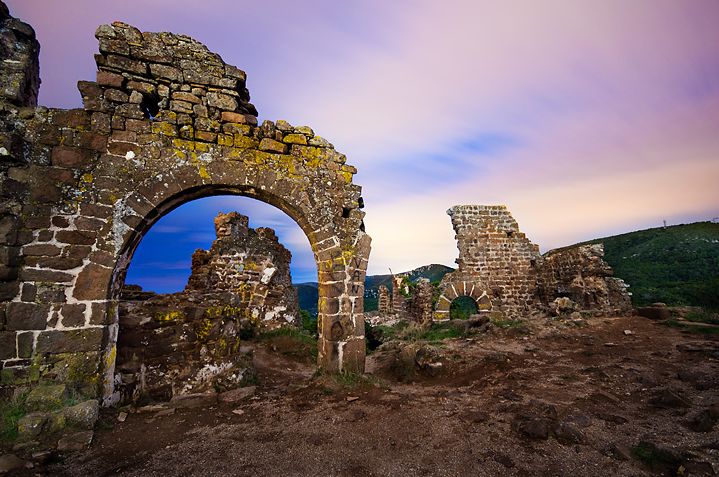
The earliest documented mention of the site, referred to as Castrum Felix, dates back to 967 AD. At this time, the monastery of Sant Cugat had established the church of St. Mary within the castle walls, following directives from Count Sunyer of Barcelona. The original fortification from this period no longer survives, likely destroyed during later conflicts or renovations in the 16th century.
By the 14th century, the site had evolved into a fortified residence surrounded by a strong curtain wall. Defensive enhancements included battlements added to the church, reflecting the turbulent political climate and the need for increased protection against external threats such as pirate raids and regional conflicts.
16th-century reconstruction and coastal defense
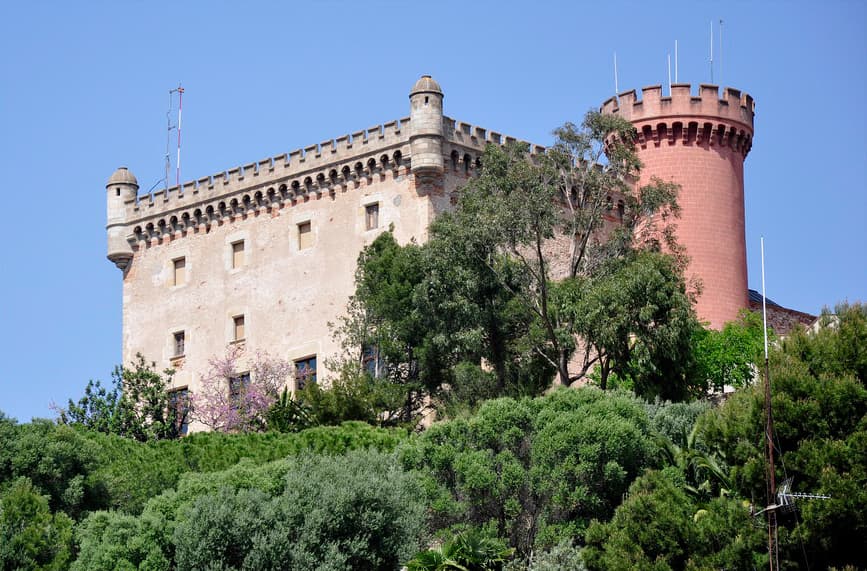
In response to the growing threat of Ottoman expansion and frequent attacks by Barbary pirates, King Philip II ordered the demolition of the older structures in the mid-16th century. The current castle was largely rebuilt using red sandstone quarried locally from Begues. A significant addition was the construction of a large southwest tower in 1590, designed to enhance the castle’s role as a coastal defense fortress.
This reconstruction transformed Castelldefels Castle into a more modern military installation, capable of withstanding artillery attacks and serving as a watchpoint against seaborne threats. The castle’s architecture from this period reflects the transition from medieval fortifications to early modern bastioned defenses.
19th-century restoration and architectural enhancements
By the late 19th century, the castle had fallen into a state of ruin, although the church remained in use. In 1893, a notorious double murder occurred in the rectory, leading to the execution of the perpetrator outside the castle walls in 1895. Shortly thereafter, the property was purchased by Manuel Girona, a wealthy banker from Barcelona, who commissioned architect Enric Sagnier to restore the castle.
The restoration, completed in 1897, introduced Gothic-style decorative crenellations and other ornamental features that enhanced the castle’s medieval character. During this period, the parish church was relocated to a new site, and the original castle church was converted into a private family chapel.
Role during the spanish civil war
During the Spanish Civil War (1936–1939), Castelldefels Castle was repurposed as a disciplinary prison camp for the International Brigades. The castle’s dark history from this era includes accounts of executions and torture, marking a grim chapter in its long existence.
Architectural features and archaeological significance
The castle is situated on a hill approximately 59 to 60 meters high, providing strategic views of the surrounding landscape and coastline. The main structure is a tall circular keep composed of two connected buildings: the eastern section built from red sandstone and the western part constructed from plaster-coated masonry with a beige hue.
Several smaller towers of varying types punctuate the castle walls, including a circular watchtower near the entrance, which was part of the original defensive system and partially restored in 1979. The Romanesque church of St. Mary within the enclosure features a single nave, three semicircular apses, a transept, and a small bell tower. Architectural highlights of the church include barrel vaults in the nave and transept, a crossing dome, and bifora windows in the bell tower. The southern apse was fortified with battlements in the 14th century to enhance defense.
The curtain wall enclosing the complex has undergone various modifications over the centuries. The main outer gate, located at the northern end of the bailey, is largely decorative and dates from the 1897 restoration. The southwest tower, built in 1590, was also embellished with decorative crenellations during the 19th-century restoration.
Archaeological excavations have revealed significant finds beneath the castle, including an Iberian water cistern carved into the bedrock and remains of Iberian houses beneath the church. Although no Iberian structures were found under the main courtyard due to 16th-century leveling, a notable Roman funerary monument inscribed in Latin was discovered embedded in the rectory wall. This monument, measuring 93 by 60 by 52 centimeters, likely served as the base for a statue dedicated to Caius Trocina Synecdemus by his wife Valeria Haline.
Modern preservation and public access
In 1988, ownership of Castelldefels Castle was transferred to the municipal council of Castelldefels, which initiated restoration and archaeological projects to preserve and study the site. Today, the castle is recognized as an important cultural and historical landmark, attracting visitors interested in its rich history spanning from ancient Iberian times through the medieval period and into modern history.
Frequently asked questions (FAQ)
- How do I visit Castelldefels Castle?
- Castelldefels Castle is open to the public with guided tours available during the tourist season. Visitors should check the local municipal website for current opening hours and tour schedules.
- What is the historical significance of Castelldefels Castle?
- Castelldefels Castle is significant for its role in defending the Carolingian Empire frontier and later serving as a coastal defense against Ottoman and pirate attacks. Its history spans from Iberian and Roman times through medieval and modern periods.
- Can I explore the castle's archaeological sites?
- Yes, visitors can explore parts of the castle grounds where archaeological excavations have uncovered Iberian and Roman remains, including a water cistern and funerary monuments.
- When was the castle restored?
- The castle underwent major restoration in 1897 led by architect Enric Sagnier, who added Gothic-style elements and decorative crenellations.
- Is Castelldefels Castle accessible for people with mobility issues?
- Due to the castle's hilltop location and historic structure, accessibility may be limited. Visitors with mobility concerns should inquire in advance about accommodations.
Photo gallery

Information
Sources & official resources
Verify the information above using these authoritative references.
Loading map...
Visitor reviews
No reviews yet. Been here? Write the first review and help other travelers!
Write the first reviewVisited this castle? Share your experience
Your review helps other travelers and adds first-hand knowledge to our encyclopedia.