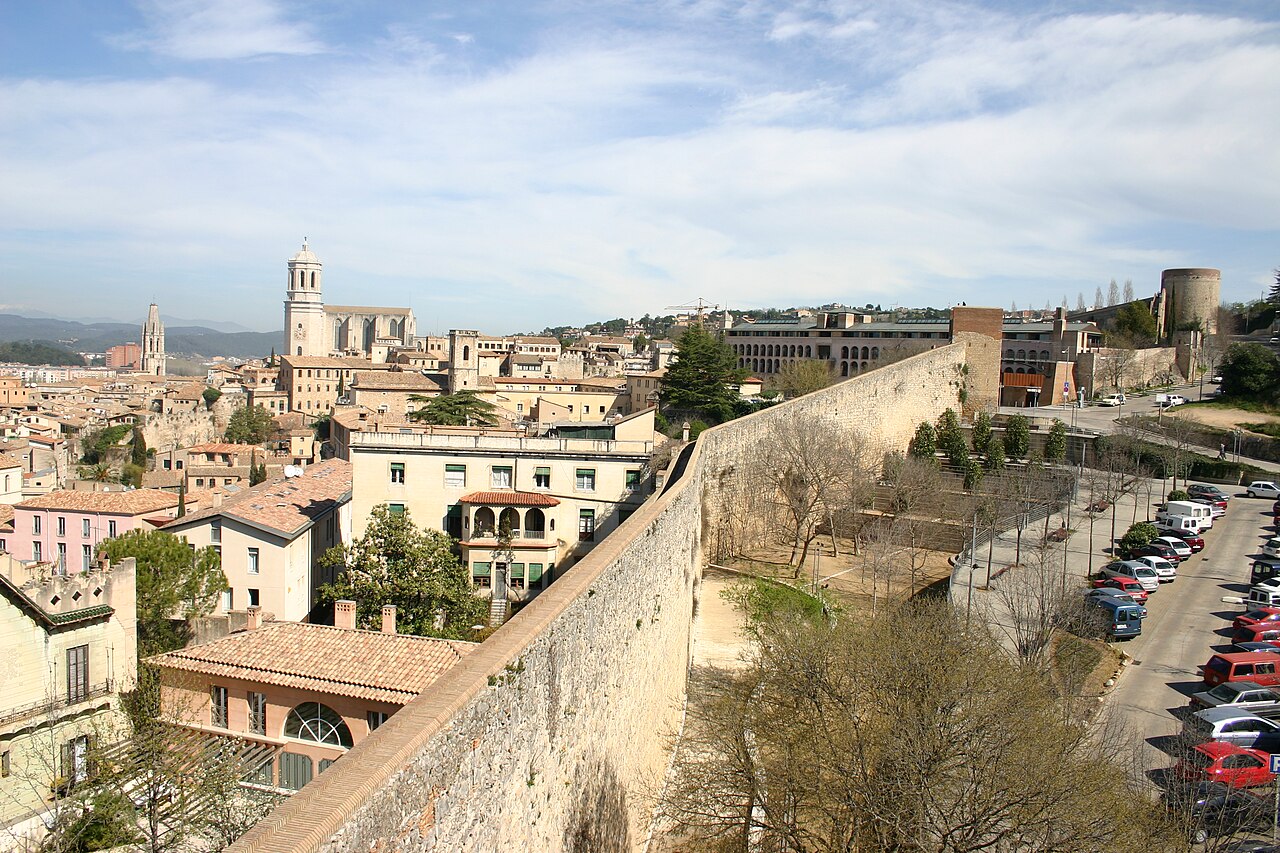
Castell de Sant Miquel
Castell de Sant Miquel stands prominently atop the Sant Miquel hill within the municipality of Girona, Spain, offering a remarkable example of layered historical and architectural evolution. This hill castle embodies centuries of strategic military importance, religious devotion, and technological innovation, reflecting the dynamic history of the region.
Medieval origins and religious significance
The exact origins of the original fortified structure at Castell de Sant Miquel remain uncertain, but its location and architectural traits suggest a medieval military purpose typical of northeastern Spain. The earliest documented reference dates to the mid-15th century, when an hermitage dedicated to Santa Maria and Saint Michael the Archangel was established on the site. This religious building likely arose on the foundations of earlier defensive works, serving as a spiritual refuge and a symbol of Christian presence in a strategically important location.
For approximately two centuries, from the 16th to the 18th century, the hermitage was inhabited by hermits who expanded the religious complex, particularly in the 18th century. Architectural modifications during this period included extending the nave and replacing the original brick-arched roof with a more durable stone vault. The hermitage featured a single nave leading to a polygonal apse, which itself was constructed atop the remains of an earlier circular defensive tower. A bell gable crowned the nave’s roof, serving as a call to worship and marking the building’s ecclesiastical function.
Napoleonic war and military adaptations
During the Peninsular War (1808–1814), Castell de Sant Miquel regained military prominence. French forces occupied the site in 1808 and 1809, fortifying it to resist attacks from local Spanish militias. Defensive features such as loopholes—narrow openings in the walls designed for firing weapons—were added to the hermitage’s apse and surrounding walls, transforming the religious site into a fortified military post. These modifications illustrate the castle’s strategic role in the conflict between Napoleonic France and Spanish resistance.
Following the war, the hermitage was destroyed, leaving ruins that would later be repurposed for new military technologies.
Optical telegraph era and technological innovation
In 1848, the site was adapted to serve as part of an optical telegraph network, a cutting-edge communication system of the time linking Madrid with the French border. Two optical telegraph towers were constructed: one on the southern side adjacent to the old hermitage ruins, and another directly over the apse remains. These towers had a square plan with battered bases—sloping walls that provided stability and defense—and featured multiple loopholes for observation and protection.
The telegraph towers utilized mechanical semaphore arms to visually transmit messages over long distances, a vital innovation before the advent of electrical telegraphy. The towers were surrounded by a moat for added defense, reflecting the continued military importance of the site. This optical telegraph system remained operational until 1856, when it was rendered obsolete by electric telegraph lines. Subsequently, control of the site passed to the Civil Guard.
Architectural features and site layout
The castle complex is enclosed within a fortified perimeter surrounded by the mid-19th century moat, which protected the telegraph installations. Within this enclosure lie the remains of the hermitage and the two optical telegraph towers. The hermitage’s polygonal apse rests on the foundation of an earlier circular tower, highlighting the site's defensive origins. The nave’s expansion and the stone vault roofing demonstrate architectural evolution through the centuries.
Adjacent to the hermitage are two large, square cisterns used historically for water collection and storage. Although one cistern was partially damaged during moat construction, both remain visible and underscore the practical needs of the site's occupants across different eras.
The southern telegraph tower’s square footprint and sloped base, combined with its loopholes, provided a secure vantage point for signal operators. The tower built over the apse ruins includes a first-floor entrance, a second-floor chamber for signaling operations, and a roof terrace where semaphore equipment was mounted.
Strategic location and panoramic views
Perched on Sant Miquel hill, the castle commands expansive views of the surrounding landscapes. Visitors can see the Costa Brava coastline, the Pyrenees mountains, and nearby natural landmarks such as the Guilleries, Montseny, the Gironès plain, and the Gavarres mountains. A notable distant peak visible from the site is Puig Alt, home to the Sanctuary of the Angels. This panoramic vantage point underscores the site’s historical role as a lookout and communication hub.
Historical governance and cultural significance
Over the centuries, administrative control of Castell de Sant Miquel shifted between the municipalities of Celrà and Girona. Initially connected to Celrà during medieval and early modern periods, governance transitioned increasingly toward Girona in the late 20th century during Spain’s democratic era. This reflects broader political and territorial changes in the region.
Today, Castell de Sant Miquel stands as a testament to the multi-layered history of northeastern Spain, illustrating the intersection of military strategy, religious devotion, and technological progress. Its preserved ruins offer valuable insights into medieval fortifications, Napoleonic-era defenses, and 19th-century communication innovations.
Frequently asked questions (FAQ)
- What is the historical significance of Castell de Sant Miquel?
- Castell de Sant Miquel has a rich history as a medieval fortified site, a religious hermitage, a Napoleonic military post, and a 19th-century optical telegraph station, reflecting its strategic importance in northeastern Spain.
- Can visitors see panoramic views from Castell de Sant Miquel?
- Yes, the castle's hilltop location offers expansive views of the Costa Brava coastline, Pyrenees mountains, and nearby natural landmarks such as the Guilleries and Montseny ranges.
- When was the optical telegraph system at Castell de Sant Miquel operational?
- The optical telegraph towers were built in 1848 and remained in use until 1856, serving as a visual communication link between Madrid and the French border before electric telegraphy replaced it.
- Are there visible remains of the Napoleonic fortifications?
- Yes, loopholes carved into the apse and lateral walls from the early 19th century are still visible, showing the site's defensive role during the Peninsular War.
- What architectural features characterize the hermitage at Castell de Sant Miquel?
- The hermitage features a single nave with a polygonal apse built over a circular tower foundation, a stone vaulted roof, and a bell gable, reflecting its religious and defensive history.
Information
Website
Visit websiteSources & official resources
Verify the information above using these authoritative references.
Loading map...
Visitor reviews
No reviews yet. Been here? Write the first review and help other travelers!
Write the first reviewVisited this castle? Share your experience
Your review helps other travelers and adds first-hand knowledge to our encyclopedia.