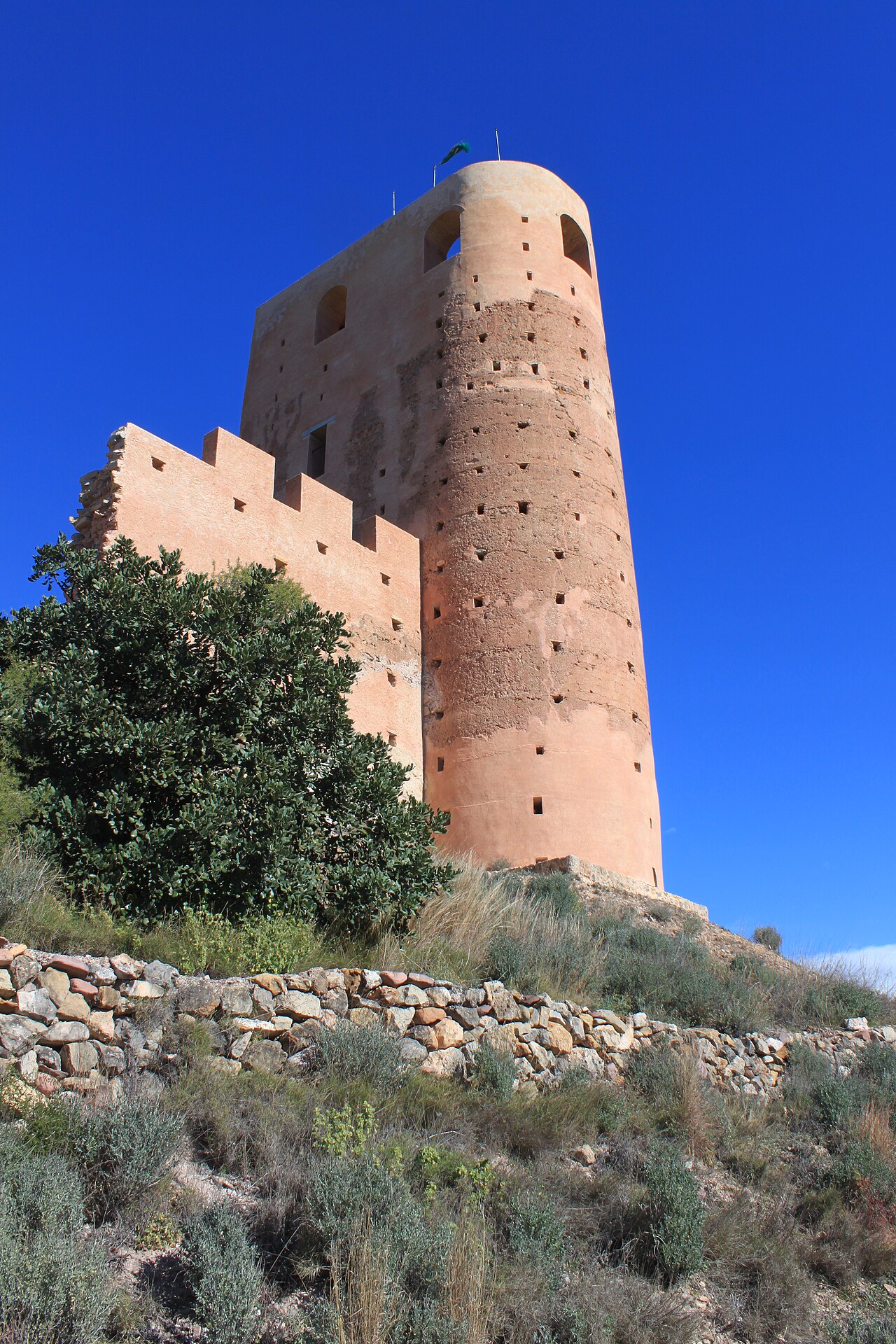
Castell de la Rodana
The Castell de la Rodana stands as a remarkable example of a hill castle with a rich history spanning multiple cultural periods in Spain. Situated near the town of Almedíjar in the Sierra de Espadán mountain range, this fortress occupies a strategic elevated position that has been of military and defensive importance since ancient times. Its origins trace back to the Iberian period, making it one of the region's oldest fortified sites.
Historical evolution and cultural layers
The castle's foundation by the Iberians established its initial role as a stronghold controlling the surrounding territory. Over time, the site was continuously occupied and adapted by successive cultures, each leaving distinctive marks on the fortress's structure and significance. The Romans later settled here, incorporating their advanced masonry techniques into the construction, as evidenced by the well-preserved Roman-style wall on the northern side of the castle. This wall, built directly on the rock base, highlights the Romans' skillful integration of natural landscape features into defensive architecture.
During the Muslim period on the Iberian Peninsula, the castle underwent further development. The southern walls, characterized by their Arab construction methods and angled design, reflect the architectural influence of this era. The castle's role expanded beyond mere defense, becoming a refuge for Muslims fleeing the Christian reconquest, particularly after 1233 when the nearby town of Burriana fell. This sanctuary function underscores the fortress's importance during times of conflict and cultural transition.
The medieval period and the Knights Templar
Following the Christian conquest of the region by King Jaime I in 1238, the castle was entrusted to Fray Bernardo de Bort, commander of Alcalá of the Knights Templar. This military order controlled the fortress until their dissolution in 1312, during which time the castle likely served both as a defensive bastion and administrative center. The Templars' presence is a testament to the castle's strategic value in the medieval Christian kingdom.
After the Templars, ownership passed through several noble families, including Bernat Serra, Siarno (Cyrano) de Fanfans, the Montcada lords, and finally the Centelles family. These transitions reflect the castle's continuing role as a feudal asset within the evolving political landscape of medieval Spain.
Military significance and notable events
The castle's military importance persisted into the early modern period. In 1526, during the last phases of the Morisco rebellion, the area around Castell de la Rodana was the site of a decisive battle. Alfonso de Aragón y Portugal, the Duke of Segorbe, led Christian forces to defeat the Morisco insurgents, effectively ending resistance in the region. This event ties the castle's history to broader conflicts that shaped Spain's religious and cultural landscape.
Architectural features and layout
The fortress exhibits an irregular and elongated shape that closely follows the contours of the rocky hill on which it is built. This adaptive design maximizes natural defensive advantages by integrating the castle with the terrain. The use of the rocky mound as a foundation provided a formidable base difficult for attackers to undermine.
One of the castle's most distinctive architectural elements is the Roman-style wall on the northern side, constructed with large stone blocks directly on the rock base. This wall exemplifies the Roman approach to fortification, emphasizing solidity and durability.
In contrast, the southern flank features a well-preserved angled wall characteristic of Arab construction techniques. This juxtaposition of styles within the same fortress illustrates the layered history and cultural influences that shaped Castell de la Rodana.
Defensive structures include remnants of a double wall encircling the castle, providing multiple layers of protection. The lower remains of the main tower are still visible, suggesting its former prominence as a lookout and stronghold within the complex. Foundations on the western side indicate the probable location of the original entrance, designed to control access and enhance security.
Strategic connections and landscape context
From the elevated vantage point of the castle, observers can see the Castillet, a nearby defensive tower that once protected the valley's inhabitants. This visual link suggests coordinated defense strategies between Castell de la Rodana and surrounding settlements, reinforcing the castle's role as a regional stronghold.
The castle's position within the Sierra de Espadán not only provided military advantages but also controlled important routes through the mountains, underscoring its significance in regional power dynamics.
Current condition and preservation
Today, Castell de la Rodana remains in a ruinous condition, with only partial walls and foundations surviving. Despite this, the site offers valuable insights into the architectural evolution from Iberian through Roman and Muslim periods to medieval Christian control. Its ruins attract historians, archaeologists, and visitors interested in Spain's complex cultural heritage and castle architecture.
Efforts to preserve and study the site continue, emphasizing its importance as a cultural landmark that embodies centuries of historical change and architectural adaptation.
Frequently asked questions (FAQ)
- How do I get to Castell de la Rodana?
- Castell de la Rodana is located near the town of Almedíjar in the Valencian Community of Spain. Visitors can reach the site by car or hiking trails from Almedíjar, with signage guiding the way to the castle ruins.
- What is the historical significance of Castell de la Rodana?
- The castle has a rich history spanning Iberian, Roman, Muslim, and medieval Christian periods. It served as a strategic stronghold, refuge during the Christian reconquest, and a site of military importance during the Morisco rebellion.
- Can I explore the ruins of Castell de la Rodana?
- Yes, visitors can explore the ruins, which include remnants of walls, towers, and fortifications. While the castle is in ruins, it offers panoramic views of the surrounding Sierra de Espadán and insight into its layered architectural history.
- When is the best time to visit the castle?
- The best time to visit Castell de la Rodana is during spring and autumn when the weather is mild and the natural surroundings are especially scenic. Summer can be hot, and winter may be less accessible due to weather conditions.
- Are there any nearby attractions to visit after Castell de la Rodana?
- Nearby attractions include the town of Almedíjar with its traditional architecture, the Sierra de Espadán Natural Park for hiking and nature exploration, and other historic sites in the Valencian Community.
Information
Loading map...
Visitor reviews
No reviews yet. Been here? Write the first review and help other travelers!
Write the first reviewVisited this castle? Share your experience
Your review helps other travelers and adds first-hand knowledge to our encyclopedia.