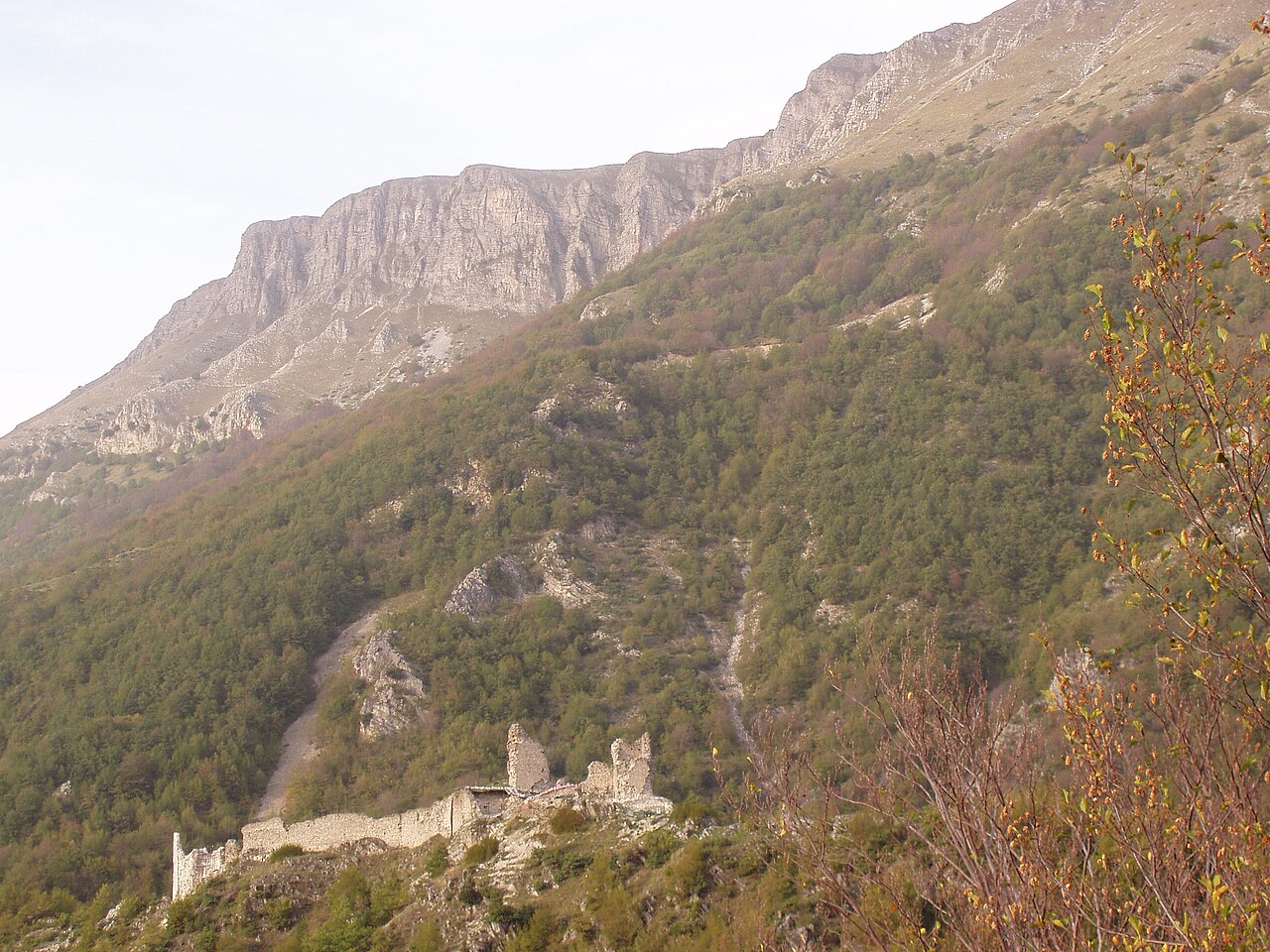
Castel di Luco
Castel di Luco stands as a remarkable example of a hill castle with deep historical roots in the municipality of Acquasanta Terme, located in the central Italian region of Marche. This castle's origins remain somewhat enigmatic, but it occupies a site of strategic and cultural significance that spans from ancient Italic and Roman times through the Byzantine era and into the medieval period. The fortress's enduring presence reflects the evolving military and social landscape of the region over centuries.
Historical significance and origins
The early history of Castel di Luco is intertwined with local legends and scholarly theories. According to the 16th-century historian Giuseppe Colucci, the site may have originally served as a sacred grove with altars dedicated to indigenous deities, used by Italic and Roman peoples. This interpretation highlights the site's long-standing spiritual and communal importance before its militarization. Another perspective, offered by historian Bernardo Carfagna, suggests that the castle's foundation dates back to the Byzantine period, when it was established as part of a military reorganization aimed at securing the region through new garrisons.
Before the rise of the Ascoli commune, Castel di Luco likely functioned as a local judicial seat and defensive stronghold. Its strategic position on a travertine rock spur provided natural fortification that was enhanced by man-made defenses. The castle notably resisted assaults during turbulent periods, including attacks by Charles I of Anjou and militias led by Galeotto I Malatesta. Control of the castle shifted over time, falling under the dominion of the Sforza family in the 13th century and later passing to the Ciucci family from the 15th century until the 19th century.
Medieval and Renaissance military architecture
Castel di Luco exemplifies the architectural evolution of fortifications responding to changing military technologies and threats. The castle's distinctive elliptical layout encloses an internal courtyard within walls that follow the natural contours of the cliff's edge, creating a roughly circular defensive perimeter. This design was typical of hill castles that maximized natural topography for defense.
The most prominent defensive feature is the 16th-century tower with sloped (battered) walls, engineered to deflect projectiles and hinder scaling attempts. This tower includes a cordon anti-climb, a projecting stone band that prevented attackers from gaining purchase to climb the walls. The presence of firing slits designed for arquebuses indicates adaptation to early firearm technology, marking a transition from medieval to Renaissance military architecture.
Additional defensive elements include travertine corbels supporting wooden balconies and machicolations. These features allowed defenders to observe and directly attack enemies below while remaining protected. A smaller defensive tower on the southeast side enhanced surveillance and defense coverage, demonstrating a layered fortification strategy.
Transition to noble residence and local governance
Over time, Castel di Luco evolved from a purely military fortress into a noble residence, particularly under the stewardship of the Ciucci family. This transition is reflected in architectural modifications that prioritized comfort and domestic functionality alongside defense. The castle became the center of a small village, arranged concentrically around the palace and rocky spur, illustrating its role as a hub of local social and territorial organization.
A notable historical event occurred on August 10, 1445, when Pietro di Vanne Ciucci, lord of Luco, led mountain men from the castle to liberate Ascoli Piceno from the control of Rinaldo di Folignano. This act reaffirmed the castle's strategic importance and its lord's political influence, culminating in the declaration of papal sovereignty over the area.
The turbulent security climate of the 16th century is exemplified by the 1562 killing of the castle's defender, Chiarino Montaroni, by the bandit Parisani. This incident, with Montaroni's body disposed of in the nearby Tronto River, underscores the ongoing challenges faced by the castle's inhabitants in maintaining order and safety.
Modern history and restoration
By the late 18th and early 19th centuries, ownership of the castle passed through marriage to Giuseppe Amici and his descendants, marking a new chapter in its history. The castle remained a symbol of local heritage and noble lineage.
In the 21st century, Castel di Luco suffered significant damage during the 2016–2017 central Italy earthquakes, which affected many historic structures in the region. Restoration efforts were undertaken to stabilize and repair the fortress, culminating in a reopening in 2024. The castle has since been repurposed for hospitality use, blending its rich historical legacy with contemporary functions.
Architectural features and layout
Situated on a natural travertine stone spur, the castle's location enhances its defensive capabilities by isolating it atop a hill. The elliptical shape of the fortress remains largely unchanged since medieval times, enclosing an internal courtyard that served as a protected communal space.
The castle's walls follow the irregular contours of the cliff, creating a unique irregular circular enclosure that maximizes natural defenses. The design reflects the dual purpose of the castle as both a military stronghold and a place of refuge for local residents during times of conflict.
The defensive tower with sloped walls is a key architectural highlight, featuring a design that resists scaling and projectile impact. The cordon anti-climb stone band and firing slits adapted for arquebuses illustrate the castle's response to advancements in siege warfare.
Travertine corbels around the perimeter supported wooden balconies and machicolations, enabling defenders to launch counterattacks while remaining shielded. The smaller tower on the southeast side provided additional vantage points for surveillance and defense.
As the castle's function shifted towards residential use, expansions accommodated living quarters and community spaces, leading to the development of a village clustered around the castle. This spatial organization highlights the castle's enduring role as a focal point of local governance and society.
Frequently asked questions (FAQ)
- How do I visit Castel di Luco?
- Castel di Luco is located in Acquasanta Terme, Marche, Italy. Visitors can access the castle by car or local transport. It is advisable to check opening hours and any visitor requirements in advance due to its use as a hospitality venue.
- What is the historical significance of Castel di Luco?
- Castel di Luco has a rich history dating back to ancient Italic and Roman times, with significant roles during the Byzantine period and medieval conflicts. It served as a defensive stronghold and noble residence, reflecting the region's evolving political landscape.
- When was Castel di Luco built?
- The castle's origins are uncertain, but its main structure dates to the High Medieval period, with significant 16th-century modifications adapting it to Renaissance military technology.
- Can I explore the architectural features of Castel di Luco?
- Yes, visitors can observe the castle's elliptical layout, sloped defensive tower, machicolations, and firing slits for arquebuses, showcasing its military architectural evolution.
- Why is Castel di Luco important for local history?
- The castle was a seat of local justice and defense, played a role in liberating Ascoli Piceno in 1445, and reflects centuries of noble family ownership and community development.
Information
Sources & official resources
Verify the information above using these authoritative references.
Loading map...
Visitor reviews
No reviews yet. Been here? Write the first review and help other travelers!
Write the first reviewVisited this castle? Share your experience
Your review helps other travelers and adds first-hand knowledge to our encyclopedia.