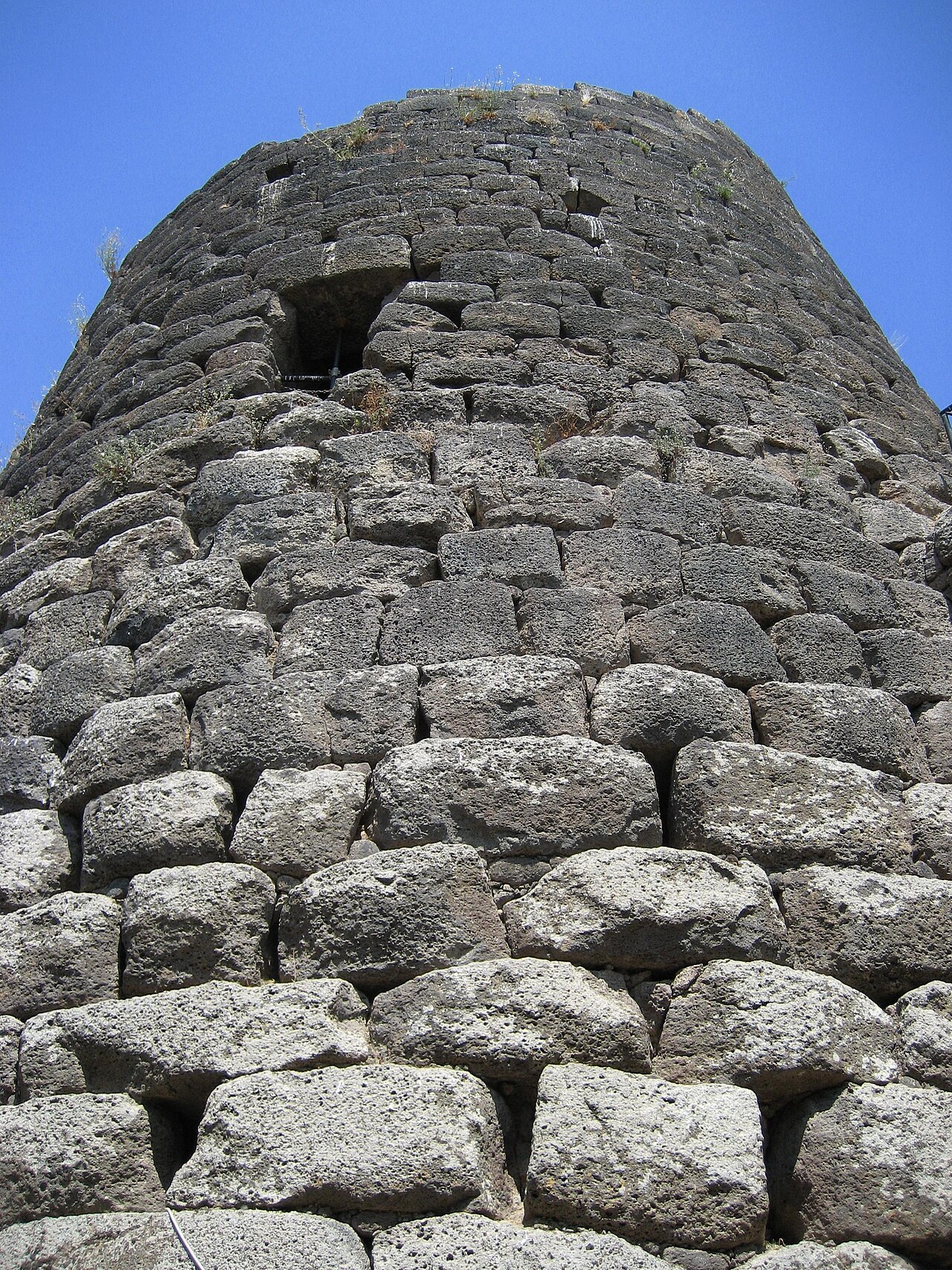
Casteddu Etzu
Casteddu Etzu stands as a significant medieval fortress located within the municipality of Cuglieri in Sardinia, Italy. This hill castle was originally constructed in 1186 by Ittocorre di Gallura, a nobleman of the Judicate of Torres, a prominent Sardinian kingdom during the Middle Ages. The castle's primary purpose was to serve as a robust defensive stronghold securing the borders of the Judicate of Torres against rival powers, most notably the neighboring Giudicato of Arborea.
The castle's strategic location atop a prominent hill composed of phonolitic trachyte, a durable volcanic rock, provided commanding panoramic views of the surrounding Montiferru mountain range. This vantage point was crucial for early detection of enemy movements and for asserting territorial control in a region marked by frequent medieval conflicts. The elongated architectural plan of Casteddu Etzu enclosed multiple interior rooms, designed to accommodate both military and residential functions, though today only the foundations remain visible.
Historical context and ownership transitions
During the 13th century, the political landscape of Sardinia underwent significant transformations. The Judicate of Torres collapsed, and its territories, including Casteddu Etzu, were absorbed by the expanding Giudicato of Arborea. Under the leadership of Mariano II, Arborea consolidated its power, marking a new era for the castle and its environs.
In the early 15th century, Sardinia came under the dominion of the Crown of Aragon in 1410. This shift in sovereignty diminished the castle's military importance, as the island's political and defensive strategies evolved under Aragonese rule. Subsequently, Casteddu Etzu passed through various noble hands, most notably the Zatrillas family, who held significant titles such as counts of Cuglieri and marquises of Siete Fuentes.
The dramatic episode of francesca zatrillas
A notable historical event associated with Casteddu Etzu occurred in 1668 involving Francesca Zatrillas. Accused of complicity in her husband's death and conspiring against the Aragonese viceroy Camarassa, Francesca sought refuge within the castle. Facing imminent arrest, she escaped under the cover of darkness, initially finding sanctuary in the nearby rural church of San Lorenzo before fleeing by sea to Livorno. This episode underscores the castle's role not only as a military bastion but also as a refuge in times of political turmoil.
Following these events, the feudal rights to the fief were reclaimed by the Crown, and the castle was abandoned from 1670 onward. This marked the end of Casteddu Etzu's active use, transitioning it into a historical ruin reflective of Sardinia's complex medieval and early modern history.
Architectural features and site remains
The ruins of Casteddu Etzu reveal an elongated plan enclosing several interior spaces, though only the foundations survive to hint at their original functions. The castle was constructed primarily from local stone, with surviving fragments of towers and wall facings that once formed a formidable defensive perimeter. These walls, though now partially ruined, illustrate the castle's robust fortification strategy.
Of particular interest are the underground chambers believed to have served as cisterns for water storage. This feature highlights the castle's preparedness for prolonged sieges or isolation, ensuring a sustainable water supply for its inhabitants. Despite the absence of decorative elements, inscriptions, or artifacts such as pottery or tools, the site offers valuable insights into the military and residential aspects of medieval Sardinian castle architecture.
Geographical and strategic significance
Situated on a hill of phonolitic trachyte within the Montiferru mountains, Casteddu Etzu's location was chosen for its natural defensive advantages. The volcanic rock foundation provided a stable and durable base, while the elevated position allowed for extensive surveillance of the surrounding landscape. This strategic placement was essential for controlling movement through the region and for early warning against potential invasions.
Cultural heritage and preservation status
Today, Casteddu Etzu remains a partially preserved ruin, offering a tangible connection to Sardinia's medieval past. The absence of extensive restoration means that visitors can witness the authentic remnants of the castle's original structures, including the foundations and surviving wall fragments. While the lack of decorative or inscriptional evidence limits detailed understanding of the castle's daily life and aesthetic qualities, the site is nonetheless a significant cultural and historical landmark.
The castle's enduring presence reflects the layered history of Sardinia, from its medieval Judicate period through Aragonese rule and into the early modern era. It stands as a testament to the island's strategic importance in the Mediterranean and the complex feudal dynamics that shaped its history.
Frequently asked questions (FAQ)
- When was Casteddu Etzu built and by whom?
- Casteddu Etzu was built in 1186 by Ittocorre di Gallura, a noble of the Judicate of Torres, as a defensive fortress.
- What is the historical significance of Casteddu Etzu?
- The castle played a key role in the defense of the Judicate of Torres and later came under the control of the Giudicato of Arborea and the Crown of Aragon, reflecting Sardinia's medieval political shifts.
- What remains of Casteddu Etzu can visitors see today?
- Visitors can see the ruins of the castle's foundations, fragments of towers, wall facings, and underground cisterns that highlight its defensive and residential functions.
- Is Casteddu Etzu accessible to the public?
- While specific visiting hours are not well documented, the castle ruins are accessible to visitors interested in Sardinian medieval history and archaeology.
- Why was Casteddu Etzu abandoned?
- The castle was abandoned after 1670 following the reclamation of feudal rights by the Crown and the decline of its strategic importance under Aragonese rule.
Information
Loading map...
Visitor reviews
No reviews yet. Been here? Write the first review and help other travelers!
Write the first reviewVisited this castle? Share your experience
Your review helps other travelers and adds first-hand knowledge to our encyclopedia.