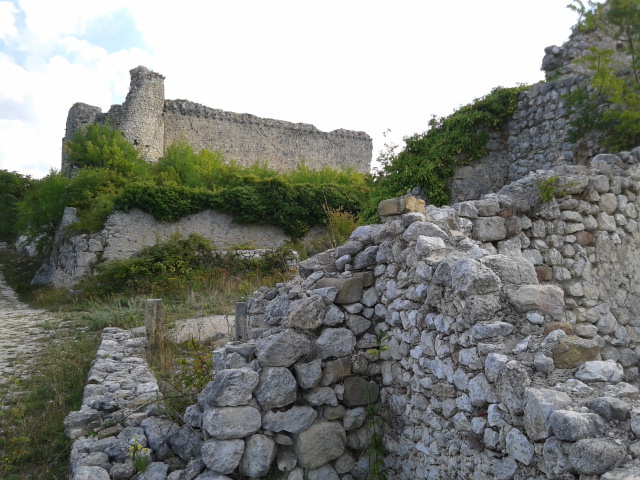
Cardinale Castle
Cardinale Castle stands as a striking example of medieval fortification nestled in the picturesque region of Lazio, Italy. Perched atop a gentle hill rather than a sheer cliff, the castle's ruins evoke a sense of mystery and historical depth. The site is notable for its strategic location overlooking a small valley, surrounded by lush greenery and crowned by tall pines, which together create a dramatic natural setting that enhances the castle's enigmatic allure.
Historical background and ownership
The origins of Cardinale Castle can be traced back to the 12th century when it was part of the fiefdom of Tuscana. By the early 14th century, the castle and its surrounding lands were incorporated into the possessions of Toscanella (modern-day Tuscania). This transition marked a political realignment, as the name change signified the castle's submission to the authority of the Municipality of Rome and Pope Boniface VIII. The castle's strategic and symbolic importance was thus tied to the shifting powers of the medieval Papal States.
In the early 15th century, the castle had fallen into partial ruin, a state that persisted until 1421 when restoration efforts were undertaken by Angelo da Lavello, the Count of Toscanella. During this restoration, a distinctive "shoe" or buttress was added to the castle's pentagonal tower and an adjoining side, enhancing its defensive capabilities. Despite these improvements, the castle suffered significant damage from multiple attacks and fell into ruin again by 1433.
Following these turbulent years, ownership of Cardinale Castle fluctuated but remained within the sphere of the Church until 1773. Subsequently, Pope Clement XVI entrusted the castle to the Gentili family. By 1892, it became the permanent property of Costanza de Gentili, a member of the Counts of Castel Cardinale, who was married to a marquis of Rende, thus linking the castle to notable noble families.
Architectural features and layout
Cardinale Castle is constructed primarily of brown tuff blocks resting on a sandstone base, materials typical of the region and indicative of medieval building practices. The castle's plan is irregular, featuring a prominent semicircular section that reflects its evolution through successive modifications over centuries.
The castle's most remarkable architectural feature is its pentagonal tower, which stands adjacent to the main access door. This tower was reinforced during the 15th-century restoration and remains one of the best-preserved elements of the fortress. The perimeter walls are also relatively intact, allowing visitors to appreciate the scale and defensive design of the stronghold.
Inside the enclosure, the remains of high and massive wall sections suggest the former presence of a substantial central keep, which would have served as the last line of defense and the lord's residence. However, no other internal buildings survive, leaving the interior largely open and evocative of the castle's former grandeur.
Strategic location and surrounding landscape
Unlike many medieval castles built on precipitous cliffs, Cardinale Castle occupies the summit of a modest hill, providing a commanding view over a small ditch and the surrounding valley. This location was strategically chosen to oversee and protect the area while maintaining accessibility.
The valley itself is rich in historical significance, dotted with numerous ruins of fortresses that testify to the region's militarized past during the Middle Ages. The proximity to ancient sites such as Musarna and the towns of Viterbo, Tuscania, and Tarquinia situates Cardinale Castle within a network of medieval defenses that controlled important routes and territories.
The natural environment surrounding the castle enhances its dramatic presence. The hill is crowned by tall pine trees and encircled by verdant meadows and dense vegetation, creating a solitary and mysterious atmosphere that captivates visitors and historians alike.
Cultural significance and current condition
Today, Cardinale Castle exists as evocative ruins that attract visitors interested in medieval architecture, history, and the natural beauty of Lazio. The castle's enigmatic and solitary ruins offer a tangible connection to the region's feudal past and the complex political dynamics of medieval Italy.
The site is a valuable cultural heritage location, reflecting the architectural styles and defensive needs of its time. Its preservation as ruins allows for archaeological study and public appreciation of medieval fortification techniques, including the use of tuff stone and the strategic incorporation of natural landscape features.
While much of the castle has succumbed to time and conflict, the surviving structures, particularly the pentagonal tower and perimeter walls, provide insight into the castle's original defensive design and the historical narrative of the region.
Visiting cardinale castle
Visitors to Cardinale Castle can explore the ruins and enjoy panoramic views of the surrounding Lazio countryside. The castle's remote and elevated position makes it an appealing destination for those interested in history, architecture, and nature.
Although the castle is in a state of ruin, the site is accessible and offers an atmospheric experience of medieval fortification amidst a tranquil natural setting. Visitors are encouraged to respect the fragile remains and the surrounding environment during their visit.
Frequently asked questions
- What is the historical significance of Cardinale Castle? Cardinale Castle was a strategic medieval fortress that played a role in the feudal and ecclesiastical power struggles in Lazio from the 12th to 15th centuries.
- When was Cardinale Castle built? The castle dates back to the 12th century, with significant restorations in the early 15th century.
- What architectural style is Cardinale Castle? The castle exhibits medieval defensive architecture typical of the region, primarily constructed in stone with a distinctive pentagonal tower.
- Is Cardinale Castle accessible to visitors? Yes, the ruins are accessible and offer scenic views, though visitors should be mindful of the site's fragile condition.
- Where is Cardinale Castle located? It is located in the Lazio region of Italy, near the towns of Tuscania and Viterbo.
- What remains can be seen at Cardinale Castle? Visitors can see the pentagonal tower, perimeter walls, and remnants of the central keep, all constructed of brown tuff stone.
Frequently asked questions (FAQ)
- What is the historical significance of Cardinale Castle?
- Cardinale Castle was a strategic medieval fortress that played a role in the feudal and ecclesiastical power struggles in Lazio from the 12th to 15th centuries.
- When was Cardinale Castle built?
- The castle dates back to the 12th century, with significant restorations in the early 15th century.
- What architectural style is Cardinale Castle?
- The castle exhibits medieval defensive architecture typical of the region, primarily constructed in stone with a distinctive pentagonal tower.
- Is Cardinale Castle accessible to visitors?
- Yes, the ruins are accessible and offer scenic views, though visitors should be mindful of the site's fragile condition.
- Where is Cardinale Castle located?
- It is located in the Lazio region of Italy, near the towns of Tuscania and Viterbo.
- What remains can be seen at Cardinale Castle?
- Visitors can see the pentagonal tower, perimeter walls, and remnants of the central keep, all constructed of brown tuff stone.
Information
Loading map...
Visitor reviews
No reviews yet. Been here? Write the first review and help other travelers!
Write the first reviewVisited this castle? Share your experience
Your review helps other travelers and adds first-hand knowledge to our encyclopedia.