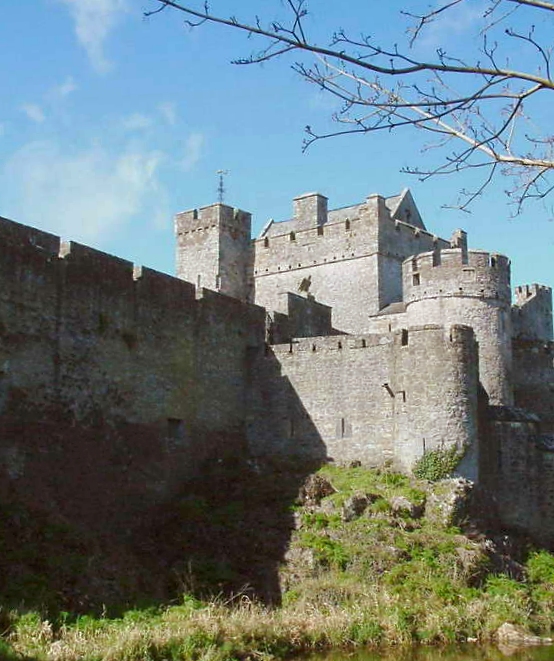
Cahir Castle
Cahir Castle stands prominently in the heart of the town of Cahir, County Tipperary, Ireland, occupying a strategic island site in the River Suir. This imposing fortress, one of the largest and best-preserved in Ireland, reflects a complex history of medieval construction, noble ownership, and military significance spanning several centuries.
The origins of Cahir Castle trace back to an earlier Gaelic stone fortification, known as a cathair, which lent its name to both the castle and the town. The earliest substantial stone construction was initiated around 1142 by Conchobar Ua Briain, King of Thomond, marking the site as a key defensive and administrative center in the region. However, the castle as it is largely recognized today was developed mainly in the 13th century by the descendants of Philip of Worcester, who relocated from their previous motte-and-bailey stronghold at Knockgraffon to this more defensible rocky island.
The medieval origins and architectural evolution
The core of Cahir Castle was constructed as a hill castle on a rocky island, utilizing the natural defensive advantages of the site. The initial 13th-century phase established massive stone walls, a formidable keep, and essential defensive structures designed to withstand siege warfare typical of the High Medieval period. The castle's robust curtain walls and towers were carefully integrated with the island's rocky outcrop, giving the fortress a sense of organic strength as if it "grew" from the rock itself.
In the 14th century, ownership passed through marriage to the Bermingham family but reverted to the English Crown after Sir William de Bermingham's execution in 1332. Subsequently, in 1375, the castle was granted to James Butler, 3rd Earl of Ormond, marking the beginning of the Butler family's long and influential tenure. The Butlers undertook significant rebuilding and expansion projects during the 15th and 16th centuries, adapting the castle to evolving military technologies and residential needs.
Architectural features and expansions
The castle's layout today reveals two distinct construction phases separated by approximately two centuries. The side facing the street contains the older sections dating from the 13th century, including the original keep and curtain walls. The opposite side, built later, houses residential quarters and the Great Hall, which was partially rebuilt in the 1840s restoration. The castle's defensive design features include thick stone walls, battlements, arrow slits, and a moat formed by the river, enhancing its impregnable reputation.
Notably, the Great Hall served as a central gathering and ceremonial space, reflecting the castle's dual role as a fortress and noble residence. The 19th-century restoration efforts aimed to preserve these medieval elements while stabilizing the structure for future generations.
Historical significance and military role
Cahir Castle played a pivotal role in several key conflicts throughout Irish history. It was besieged and captured multiple times, illustrating its strategic importance. In 1599, during the Elizabethan wars, the castle fell to Robert Devereux, 2nd Earl of Essex, after a three-day artillery siege. The castle's commander, James Galida Butler, famously escaped by swimming under the adjacent water mill but recaptured the fortress the following year, demonstrating the fierce loyalty and resilience of the Butler family.
During the Irish Confederate Wars in the mid-17th century, Cahir Castle endured two sieges. It was first taken in 1647 by Murrough O'Brien, 1st Earl of Inchiquin after a brief siege and later surrendered without resistance to Oliver Cromwell's forces in 1650. Following these events, the castle ceased to serve as a noble residence but remained in Butler possession.
Notable events and family history
The castle's history is intertwined with the complex political and familial dynamics of Ireland. In 1627, it was the site of a notorious murder involving Lord Dunboyne and James Prendergast, linked to inheritance disputes. Such incidents highlight the castle's role not only as a military stronghold but also as a center of local power and intrigue.
Restoration and modern preservation
By the late 18th century, Cahir Castle had fallen into partial ruin. The Butler family initiated restoration efforts in the 1840s, notably rebuilding the Great Hall to preserve the castle's historical grandeur. These 19th-century works reflect the Romantic era's renewed interest in medieval architecture and heritage.
After the death of the last Lord Cahir in 1961, the castle was transferred to the Irish state and designated a National Monument. It is now managed by the Office of Public Works, which maintains the site and operates guided tours. Modern visitors can explore the castle's well-preserved defensive structures, including the keep, towers, and curtain walls, as well as enjoy an informative audio-visual exhibit available in multiple languages.
Visitor experience and cultural importance
Today, Cahir Castle stands as a testament to Ireland's medieval heritage and the legacy of the Butler family. Its location on a river island adds a unique scenic and defensive character. Visitors can appreciate the castle's imposing architecture, learn about its turbulent history, and experience the atmosphere of a fortress that has witnessed centuries of Irish history.
The castle's combination of original medieval fabric and sympathetic restoration makes it one of Ireland's premier historic sites. Its accessibility, interpretive programs, and preservation ensure that Cahir Castle remains a vital cultural landmark and a popular destination for history enthusiasts and tourists alike.
Frequently asked questions (FAQ)
- How do I get to Cahir Castle?
- Cahir Castle is located in the town center of Cahir, County Tipperary, accessible by car or public transport. Ample parking and local bus services are available nearby.
- What are the opening hours for visiting Cahir Castle?
- The castle is open daily from 09:00 to 17:00, allowing visitors to explore its historic interiors and grounds throughout the week.
- Is there an admission fee to enter Cahir Castle?
- Yes, admission is charged at €8 for adults and €5 for children, supporting the maintenance and preservation of the site.
- What architectural styles are visible at Cahir Castle?
- Cahir Castle exhibits a mix of medieval defensive architecture with later modifications and 19th-century restoration influences, reflecting its long history.
- Can I take guided tours at Cahir Castle?
- Guided tours are available, providing detailed insights into the castle's history, architecture, and the Butler family's role.
- What makes Cahir Castle historically significant?
- Its strategic island location, association with the Butler family, and involvement in key sieges during the Elizabethan wars and Irish Confederate Wars highlight its importance.
- Is the castle accessible for visitors with mobility issues?
- While efforts have been made to improve accessibility, some areas with uneven terrain and stairs may pose challenges for visitors with limited mobility.
Information
Opening hours
09:00-17:00, daily
Ticket prices
€8 adult, €5 child
Current owner
State monument
Website
Visit websiteAddress
Castle Street, Cahir, County Tipperary, Ireland
Sources & official resources
Verify the information above using these authoritative references.
Loading map...
Visitor reviews
No reviews yet. Been here? Write the first review and help other travelers!
Write the first reviewVisited this castle? Share your experience
Your review helps other travelers and adds first-hand knowledge to our encyclopedia.