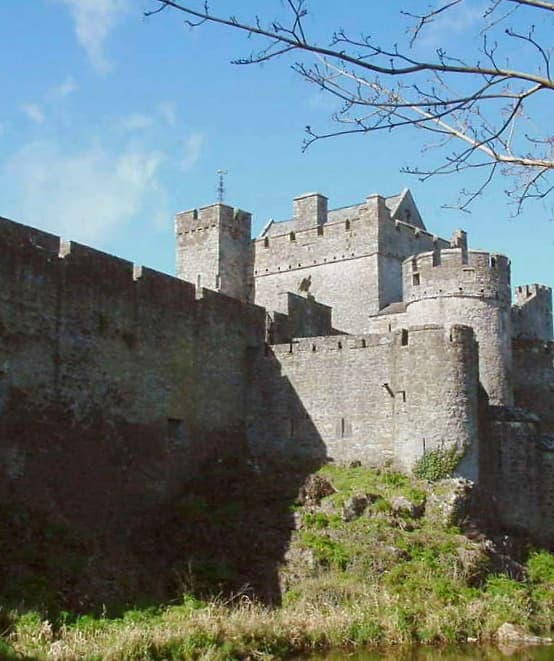
Cahir Castle — Ireland castle

Cahir Castle

Cahir Castle: a well-preserved medieval fortress on the river Suir
Cahir, Ireland
High Medieval (11th–13th c.)
Well Preserved

Cahir Castle (Irish: Caisleán na Cathrach) stands as one of the most significant and well-preserved medieval castles in Ireland. Located on an island in the river Suir, the castle is now situated within the heart of Cahir town centre, County Tipperary. Its strategic position on an island provided natural defenses, enhancing its military strength during the turbulent High Medieval period.

Construction of Cahir Castle began in 1142, commissioned by Conchobar Ua Briain, the King of Thomond. This early phase established the castle's foundation as a formidable hill castle with robust defensive features typical of the 12th century. Over the centuries, the castle underwent various modifications and expansions, reflecting the evolving needs of its occupants and advances in military architecture.

Architectural features and defensive structures

Cahir Castle is renowned for its imposing stone walls and well-preserved battlements. The castle's layout includes a large keep, which served as the central stronghold and residence. Surrounding the keep are extensive curtain walls equipped with towers and gatehouses designed to repel attackers.

The castle's location on an island in the river Suir provided a natural moat, enhancing its defensive capabilities. The water barrier limited access and made direct assaults difficult. Additionally, the castle features a drawbridge and portcullis at the main entrance, common defensive elements in medieval fortifications.

Interior layout and living quarters

Inside, the castle contains a variety of chambers, including a great hall, private chambers, and storage rooms. The great hall was the social and administrative heart of the castle, where the lord would hold court and entertain guests. The living quarters were designed for both comfort and defense, with thick walls and narrow windows to protect inhabitants during sieges.

Historical significance and ownership

Throughout its history, Cahir Castle played a key role in regional power struggles. It was a stronghold for the Butler family, one of the most influential noble families in Ireland. The castle witnessed numerous sieges and battles, particularly during the Elizabethan wars and the Irish Confederate Wars in the 16th and 17th centuries.

The castle's strategic importance made it a coveted prize during conflicts. Its control allowed dominance over the surrounding region and the vital river crossing. Despite several attacks, the castle's robust defenses allowed it to endure through centuries of warfare.

Preservation and modern use

Today, Cahir Castle is remarkably well preserved, retaining much of its original medieval character. The castle is managed as a heritage site open to the public, featuring guided tours and audiovisual shows available in multiple languages. These presentations provide visitors with insights into the castle's history, architecture, and the lives of its former inhabitants.

The castle's accessibility and educational programs make it a popular destination for tourists interested in medieval history and Irish heritage. Its commanding presence on the river Suir continues to attract visitors, offering a tangible connection to Ireland's medieval past.

Visitor experience and facilities

Visitors to Cahir Castle can explore the extensive grounds, including the towers and battlements, which offer panoramic views of the surrounding landscape. The castle's interiors showcase period furnishings and exhibits that illustrate medieval life.

The site includes amenities such as a visitor center and gift shop, enhancing the overall experience. Seasonal events and reenactments are occasionally held, further bringing the castle's history to life for guests.

Frequently asked questions (FAQ)

How do I get to Cahir Castle?
Cahir Castle is located in Cahir, County Tipperary, Ireland. You can reach it by car, with ample parking available nearby, or by public transport, as it is accessible via local bus services from major cities like Cork and Limerick.
What is the historical significance of Cahir Castle?
Cahir Castle is one of the best-preserved castles in Ireland, dating back to the 12th century. It played a crucial role in the defense of the area against English invasion and has a rich history connected to the prominent Butler family.
When was Cahir Castle built?
Cahir Castle was built in 1142 and has been expanded and modified over the centuries. Its well-preserved structures reflect various architectural styles influenced by the historical events of the region.
Can I take guided tours at Cahir Castle?
Yes, guided tours are available at Cahir Castle, providing visitors with in-depth insights into its history and architecture. Additionally, informative signage throughout the castle allows for a self-guided experience if you prefer to explore at your own pace.
Why is Cahir Castle considered an architectural gem?
Cahir Castle is renowned for its impressive medieval architecture, including its strong defensive features and the unique design of its towers and walls. The castle's layout and historical elements showcase the strategic importance it held during its time.
Is it possible to visit Cahir Castle year-round?
Yes, Cahir Castle is open to visitors throughout the year, although opening hours may vary seasonally. It is advisable to check the official website for the most current information regarding hours and any potential closures.
What are the ticket prices for Cahir Castle?
Ticket prices for Cahir Castle are generally affordable, with discounts available for children, students, and seniors. Family tickets and group rates may also be offered, making it accessible for all visitors.
What is the best time to visit Cahir Castle?
The best time to visit Cahir Castle is during the spring and summer months when the weather is milder and the gardens are in full bloom. However, visiting during the off-peak season can also provide a quieter experience with fewer crowds.
Are there any nearby attractions to Cahir Castle?
Yes, there are several attractions near Cahir Castle, including the picturesque Swiss Cottage and the scenic River Suir. The town of Cahir itself offers charming shops and eateries, making it a great spot for a full day of exploration.

Photo gallery

Cahir Castle
Click to view

Photo by Chmouel Boudjnah Original uploader was Chmouel at fr.wikipedia•CC BY-SA 3.0

1 photo • Click any image to view in full screen

Information

Hill Castle

Loading map...

Visitor reviews

No reviews yet. Been here? Write the first review and help other travelers!

Write the first review

Visited this castle? Share your experience

Your review helps other travelers and adds first-hand knowledge to our encyclopedia.

Write a review

(5/5)

0/2000 characters

Your review will be visible after admin approval

Nearby castles

0 km

Cahir Castle

Cahir, United Kingdom

Cahir Castle stands prominently in the heart of the town of Cahir, County Tipperary, Ireland, occupying a strategic island site in the River Suir. This imposing fortress, one of the largest and best-preserved in Ireland, reflects a complex history of medieval construction, noble ownership, and military significance spanning several centuries. The origins of Cahir Castle trace back to an earlier Gaelic stone fortification, known as a cathair, which lent its name to both the castle and the town. The earliest substantial stone construction was initiated around 1142 by Conchobar Ua Briain, King of Thomond, marking the site as a key defensive and administrative center in the region. However, the castle as it is largely recognized today was developed mainly in the 13th century by the descendants of Philip of Worcester, who relocated from their previous motte-and-bailey stronghold at Knockgraffon to this more defensible rocky island. The medieval origins and architectural evolution The core of Cahir Castle was constructed as a hill castle on a rocky island, utilizing the natural defensive advantages of the site. The initial 13th-century phase established massive stone walls, a formidable keep, and essential defensive structures designed to withstand siege warfare typical of the High Medieval period. The castle's robust curtain walls and towers were carefully integrated with the island's rocky outcrop, giving the fortress a sense of organic strength as if it "grew" from the rock itself. In the 14th century, ownership passed through marriage to the Bermingham family but reverted to the English Crown after Sir William de Bermingham's execution in 1332. Subsequently, in 1375, the castle was granted to James Butler, 3rd Earl of Ormond, marking the beginning of the Butler family's long and influential tenure. The Butlers undertook significant rebuilding and expansion projects during the 15th and 16th centuries, adapting the castle to evolving military technologies and residential needs. Architectural features and expansions The castle's layout today reveals two distinct construction phases separated by approximately two centuries. The side facing the street contains the older sections dating from the 13th century, including the original keep and curtain walls. The opposite side, built later, houses residential quarters and the Great Hall, which was partially rebuilt in the 1840s restoration. The castle's defensive design features include thick stone walls, battlements, arrow slits, and a moat formed by the river, enhancing its impregnable reputation. Notably, the Great Hall served as a central gathering and ceremonial space, reflecting the castle's dual role as a fortress and noble residence. The 19th-century restoration efforts aimed to preserve these medieval elements while stabilizing the structure for future generations. Historical significance and military role Cahir Castle played a pivotal role in several key conflicts throughout Irish history. It was besieged and captured multiple times, illustrating its strategic importance. In 1599, during the Elizabethan wars, the castle fell to Robert Devereux, 2nd Earl of Essex, after a three-day artillery siege. The castle's commander, James Galida Butler, famously escaped by swimming under the adjacent water mill but recaptured the fortress the following year, demonstrating the fierce loyalty and resilience of the Butler family. During the Irish Confederate Wars in the mid-17th century, Cahir Castle endured two sieges. It was first taken in 1647 by Murrough O'Brien, 1st Earl of Inchiquin after a brief siege and later surrendered without resistance to Oliver Cromwell's forces in 1650. Following these events, the castle ceased to serve as a noble residence but remained in Butler possession. Notable events and family history The castle's history is intertwined with the complex political and familial dynamics of Ireland. In 1627, it was the site of a notorious murder involving Lord Dunboyne and James Prendergast, linked to inheritance disputes. Such incidents highlight the castle's role not only as a military stronghold but also as a center of local power and intrigue. Restoration and modern preservation By the late 18th century, Cahir Castle had fallen into partial ruin. The Butler family initiated restoration efforts in the 1840s, notably rebuilding the Great Hall to preserve the castle's historical grandeur. These 19th-century works reflect the Romantic era's renewed interest in medieval architecture and heritage. After the death of the last Lord Cahir in 1961, the castle was transferred to the Irish state and designated a National Monument. It is now managed by the Office of Public Works, which maintains the site and operates guided tours. Modern visitors can explore the castle's well-preserved defensive structures, including the keep, towers, and curtain walls, as well as enjoy an informative audio-visual exhibit available in multiple languages. Visitor experience and cultural importance Today, Cahir Castle stands as a testament to Ireland's medieval heritage and the legacy of the Butler family. Its location on a river island adds a unique scenic and defensive character. Visitors can appreciate the castle's imposing architecture, learn about its turbulent history, and experience the atmosphere of a fortress that has witnessed centuries of Irish history. The castle's combination of original medieval fabric and sympathetic restoration makes it one of Ireland's premier historic sites. Its accessibility, interpretive programs, and preservation ensure that Cahir Castle remains a vital cultural landmark and a popular destination for history enthusiasts and tourists alike.

High Medieval (11th–13th c.)
Details
0.4 km

Carrigeen Castle

Cahir, United Kingdom

Carrigeen Castle is located in the historic town of Cahir, in County Tipperary, Ireland. The castle sits atop a hilltop site that has been fortified since at least the 16th century, reflecting its strategic importance in the region during the Renaissance period. Although the current structure resembles a castle, it is in fact a building with a very different original function, constructed in the early 19th century. The original fortified site and its evolution The hill on which Carrigeen Castle stands was historically occupied by a defensible structure dating back to the 16th century. This early fortification was typical of the period, likely serving as a small stronghold or fortified residence designed to control local territory and provide defense against regional conflicts common in Ireland during the Renaissance era. Despite its historic roots, the existing building is not a medieval castle but a product of the early 19th century. Between 1813 and 1816, the site was transformed into a small town jail, known as a bridewell. This type of facility was common in Ireland and Britain for housing minor offenders and managing local law enforcement. Architecture and layout of the 19th-century bridewell The construction of the jail incorporated building materials from the earlier fortified structure, linking the new building to its historical predecessor. The original design included five cells, two dayrooms, two keeper’s rooms, two exercise yards, and an attached keeper's residence. This layout reflects the functional needs of a small prison designed to segregate prisoners by gender and behavior. In the decades following its initial construction, the building's condition deteriorated, prompting repairs in 1841 and an enlargement around 1850. The expansion increased the capacity to eight cells: four for males, three for females, and one specifically for drunken or violent prisoners. This adaptation highlights the evolving penal practices of the mid-19th century and the need for more specialized detention facilities. Later history and current use Carrigeen Castle functioned as a jail until its closure in 1878. Following its decommissioning as a prison, the building was repurposed as a residence for military officers, reflecting a common practice of reusing institutional buildings for housing. In 1919, the property was purchased by the Butler family, who continue to own it today. In 1976, they opened the castle as a bed and breakfast accommodation, allowing visitors to experience staying within a building steeped in local history. Although it is a private residence and B&B, guests have the unique opportunity to explore the castle's historic atmosphere firsthand. Visiting Carrigeen Castle and nearby attractions Visitors interested in Carrigeen Castle can only access the site as guests of the bed and breakfast, as it remains a private residence. The castle offers a distinctive lodging experience that combines historical architecture with modern hospitality. For those seeking a more traditional medieval castle experience, the famous Cahir Castle is located just a five-minute walk away. Cahir Castle is one of Ireland's largest and best-preserved castles, offering a contrasting glimpse into medieval military architecture and history. Architectural significance While Carrigeen Castle does not retain the classic features of a medieval fortress, its transformation from a Renaissance-era fortified site to a 19th-century bridewell illustrates the adaptive reuse of defensive sites over time. The building's stone construction and prison layout provide insight into early 19th-century penal architecture in Ireland. Preservation and condition The castle is well preserved due to its continuous use and maintenance as a residence and hospitality venue. Its survival offers valuable evidence of how historical sites can be repurposed while retaining their cultural significance.

Renaissance (15th–17th c.)
Details
3.7 km

Loughlohery Castle

Cahir, United Kingdom

Loughlohery Castle is a notable example of a 16th-century tower house located east of the town of Cahir in County Tipperary, Ireland. This castle is part of the rich architectural heritage of Ireland's Renaissance period, reflecting the defensive and residential needs of the Irish gentry during that era. Historical context and ownership The castle dates back to the late 16th century, a period marked by social and political upheaval in Ireland. It was owned by the Keating family, a prominent local lineage who also held Nicholastown Castle nearby. The Keatings were part of the Irish gentry who built and maintained such tower houses as symbols of status and for protection during turbulent times. Although detailed records about Loughlohery Castle's history are sparse, its association with the Keating family situates it within the network of fortified residences that dotted the Irish countryside in this period. Architectural features and design Loughlohery Castle is a rectangular tower house rising to four stories in height. Tower houses were a common type of fortified dwelling built across Ireland from the late medieval period into the Renaissance. Their design balanced defense and domestic comfort, often featuring thick stone walls, narrow windows for archery defense, and battlements. The castle's full height remains intact, which is significant given the many tower houses that have fallen into ruin or partial collapse. Its rectangular plan is typical of the period, providing a compact, defensible footprint. The interior would have included a great hall, private chambers, and storage areas, although specific internal details for Loughlohery Castle are not well documented. Defensive elements While detailed descriptions of Loughlohery Castle's defensive features are limited, tower houses generally included features such as murder holes, arrow slits, and to resist attack. The castle's elevated height and narrow windows would have aided defenders in monitoring and repelling potential threats. Location and current condition The castle is situated next to a road within a fenced field likely used for cattle grazing, which restricts public access. Despite this, Loughlohery Castle remains a well-preserved tower house ruin that stands prominently in the landscape. Its preservation to full height makes it an important architectural relic of the Renaissance period in Ireland. The surrounding area is rural, with the castle's proximity to Cahir placing it within an area rich in historical sites. Though it is not currently open for public visitation, its visible exterior offers valuable insight into the construction and form of 16th-century Irish tower houses. Significance in Irish castle architecture Tower houses like Loughlohery Castle were widespread across Ireland from the 15th to the 17th centuries. They represent a distinct architectural response to the social conditions of the time, combining defensive features with residential needs. Loughlohery's preservation contributes to understanding this typology and the lifestyle of the Irish gentry during the Renaissance. Its connection to the Keating family also highlights the role of such families in regional power structures and landholding patterns. While less grand than large castles or palaces, tower houses were central to Ireland's medieval and early modern landscape.

Renaissance (15th–17th c.)
Details
