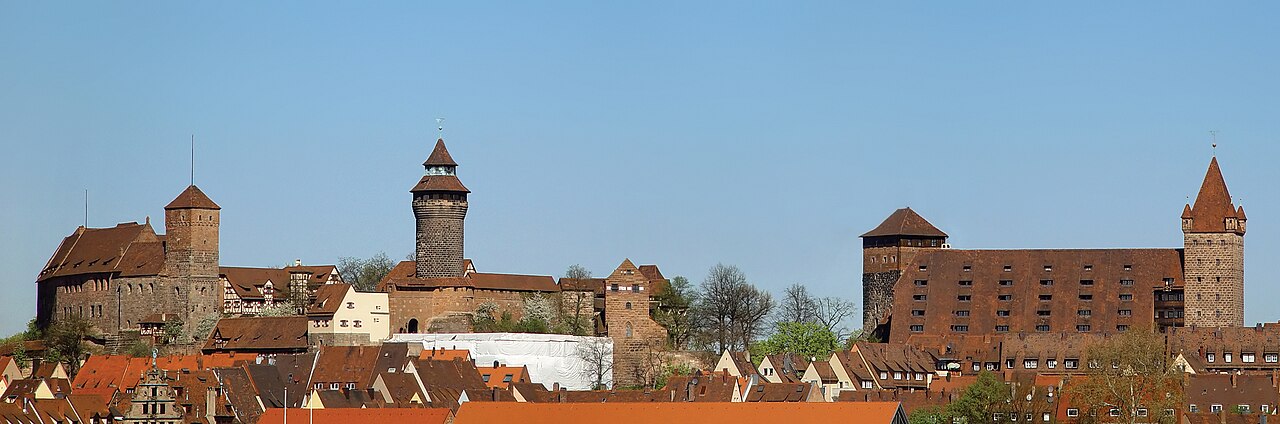
Cadolzburg Castle
Cadolzburg Castle stands as a prominent hill castle with origins dating back to the mid-13th century, located in the municipality of Cadolzburg, Germany. It served as a significant residence and administrative center for the House of Hohenzollern, one of the most influential noble families in German history. The castle's strategic hilltop position, surrounded by formidable curtain walls and multiple defensive features, reflects its medieval military and political importance.
The castle’s core was established around 1240 under Frederick III of Zollern, who constructed the inner gatehouse and curtain walls that still shape the castle’s layout today. Over the centuries, the castle evolved architecturally and functionally, reflecting changing styles and the needs of its occupants, from medieval fortification to Renaissance residence and administrative hub.
Medieval origins and the rise of the hohenzollern family
The earliest documented reference to Cadolzburg Castle appears in 1157, mentioning a figure named Helmericus de Kadoldeßburc, indicating the site’s early medieval significance. The Zollern family, ancestors of the Hohenzollerns, initially built the castle to assert territorial control and protect their holdings. During the high medieval period, the castle became a symbol of the family's rising power in Franconia.
In the 14th century, the Hohenzollern family expanded their influence, acquiring rights such as the privilege to mint coins at Cadolzburg starting in 1361. This economic authority underlined the castle’s role not only as a military stronghold but also as a center of governance and commerce.
Architectural evolution from the 13th to 18th century
The old castle and gothic elements
The Old Castle (Altes Schloss) was constructed beginning in 1415 under Frederick VI of Nuremberg, who became Frederick I of Brandenburg. This section housed the main residential and administrative quarters. The castle features notable Gothic architectural elements, including the Wall Tower with its clock dating from the 13th or 14th century. The courtyard is enclosed by the Old Castle, the kitchen, and the chapel, with remnants of Gothic windows visible in the walls.
Renaissance remodeling and the new castle
Starting in 1527, the castle underwent extensive renovations in the Renaissance style, particularly affecting the so-called New Castle (Neues Schloss). Although older than the Old Castle, this palas building was remodeled to reflect Renaissance aesthetics, contrasting with the Romanesque and Gothic features of the older sections. The New Castle was a 30-meter-long great hall that later served various residential and administrative functions.
Baroque additions and later modifications
Throughout the 17th and 18th centuries, the castle saw further modifications, including late Baroque style enhancements commissioned by Charles William Frederick of Brandenburg-Ansbach. The castle complex also includes an Antecastle (Vorburg) south of the main structure, consisting of multiple buildings and a walled garden dating from the 17th and 18th centuries.
Historical significance and notable events
Frederick I of Brandenburg, a key figure in the castle’s history, rebuilt Cadolzburg entirely and died there in 1440. He donated an altar to the church dedicated to St. Cecilia between 1420 and 1425, which depicts him and his wife Elisabeth of Bavaria-Landshut. The altar was later gifted to Frederick III and moved to Berlin; the original now resides in the Jagdschloss Grunewald, while the church at Cadolzburg displays a copy.
The castle notably escaped damage during the Thirty Years' War, preserving much of its medieval structure. In the 20th century, from 1933 to 1945, the New Castle was used as a Gebietsführerschule by the Hitler Youth. However, in April 1945, during the final battles of World War II, the castle suffered a devastating fire caused by combat between Waffen-SS defenders and American forces. The timber upper floors and interiors were destroyed, leaving the castle a ruin for decades.
Post-war restoration and modern use
After standing as a ruin for over 30 years, the castle’s reconstruction began in 1979 under the direction of the Bavarian Administration of State-Owned Palaces, Gardens and Lakes and the Bauamt Nuremberg-Erlangen. Restoration efforts, including significant structural stabilization and modern rebuilding techniques, took place from 1982 to 2007, culminating in the recreation of the castle gardens.
In 2013, the decision was made to transform the Old Castle into an experiential museum named HerrschaftsZeiten. Erlebnis Cadolzburg, which opened in 2017. The museum offers visitors immersive exhibitions on the castle’s history, the Hohenzollern family, and medieval life, featuring interactive displays, reconstructed rooms, and educational programs.
Architectural features and visitor experience
Defensive structures and layout
The castle occupies a commanding hilltop site, enclosed by a curtain wall with two zwingers—outer defensive courtyards designed to trap attackers. The main entrance is accessed via a gatehouse reached by a stone bridge, flanked by alliance coats of arms representing the castle’s historical allegiances. Notably, a Judensau caricature is present below one coat of arms, a controversial medieval antisemitic image of uncertain date.
Inner courtyard and buildings
The inner courtyard features a grassy area surrounded by several historic buildings, including an old schoolhouse, the governor’s administrative building, and the Hungerturm, believed to have served as a prison. Nearby are a former horse pond and a herb garden cultivated with medieval crops, offering insights into the castle’s agricultural practices.
Chapel and religious art
The castle chapel, dedicated to St. Cecilia, is a two-story structure with the oldest part being its cellar or crypt dating to around 1130. Although it contains no burials of the Zollern family, the chapel houses a modern golden disk artwork. The upper floor once featured a square opening through which the ruling family could observe services. The chapel’s stained-glass window donated by Emperor Wilhelm II in 1898 was destroyed in the 1945 fire, with only a single shard surviving.
Kitchen and medieval life
The castle kitchen is notable for its Ochsenschlot, a large chimney approximately 15 meters tall rising above the curtain wall. It displays medieval pottery and recreates the aromas of historical cooking. Visitors can learn about medieval recipes and the diverse diet of the Zollern family, who reportedly consumed up to twenty different dishes daily.
Museum exhibitions and modern reconstructions
The museum within the castle offers extensive exhibitions on the history of the castle and the Hohenzollern dynasty. Interactive displays include a digital family tree, replicas of historical garments and armor, and an animated dialogue between Albrecht Achilles and Anna of Saxony. The upper floors feature reconstructed halls such as the oriel hall with its ribbed vault ceiling and dance hall playing Renaissance music.
The third floor hosts exhibitions on hunting, artillery, alchemy, medieval professions, and leisure activities. It also includes a reconstructed noble bedroom and educational spaces for school groups. The New Castle’s hollow structure, reinforced with concrete, allows visitors to explore its historical footprint, with sound installations and a documentary recounting the 1945 fire.
Cultural heritage and ongoing preservation
Today, Cadolzburg Castle is a well-preserved monument of high medieval architecture and history, showcasing the legacy of the Hohenzollern family and the evolution of castle design over several centuries. Its restoration and transformation into an experiential museum highlight the importance of preserving cultural heritage while making history accessible and engaging for the public.
The castle remains under the stewardship of the Bavarian Administration of State-Owned Palaces, Gardens and Lakes, ensuring ongoing maintenance and public access. It stands as a testament to medieval fortification, Renaissance remodeling, and modern conservation efforts, attracting visitors interested in German history, architecture, and noble lineage.
Frequently asked questions (FAQ)
- When was Cadolzburg Castle originally built?
- Cadolzburg Castle was originally built in the mid-13th century by the Zollern family, ancestors of the House of Hohenzollern.
- What architectural styles are present in Cadolzburg Castle?
- The castle features a mix of architectural styles, including Gothic elements from the 13th and 14th centuries, Renaissance remodeling in the 16th century, and Baroque modifications from the 17th and 18th centuries.
- Is Cadolzburg Castle open to the public for visits?
- Yes, Cadolzburg Castle is open to the public as an experiential museum offering interactive exhibitions, reconstructed rooms, and educational programs.
- What significant historical events affected Cadolzburg Castle?
- The castle was a residence of the Hohenzollern family, escaped damage during the Thirty Years' War, but was heavily damaged by fire in 1945 during World War II combat.
- Who currently manages Cadolzburg Castle?
- The castle is managed by the Bavarian Administration of State-Owned Palaces, Gardens and Lakes, which oversees its restoration and public access.
- What can visitors expect to see inside Cadolzburg Castle?
- Visitors can explore medieval defensive structures, a chapel with historical art, a large kitchen with medieval cooking displays, and exhibitions on the Hohenzollern family and medieval life.
Information
Current owner
Bavarian Administration of State-Owned Palaces, Gardens and Lakes
Website
Visit websiteSources & official resources
Verify the information above using these authoritative references.
Loading map...
Visitor reviews
No reviews yet. Been here? Write the first review and help other travelers!
Write the first reviewVisited this castle? Share your experience
Your review helps other travelers and adds first-hand knowledge to our encyclopedia.