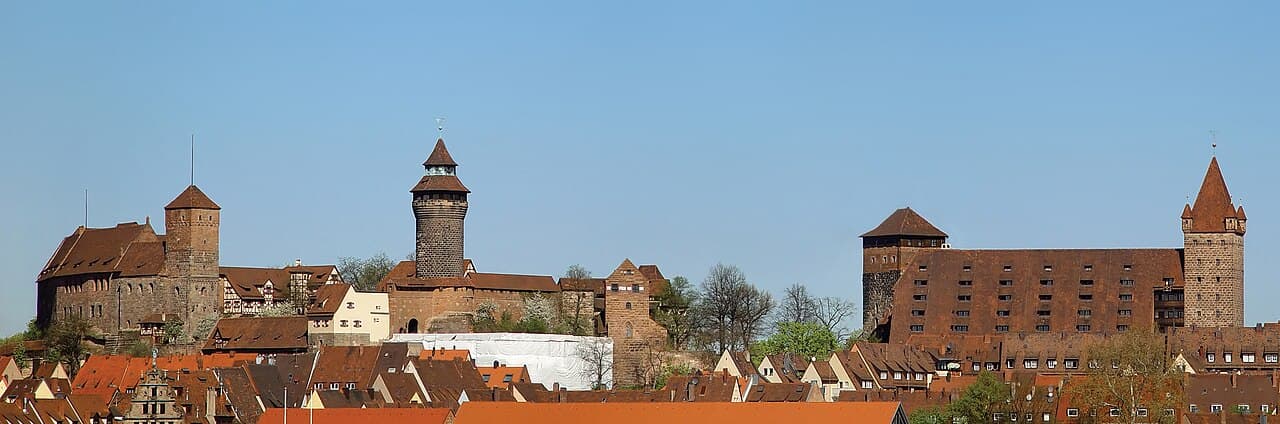
Nuremberg Castle
Nuremberg Castle stands prominently on a sandstone ridge overlooking the historic city of Nuremberg in Bavaria, Germany. This hill castle is one of the most significant medieval fortifications in Europe, embodying the power and prestige of the Holy Roman Empire and the imperial city itself. Its commanding position on a rocky outcrop north of the Pegnitz River provided both strategic defense and a visible symbol of imperial authority from the 11th century onward.
The castle complex is composed of three primary sections: the Imperial castle (Kaiserburg), the Burgraves' castle (Burggrafenburg), and the municipal buildings of the Imperial City (Reichsstadtische Bauten). Together with the extensive city walls, these structures formed a formidable defensive system that protected Nuremberg and asserted its importance within the empire.
The origins and early development
The earliest fortifications on the site date back to around the year 1000, with the castle first documented as a royal property in 1050 under the Salian dynasty. During the High Medieval period, the castle became a favored residence for emperors of the Salian and Hohenstaufen dynasties, including Frederick I Barbarossa, Henry VI, and Frederick II. These rulers used Nuremberg Castle as a political and military center, hosting imperial diets and court assemblies that shaped the governance of the empire.
To administer the castle and maintain order, the office of the burgrave was established, with the burgrave residing in the front section of the complex known as the Burggrafenburg. This office passed to the Counts of Zollern (Hohenzollern family) in 1191, who expanded their territorial influence from this base but eventually came into conflict with the growing autonomy of the imperial city.
The castle and the imperial city in the Middle Ages
The rise of Nuremberg as an imperial city
Nuremberg's strategic location at the crossroads of major trade routes helped it develop into a crucial center for commerce and finance. The Letter of Freedom granted by Emperor Frederick II in 1219 significantly enhanced the city's autonomy, diminishing the power of the burgraves and establishing Nuremberg as an independent imperial city by the mid-13th century.
Power struggles and territorial disputes
Throughout the 14th and early 15th centuries, tensions between the burgraves and the city escalated. In 1420, the Burgrave's castle was attacked and burned during conflicts involving Ludwig VII of Bavaria-Ingolstadt. By 1427, the city had acquired the remains of the Burgrave's castle, consolidating control over the entire castle complex. This transfer marked a turning point, as the castle became fully integrated into the city's administration and defense.
The castle's role in imperial politics
During the late Middle Ages, Nuremberg was regarded as the "most distinguished and best positioned city of the realm." It hosted numerous Imperial Diets, including those mandated by the Golden Bull of 1356 issued by Emperor Charles IV, which required newly elected rulers to hold their first diet in Nuremberg. This elevated the city's status as a political center alongside Frankfurt and Aachen.
Many emperors frequented the castle and city, with Ludwig IV "the Bavarian" staying 74 times and Charles IV 52 times. However, over time, the castle's importance as a royal residence declined. The city hall, completed in 1340, became the preferred venue for assemblies, and emperors increasingly chose to stay in the more comfortable patrician houses of the city.
The imperial regalia were entrusted to the city in 1423 by Emperor Sigismund, symbolizing the trust placed in Nuremberg. The Habsburg emperors Friedrich III and Maximilian I were among the last to reside extensively in the castle. Later emperors, such as Charles V, shifted their political focus elsewhere, partly due to health concerns and changing religious dynamics following the city's acceptance of the Reformation in 1524.
Architectural features and fortifications
Castle layout and key structures
The castle complex is arranged along the sandstone ridge with steep slopes on three sides, providing natural defense. The Kaiserburg includes the Inner and Outer Courtyards, the Palas (main hall), the double chapel, the Sinwell Tower, and the Heidenturm (Pagan Tower). The double chapel, dating from around 1200, is an exceptional example of Romanesque architecture with its two-level design symbolizing medieval social hierarchy. The upper chapel was reserved for nobility and included a special loge for the emperor.
The Sinwell Tower, a cylindrical defensive tower from the 13th century, was heightened in the 1560s to improve surveillance and defense. The Kemenate, a residential building for women, was rebuilt after World War II. The castle also features a 53-meter deep well, the Tief Brunnen (Deep Well), carved into the sandstone to provide water during sieges.
Burgrave castle and city fortifications
The Burggrafenburg retains medieval elements such as the pentagonal tower built around 1192, the Burgvogt’s house from the 11th or 12th century, and the Walpurgiskapelle with its defensive tower. Despite damage during World War II, the chapel was restored and reopened in 1970. The Burggrafenburg also includes the Secret Watchman’s Walk and defensive walls, with a shallower well supplying water.
The imperial city buildings include the Luginsland observation tower (1377) for monitoring the Burggrafenburg, the Vestnertor bastion and gate (1428), and the Kaiserstallung (Imperial Stables), built between 1494 and 1495 by Hans Beheim the Elder. The stables were heavily damaged in World War II and rebuilt in 1953, now serving as a youth hostel. Northern bastions added between 1538 and 1545 by Italian engineer Antonio Fazuni enhanced artillery defenses.
Destruction, restoration, and modern use
The castle suffered severe damage during Allied air raids in World War II, with only the double chapel and Sinwell Tower remaining intact. Postwar reconstruction, led by Rudolf Esterer, adhered to the principle of "creative conservation," restoring the castle to its medieval appearance without reinstating the 19th-century neo-Gothic interiors.
Since the late 20th century, the castle has served cultural and educational roles. A permanent exhibition redesigned in 2013 provides visitors with detailed insights into the castle's architecture, its role within the Holy Roman Empire, and the history of Nuremberg as an imperial city. The exhibition uses engaging displays to appeal to a wide audience, emphasizing the castle's historical significance and its enduring legacy as a symbol of German heritage.
Geological and archaeological significance
Nuremberg Castle is situated on a geologically important sandstone ridge known as the Burgsandstein formation, the type locality for this rock. Archaeological excavations have uncovered foundations of earlier structures, including a Salian round chapel and a bergfried with walls up to two meters thick, dating back to around the year 1000 or earlier. These findings highlight the castle's long history of continuous occupation and strategic importance.
Inside the castle, notable artistic treasures include a late Gothic crucifix by Veit Stoß housed in the imperial chapel. The castle's water supply system, with its deep and shallow wells, exemplifies medieval engineering designed to sustain the fortress during prolonged sieges.
Nuremberg Castle remains a testament to medieval military architecture, imperial power, and the complex political history of the Holy Roman Empire. Its well-preserved structures and rich history make it a vital cultural landmark and a must-visit destination for those interested in medieval history and architecture.
Frequently asked questions (FAQ)
- What is the historical significance of Nuremberg Castle?
- Nuremberg Castle is one of the most important medieval fortifications in Germany and served as the residence of the Holy Roman Emperors. Its strategic location and impressive architecture made it a symbol of imperial power from the 11th century onwards.
- When was Nuremberg Castle built?
- Construction of Nuremberg Castle began in the late 11th century, with significant expansions and renovations occurring over the following centuries. The castle complex reflects various architectural styles, primarily Romanesque and Gothic, which developed as the castle evolved.
- What are the opening hours for Nuremberg Castle?
- Nuremberg Castle is typically open to visitors from 9 AM to 6 PM during the summer months and from 10 AM to 4 PM in winter. It's advisable to check the official website for any seasonal changes or special holiday hours before your visit.
- Can I access Nuremberg Castle with a wheelchair?
- Yes, Nuremberg Castle is partially accessible for visitors with mobility challenges. While some areas may have restrictions due to the historical nature of the site, there are provisions in place to assist those who require it.
- Is it possible to take guided tours of Nuremberg Castle?
- Yes, guided tours are available at Nuremberg Castle, offering visitors insights into its rich history and architectural features. These tours are conducted in multiple languages and can enhance your experience by providing a deeper understanding of the castle's significance.
- What is the best time to visit Nuremberg Castle?
- The best time to visit Nuremberg Castle is during spring and early autumn when the weather is pleasant and the surrounding gardens are in full bloom. Additionally, visiting during weekdays can help you avoid larger crowds typically seen on weekends.
- Are there any nearby attractions to Nuremberg Castle?
- Yes, nearby attractions include the Nuremberg Old Town, the German National Museum, and the Documentation Center Nazi Party Rally Grounds. These sites offer a comprehensive view of Nuremberg's rich history and cultural heritage, making them perfect companions for your castle visit.
- How much do tickets cost for Nuremberg Castle?
- Ticket prices for Nuremberg Castle are generally around €7 for adults, with discounts available for students and seniors. Children under a certain age may enter for free, so it's recommended to check for specific pricing details on the official website before your visit.
Photo gallery

Information
Website
Visit websiteSources & official resources
Verify the information above using these authoritative references.
Loading map...
Visitor reviews
No reviews yet. Been here? Write the first review and help other travelers!
Write the first reviewVisited this castle? Share your experience
Your review helps other travelers and adds first-hand knowledge to our encyclopedia.



