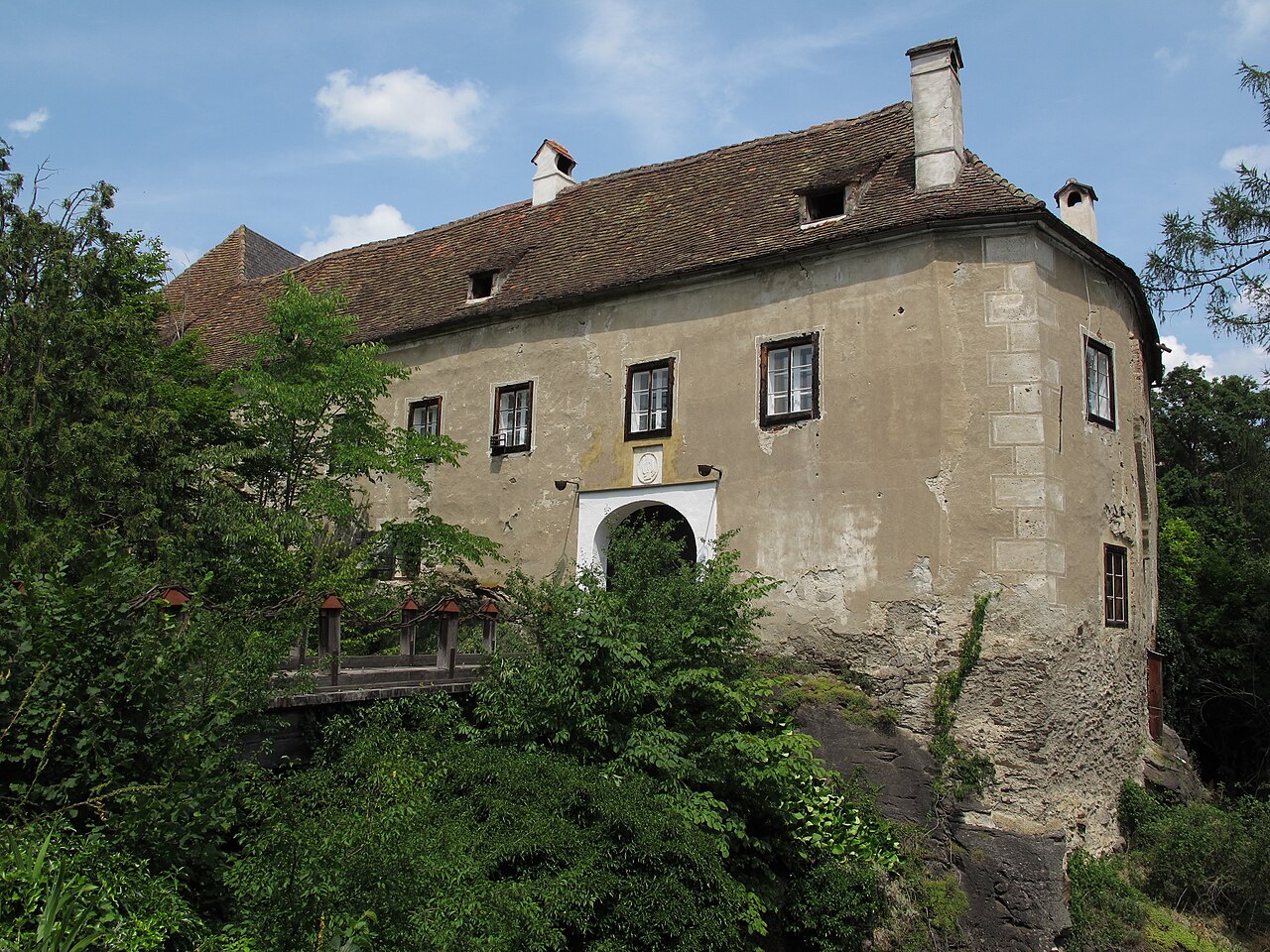
Burgruine Waxenegg
Burgruine Waxenegg stands as a remarkable example of medieval fortification in Austria, embodying centuries of historical evolution and architectural adaptation. Located in the municipality of Naintsch, this hill castle ruin offers a glimpse into the strategic and administrative significance of castles during the medieval period in the region influenced by the Salzburg Prince-Archbishopric.
The earliest records date back to 1217, when the site was first mentioned under the name “Wesseneck.” This documentation marks Burgruine Waxenegg as the earliest known settlement in the Anger area and the upper Feistritz valley. The castle complex is distinguished by its dual structure, consisting of two separate sections: the upper castle, Alt-Waxenegg, and the lower castle, Neu-Waxenegg. These sections are situated on different elevations, with the upper castle occupying a strategic spur of land and the lower castle positioned approximately 100 meters to the east and 50 meters below on a natural terrace.
Historical development and strategic importance
Constructed in the early 13th century, the upper castle was established as a spur castle under ecclesiastical authority, serving both defensive and administrative roles. Its location on elevated terrain provided natural defensive advantages and commanding views over the surrounding landscape, essential for monitoring and controlling the region.
The lower castle, built shortly after the upper section, reflects an expansion of the site’s strategic footprint. This deliberate placement on a lower terrace suggests a functional differentiation between the two parts, possibly accommodating different administrative or residential needs.
Throughout the medieval and early modern periods, Burgruine Waxenegg served as a significant regional administrative center. Its jurisdiction extended from Anger to the border of Lower Austria, underscoring its political and territorial importance. Around the mid-16th century, notable transformations occurred: the upper castle was converted from a purely defensive fortress into a residential dwelling, signaling a shift in the castle’s role in response to changing political and social conditions. Concurrently, the lower castle was abandoned, marking a consolidation of the castle’s functional use.
In 1571, territorial adjustments led to the creation of the new lordship of Birkenstein, based in Birkfeld, which involved ceding part of Waxenegg’s lands. By 1723, administrative functions had moved away from the castle to the nearby market town of Anger, initiating a decline in the castle’s political relevance. From the early 19th century, the castle gradually fell into disrepair, reflecting broader shifts in regional governance and military technology.
The property changed hands multiple times until Ferdinand Reichsfreiherr von Gudenus acquired it in 1806. The castle remains in the Gudenus family today. The late 20th and early 21st centuries have seen renewed interest in the site, with local associations undertaking preservation and restoration efforts since 2021. These initiatives aim to stabilize the ruins and promote cultural activities, although the castle is not officially designated as a protected cultural monument.
Architectural features and ruins
The ruins of Burgruine Waxenegg present a fascinating dual structure, with the upper and lower castle complexes distinctly separated by elevation and terrain. The upper castle occupies a spur of land, utilizing the natural topography for defense and visibility. Remnants of the bergfried, the main defensive tower, are still visible, illustrating the castle's original military function.
Surviving stone walls from various residential buildings within the upper castle highlight the site's adaptation for habitation, particularly following its 16th-century conversion into a residence. A prominent feature is the large gatehouse with an attached tower and ramp designed for a drawbridge, dating from the 16th century. This architectural element exemplifies the blending of defensive and residential purposes during this period.
The lower castle shows remains of substantial walls, though it is heavily overgrown and less accessible. The preserved masonry confirms the extent of this section, but its condition reflects long-term abandonment and natural reclamation by vegetation.
Today, the upper castle is surrounded by forest and accessible via clearly marked, gentle walking paths from nearby parking areas. In contrast, the lower castle is reached by a narrow, unmarked path, underscoring the difference in accessibility and focus of preservation efforts. Restoration work concentrates primarily on the upper castle, aiming to stabilize its ruins while maintaining the site's historical authenticity.
Preservation and cultural significance
Although Burgruine Waxenegg is not officially protected as a cultural monument, local initiatives have played a crucial role in its preservation. Since 2021, a dedicated association has undertaken substantial restoration and stabilization projects. These efforts not only prevent further deterioration but also enhance the site's potential for cultural events and tourism.
The castle's historical importance as an early medieval settlement and administrative center in the Salzburg Prince-Archbishopric region adds to its cultural value. Its dual structure and architectural evolution provide insight into the changing defensive and residential needs of medieval nobility.
Visitors today can explore the ruins and appreciate the blend of military architecture and residential adaptation. The site's natural setting amidst forested hills enhances its appeal, making it a significant landmark for both history enthusiasts and casual hikers.
Visiting information and access
The upper castle ruins are accessible via well-maintained walking paths that start from nearby parking facilities, offering visitors a gentle ascent through scenic forest terrain. Interpretive signage is available to guide visitors and provide historical context, enriching the experience.
Access to the lower castle is more challenging due to the narrow and unmarked path, which requires caution and some hiking experience. The difference in accessibility reflects the focus on preserving the upper castle as the primary site for public engagement.
While there are no official visitor facilities or entrance fees, the site is open year-round, with the best visiting conditions in late spring through early autumn when the paths are clear and the weather is favorable.
Architectural style and period
Burgruine Waxenegg is a quintessential example of an early 13th-century hill castle built in the medieval period. Its original design reflects the typical characteristics of a spur castle, utilizing natural terrain for defense. The 16th-century modifications introduced residential elements and a sophisticated gatehouse, blending defensive architecture with increased comfort and status display.
The castle's architectural style is predominantly medieval, with later adaptations reflecting evolving needs rather than a distinct stylistic movement. The surviving ruins offer valuable insights into construction techniques and castle life during the high to late medieval periods.
Frequently asked questions (FAQ)
- How do I get to Burgruine Waxenegg?
- Burgruine Waxenegg is located near the municipality of Naintsch in Styria, Austria. Visitors can reach the upper castle ruins via marked walking paths starting from nearby parking areas, offering a gentle forest hike.
- What is the historical significance of Burgruine Waxenegg?
- Burgruine Waxenegg is historically significant as the earliest documented settlement in the Anger area and upper Feistritz valley, serving as a medieval administrative center under the Salzburg Prince-Archbishopric.
- Can I visit both the upper and lower castle ruins?
- Yes, visitors can access both the upper and lower castle ruins, but the upper castle is more accessible with marked paths, while the lower castle requires navigating a narrow, unmarked trail and is less accessible.
- Why was the lower castle abandoned?
- The lower castle was abandoned around the mid-16th century when the upper castle was converted into a residential dwelling, consolidating habitation and administrative functions in the upper section.
- Is Burgruine Waxenegg a protected cultural monument?
- Currently, Burgruine Waxenegg is not officially designated as a protected cultural monument, but local associations have undertaken restoration efforts to preserve the ruins and promote cultural activities.
Information
Sources & official resources
Verify the information above using these authoritative references.
Loading map...
Visitor reviews
No reviews yet. Been here? Write the first review and help other travelers!
Write the first reviewVisited this castle? Share your experience
Your review helps other travelers and adds first-hand knowledge to our encyclopedia.