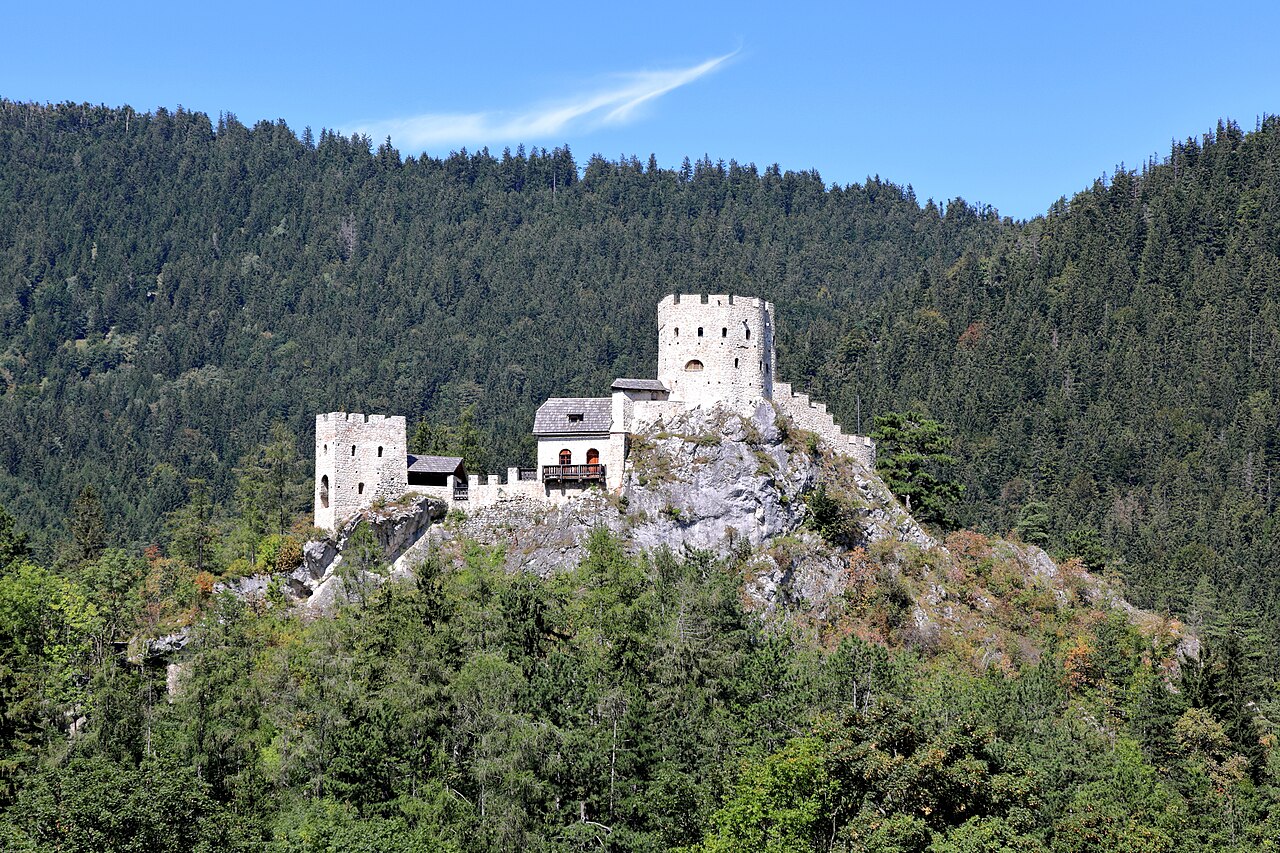
Burgruine Puchberg
Burgruine Puchberg is a remarkable medieval hill castle ruin perched above the Sierning stream on a small plateau in the municipality of Puchberg am Schneeberg, Austria. Constructed in the early 13th century, this fortress has witnessed nearly a millennium of regional history, reflecting the architectural and social transformations of Central Europe over the centuries. It stands today as a testament to medieval defensive design and the adaptive reuse of historic structures through time.
Early history and ownership
The castle's origins date back to the winter of 1204-1205, confirmed by dendrochronological dating of timber from the bergfried, making it one of the oldest precisely dated towers in Lower Austria. The first documented figure associated with Burgruine Puchberg is Eberhard von Puchberg in the 1260s, linked to the Losenheim family. Ownership records are complicated by confusion with another Puchberg am Kamp, but by 1357 the castle likely came under the control of the Stühcse von Trautmannsdorf family.
By 1381, the castle was integrated into a princely domain before passing to Johann von Liechtenstein. After Johann's fall from favor in 1395, control reverted to the prince, underscoring the castle's strategic and noble importance. The Stixenstein family incorporated the lordship around 1500, and by 1547, Hans von Hoyos redeemed the pledge on the estate, taking formal possession in 1549. This marked the beginning of significant structural and functional changes to the castle.
Architectural features and modifications
Fortifications and bergfried
The castle's remains form an irregular quadrangular enclosure, defined by a fortified ring wall approximately 38 meters long on its longest side. The centerpiece is the bergfried, a main tower standing about 18 meters tall, constructed in two phases. The masonry joint on the tower's north side indicates that the ring wall predates the final elevation of the bergfried, revealing a complex building history.
Originally built as a defensive stronghold, the bergfried's construction during the early 13th century reflects typical medieval military architecture, designed for observation and refuge. In the 16th century, the tower was adapted for storage by doubling the intermediate floors, and the original elevated entrance on the south was sealed and replaced by a ground-level entrance on the north side for easier access.
Adaptations for storage and community use
Around 1674, the castle's role shifted from military defense to agricultural storage, specifically as a grain store. This is evidenced by the addition of eight secondary window openings on the south and east sides of the ring wall to provide ventilation. Beam holes within the courtyard suggest the installation of wooden platforms or equipment related to grain handling.
By the mid-19th century, the castle retained a roof and even housed a school until 1837, illustrating its integration into local community life beyond its feudal origins. However, the removal of the roof around 1850 accelerated the ruin's deterioration.
Damage, preservation, and restoration efforts
The castle suffered notable damage during World War II when Russian tanks shelled the southern ring wall, causing significant structural harm. Post-war uses included breeding fur animals and storage, reflecting a period of decline and utilitarian repurposing.
In the 1950s, the local municipality leased the site from the Hoyos family and initiated preservation efforts, including the installation of concrete collars around the bergfried's base to stabilize the masonry. Despite these efforts, safety concerns due to falling stones led to the castle's closure to the public in the 1970s.
The founding of the Burgverein Puchberg am Schneeberg in 2001 marked a turning point in the castle's conservation. Comprehensive surveys and documentation began in 2002, followed by extensive stabilization and restoration work supported by the Federal Monuments Office and local community programs. Between 2002 and 2007, wooden floors inside the bergfried were reconstructed, and a battlement walkway was built along the northern side of the ring wall, facilitating safe public access.
In 2007, archaeological investigations revealed traces of a combined living room and kitchen within the courtyard. This led to the construction of a timber-framed building with a shed roof, featuring a hearth and tiled stove for smoke-free heating, replicating the domestic arrangements of the medieval occupants.
Cultural significance and modern use
Today, Burgruine Puchberg serves as a cultural landmark and venue for community events. Since 2003, it has hosted an international medieval festival every two years, celebrating 13th-century crafts, daily life, and weaponry. Starting in 2006, the castle also became the site for an annual Advent celebration and various receptions, highlighting its renewed role as a center for cultural heritage and public engagement.
The castle's layered history—from a medieval fortress to a grain store, school, and finally a preserved ruin—offers visitors a unique glimpse into the evolving functions of such sites in European history. The combination of original medieval structures and sensitive modern restorations allows for an immersive experience into the architectural and social fabric of the region across centuries.
Architectural legacy and visitor experience
Visitors to Burgruine Puchberg can explore the irregular quadrangular layout enclosed by the fortified ring wall, ascend the restored bergfried to appreciate its medieval construction techniques, and observe the interplay of defensive and domestic architecture. The battlement walkway provides panoramic views and a tangible connection to the castle's military past.
The reconstructed timber-framed building within the courtyard offers educational insights into medieval living conditions, while the ventilation windows and beam holes in the walls tell the story of the castle's adaptation to agricultural storage. Interpretive signage and guided tours enrich the visitor experience by contextualizing the castle's historical transformations.
Burgruine Puchberg stands not only as a monument to medieval architecture but also as a vibrant cultural site, bridging past and present through preservation, education, and community involvement.
Frequently asked questions (FAQ)
- How do I get to Burgruine Puchberg?
- Burgruine Puchberg is located in Puchberg am Schneeberg, Lower Austria. It is accessible by car and local public transportation from Vienna and nearby towns. Parking is available near the site.
- What is the best time to visit Burgruine Puchberg?
- The best time to visit is during the warmer months from spring to autumn when the castle is open for tours and events. The biennial medieval festival and annual Advent celebration are especially popular.
- Is Burgruine Puchberg suitable for families and children?
- Yes, the castle hosts family-friendly events such as medieval festivals that include crafts and demonstrations. The site is safe to explore with supervision, though some areas may have uneven terrain.
- Can I tour the bergfried tower?
- Yes, the bergfried has been restored with wooden floors and a battlement walkway, allowing visitors to safely ascend and enjoy views of the surrounding landscape.
- Are there guided tours available at Burgruine Puchberg?
- Guided tours are available during special events and by arrangement with the local municipality. These tours provide detailed historical and architectural insights.
Information
Opening hours
Seasonal hours, typically spring to autumn
Ticket prices
Free or nominal fee during events
Current owner
Municipality of Puchberg am Schneeberg
Website
Visit websiteSources & official resources
Verify the information above using these authoritative references.
Loading map...
Visitor reviews
No reviews yet. Been here? Write the first review and help other travelers!
Write the first reviewVisited this castle? Share your experience
Your review helps other travelers and adds first-hand knowledge to our encyclopedia.