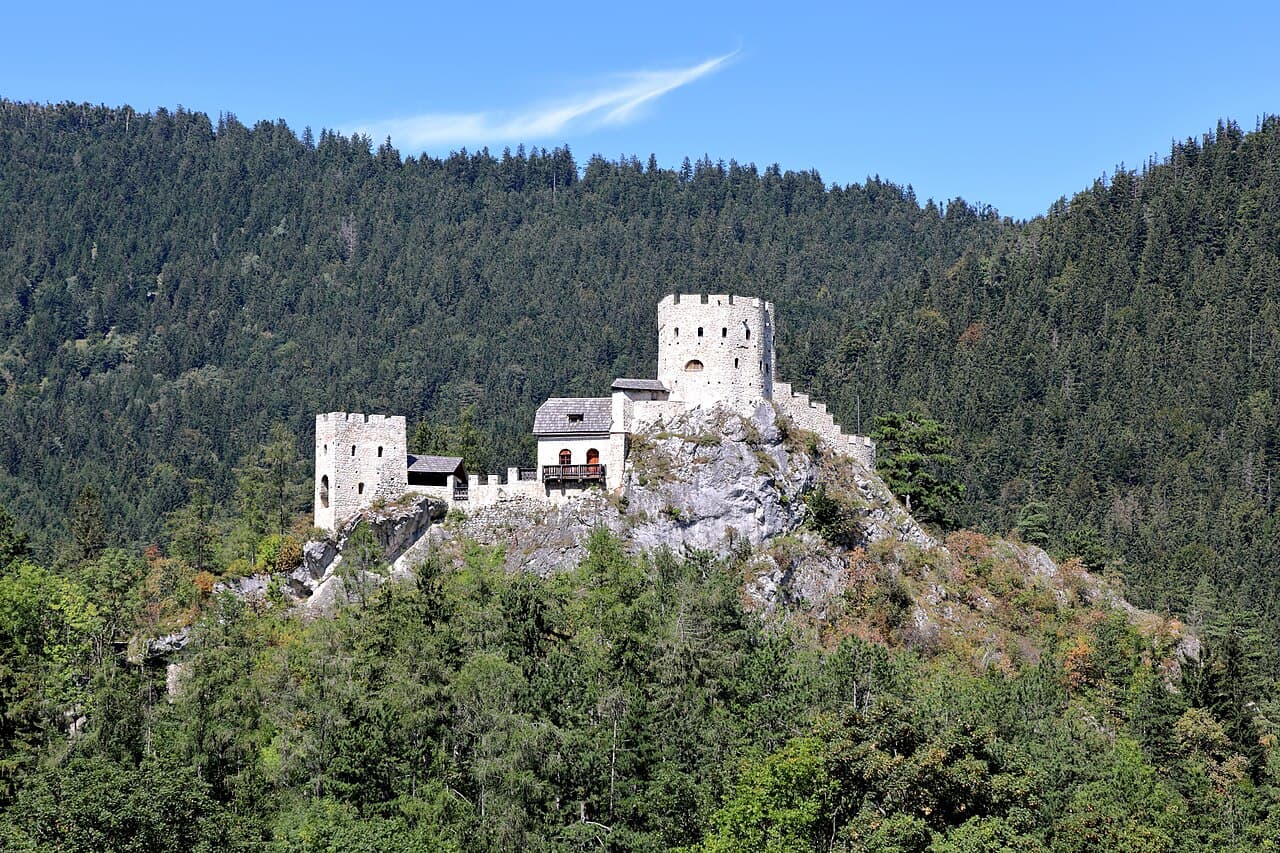
Burgruine Losenheim
Burgruine Losenheim stands as a testament to medieval fortification in the region of Lower Austria. Constructed in the late 12th century, this hill castle was established by the local nobility to assert control over the surrounding territory. Its strategic position on an isolated rocky outcrop north of the modern settlement of Losenheim provided a commanding view of the landscape, crucial for defense and oversight of the surrounding lands.
Historical background and noble lineage
The earliest historical records associate Burgruine Losenheim with the Losenheim family, a noble lineage documented from the early 13th century. This family belonged to the service nobility under the influential Babenberg dynasty, particularly under Duke Leopold VI. Between 1220 and 1304, members of the Losenheim family are noted for their lordship and administrative duties, including managing local lands and overseeing religious tithes.
Throughout the 13th century, the castle formed part of a broader network of fortifications in the Puchberg valley, alongside sites such as Puchberg Castle and an outpost on Romaikogel. These fortifications were instrumental in consolidating territorial control by the Gleißenfeld-Puchberger family, with the Losenheims playing a significant role in the local governance and defense.
In 1264, a notable event was the gift of land and rights by Rüdiger von Losenheim to the Heiligenkreuz Abbey. This transaction included ownership of farms and gardens and the protective authority or vogtship over church tithes in nearby Höflein. Such donations highlight the Losenheim family's influence and their connections with ecclesiastical institutions, which was common among medieval noble families seeking to strengthen their social and political standing.
By the mid-14th century, the lordship of Losenheim appears to have been absorbed into the holdings of Puchberg, reflecting a period of territorial consolidation. This shift likely contributed to the decline in the castle's strategic importance, leading to its eventual abandonment as a noble residence.
Architectural features and site layout
The castle's remains today are modest, reflecting its probable function as a smaller-scale fortified residence rather than a large military fortress. The ruins occupy a rocky spur that provides natural defensive advantages due to its elevation and isolation. The surviving masonry fragments, primarily sections of wall, suggest a compact layout adapted to the rugged terrain.
Typical of hill castles of the period, Burgruine Losenheim would have included a central residential keep or tower, surrounded by defensive walls and possibly a courtyard. The rocky foundation limited extensive expansion, which is consistent with the castle's relatively small footprint. Defensive features such as battlements and arrow slits would have been integrated into the walls to provide protection against attackers.
Restoration efforts initiated in the 1990s by private individuals have focused on preserving these remaining structures, stabilizing the masonry to prevent further decay. These conservation activities ensure that the castle's historical footprint remains visible within the natural landscape, allowing visitors to appreciate the medieval architecture and strategic placement.
Archaeological findings and cultural significance
Archaeological excavations at Burgruine Losenheim have unearthed medieval ceramic shards and other artifacts that provide insight into the daily life and occupation of the castle during its active years. These finds are curated and displayed at the Schneeberg Museum in Puchberg, offering valuable context for understanding the material culture of the region's medieval nobility.
The castle's ruins, though limited in scale, contribute to the cultural heritage of Lower Austria by illustrating the network of noble residences and fortifications that shaped medieval territorial control. The site serves as a tangible link to the region's feudal past and the complex relationships between noble families, ecclesiastical institutions, and territorial lords.
Location and visitor information
Situated approximately five kilometers from Puchberg am Schneeberg, Burgruine Losenheim is accessible for visitors interested in medieval history and castle architecture. The isolated rocky outcrop offers a scenic setting that combines natural beauty with historical intrigue.
While the site is primarily in ruins, the preserved masonry and archaeological context provide an engaging experience for visitors. Conservation efforts have made the ruins safer to explore, though visitors should be prepared for uneven terrain typical of hilltop castle sites.
Nearby attractions
Visitors to Burgruine Losenheim can also explore other nearby historical sites such as Puchberg Castle and the Heiligenkreuz Abbey, both of which hold significant historical and architectural interest in the region.
Accessibility
Due to the castle's hilltop location and rocky terrain, access may be challenging for individuals with mobility impairments. Visitors are advised to wear appropriate footwear and exercise caution when exploring the ruins.
Frequently asked questions (FAQ)
- When was Burgruine Losenheim built?
- Burgruine Losenheim was constructed in the late 12th century, serving as a fortified residence for local nobility.
- What is the historical significance of Burgruine Losenheim?
- The castle was linked to the Losenheim family and played a role in regional power structures during the 13th and 14th centuries.
- Can visitors explore the ruins of Burgruine Losenheim?
- Yes, visitors can explore the ruins, which have been preserved and stabilized through restoration efforts since the 1990s.
- Where can I see artifacts from Burgruine Losenheim?
- Medieval artifacts excavated from the site are displayed at the Schneeberg Museum in Puchberg, providing insight into the castle's history.
- Is Burgruine Losenheim accessible for people with mobility issues?
- Due to its hilltop location and rocky terrain, accessibility is limited, and visitors should be prepared for uneven ground and steep paths.
Photo gallery

Information
Website
Visit websiteSources & official resources
Verify the information above using these authoritative references.
Loading map...
Visitor reviews
No reviews yet. Been here? Write the first review and help other travelers!
Write the first reviewVisited this castle? Share your experience
Your review helps other travelers and adds first-hand knowledge to our encyclopedia.



