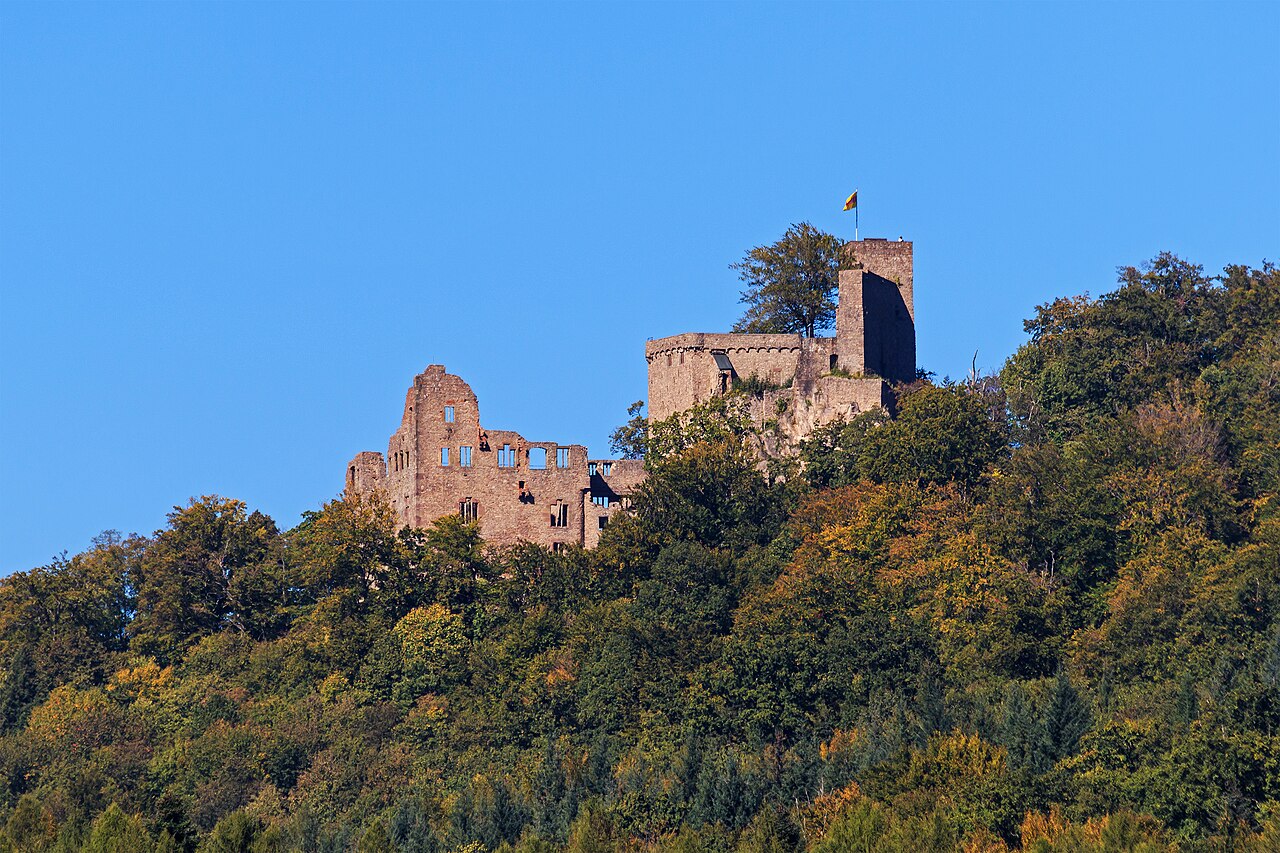
Burg Waldenfels stands as a small yet historically significant medieval hill castle located in the municipality of Malsch in present-day Germany. Constructed during the High Medieval period, this fortress was originally established by the noble Reginbodonen family, a lineage closely tied to the Ufgau region. The castle's strategic position atop a narrow ridge or spur provided natural defense, enhanced by the convergence of two streams at the spur's tip, making it a formidable stronghold despite its relatively compact size.
Early history and foundation
The origins of Burg Waldenfels trace back to shortly after 1086, following the withdrawal of Reginbodo I from official duties. Settling near Malsch, he fostered the development of the surrounding lands and encouraged settlement. By 1110, his successor, Reginbodo II, had reclaimed influence, styling himself as the Count of Malsch and regaining the title of Count of Ufgau. However, after 1115, the Reginbodonen family disappears from regional records, indicating a decline or relocation.
Ownership transitions and medieval significance
Between the mid-12th and mid-13th centuries, the castle came under the control of the Eberstein family, who served as ministerials to the Margraves of Baden after 1219. The Ebersteins were notable for their role as unfree knights or officials, and although the castle and the village of Malsch were associated with them, it remains unclear if Burg Waldenfels was their primary residence or if they lived mainly in the nearby village.
The first documented mention of the castle under the name "castrum wildenfels" dates to 1309, during a partition of the Baden margraviate. At this time, the castle was awarded to Friedrich II. In 1314, Friedrich II and his relative Rudolf IV granted possession to Reinhard von Neuenburg, who likely died shortly thereafter. By 1318, the castle and village were sold to the Herrenalb convent, and were recorded as fiefs of the Weißenburg monastery, indicating a shift to ecclesiastical control.
Later history and decline
Burg Waldenfels is mentioned again in 1431, when Margrave Jakob I of Baden paused his hunting near the site, illustrating its continued recognition in the region. By the 19th century, the castle had fallen into ruin. Starting in 1826, much of its remaining stone was removed to aid in the expansion of the nearby St. Cyriak church in Malsch, accelerating its physical decline.
In the early 21st century, archaeological efforts in 2007 and 2008 sought to preserve and document the remnants of Burg Waldenfels. Excavations uncovered looting pits, surviving foundations, and parts of the castle walls. Informational panels were installed to educate visitors about the castle's history and significance.
Architectural features and castle layout
Burg Waldenfels was designed as a small tower castle occupying less than 400 square meters. Its most prominent feature was a bergfried, a tall main tower typical of medieval German castles, measuring approximately 12.5 meters on each side with foundation walls over 2.6 meters thick. This bergfried was connected to a surrounding ring wall, originally about 1.3 meters wide, which was later reinforced on the western side to around 1.7 meters for enhanced defense.
The southern wall of the castle experienced collapse or slippage into the surrounding ditch during the late Middle Ages and was subsequently rebuilt further inward, altering the castle's original footprint. Defensive structures included two neck ditches to the south, which protected the castle from the higher plateau above. The main entrance was likely located at the southwestern corner of the ring wall, a position that facilitated defense and controlled access.
Within the western portion of the castle grounds, archaeological evidence revealed deposits of slag, indicating the presence of a smithy where metalworking took place. This area likely served as the courtyard for daily activities and crafts. Between the bergfried and the ring wall, in the zwinger or outer ward, layers of refuse from the 11th to 14th centuries were found, including gray pottery and domestic ceramics, providing insights into the castle's prolonged occupation.
Current condition and preservation
Today, only fragments of the western wall and parts of the southern neck ditches remain visible at the site. The archaeological excavations of the early 2000s have allowed for the marking of the bergfried's foundations and sections of the ring wall on the ground, offering visitors a tangible sense of the castle's original layout and scale. These preservation efforts have been crucial in maintaining the historical memory of Burg Waldenfels despite its ruined state.
Cultural and historical importance
Burg Waldenfels serves as a valuable example of a small medieval hill castle with a complex history of noble ownership, ecclesiastical control, and military architecture. Its ties to the Reginbodonen and Eberstein families reflect the shifting power dynamics of the region during the High and Late Middle Ages. The castle's archaeological remains provide important insights into medieval construction techniques, defensive strategies, and daily life within a compact fortress environment.
Frequently asked questions (FAQ)
- What is the historical significance of Burg Waldenfels?
- Burg Waldenfels is a medieval castle that dates back to the 13th century, reflecting the architectural styles and defensive strategies of its time. It played a crucial role in the regional power dynamics of the area and is a testament to the feudal era in Germany.
- When was Burg Waldenfels built?
- Construction of Burg Waldenfels began around the year 1250, and it served as a fortified residence for local nobility. Over the centuries, it has undergone various modifications, showcasing the evolution of castle architecture in Germany.
- Can I visit Burg Waldenfels?
- Yes, visitors are welcome to explore Burg Waldenfels. Guided tours are often available, allowing guests to learn about the castle's history and architecture while enjoying scenic views of the surrounding landscape.
- What are the opening hours for Burg Waldenfels?
- Burg Waldenfels typically opens to visitors from April to October, but hours can vary based on the season. It is advisable to check the official website or contact the castle directly for specific opening times before your visit.
- Is it possible to access Burg Waldenfels for individuals with disabilities?
- Burg Waldenfels has made efforts to improve accessibility; however, due to its historical structure, some areas may present challenges. It is recommended to inquire in advance about specific accommodations available for visitors with disabilities.
- What is the best time to visit Burg Waldenfels?
- The best time to visit Burg Waldenfels is during the spring and early autumn when the weather is pleasant and the surrounding nature is at its most beautiful. These seasons also offer fewer crowds, allowing for a more enjoyable experience.
- Are there any nearby attractions to Burg Waldenfels?
- Yes, there are several attractions near Burg Waldenfels, including picturesque hiking trails and other historical sites. The charming town of Waldenfels itself also offers local dining and shopping experiences for visitors.
- How much do tickets to Burg Waldenfels cost?
- Ticket prices for Burg Waldenfels are typically reasonable, with discounts often available for students, seniors, and children. It's best to check the castle's official website for the most accurate and up-to-date pricing information.
Information
Website
Visit websiteSources & official resources
Verify the information above using these authoritative references.
Loading map...
Visitor reviews
No reviews yet. Been here? Write the first review and help other travelers!
Write the first reviewVisited this castle? Share your experience
Your review helps other travelers and adds first-hand knowledge to our encyclopedia.