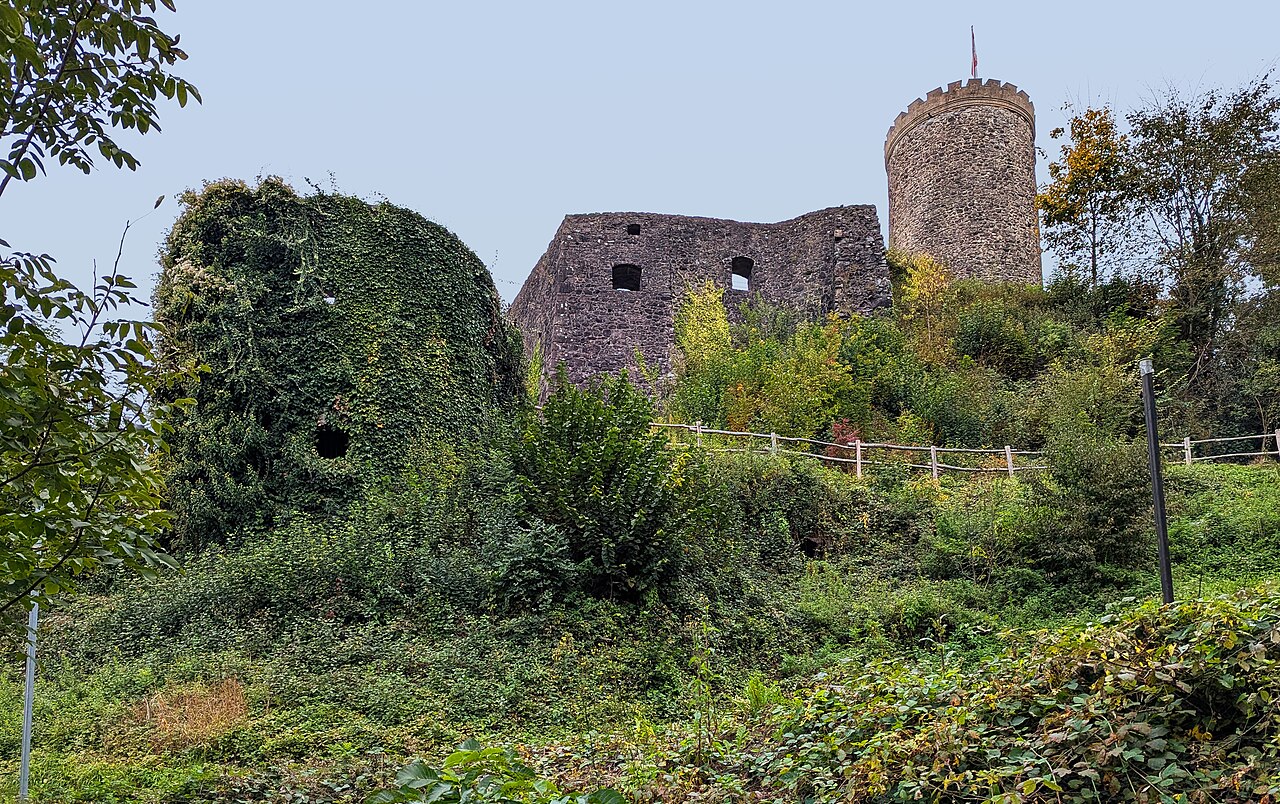
Burg Triberg
Burg Triberg is a notable medieval hill castle situated near the town of Triberg in the scenic region of the Black Forest, Germany. Constructed in the early 13th century, around the year 1200, it was originally built by the local population linked to the territorial division of the noble Hornberg family. The castle’s strategic position on a mountain spur overlooking the Gutach river exemplifies the typical defensive use of natural terrain in medieval fortifications.
The earliest documented mention of Burg Triberg dates back to 1239, found in a legal document involving Count Berthold of Neuenburg and Bishop Lüthold of Basel. This record also references a ministerial named Peter von Triberc, indicating the castle’s early administrative importance and its role within the feudal system. The castle was likely constructed by Burkhard I of Triberg, a scion of the Hornberg lineage, establishing it as a significant noble residence and stronghold.
Historical ownership and political significance
Following the extinction of the Triberg family line, ownership of the castle and the adjacent town passed to the Counts of Hohenberg. In 1355, the castle entered the sphere of influence of the powerful Habsburg dynasty when Duke Albrecht II of Austria acquired the lordship, incorporating Burg Triberg into the Habsburg territories. By 1654, it was officially part of Austrian Vorderösterreich (Further Austria), underscoring its geopolitical importance in the region.
Throughout its history, Burg Triberg was frequently pledged to various regional powers. In 1372, it was pledged to the Margraves of Baden, and later, in 1493, control shifted to the Counts of Fürstenberg. The castle also came under the possession of notable figures such as the legal scholar Ulrich Zasius from Freiburg and the military commander Lazarus von Schwendi during the 16th century.
Destruction and rebuilding phases
Burg Triberg endured several episodes of destruction and reconstruction throughout its active history. It was severely damaged by fire in 1489, necessitating a comprehensive rebuilding effort. The castle suffered again during the German Peasants’ War of 1525, when local rebels and townspeople set it ablaze, leading to another round of repairs carried out with forced labor.
Additional damage occurred in 1616, although details are sparse. The castle’s final destruction came during the Thirty Years’ War when Swedish troops demolished it on Christmas Day in 1642, effectively ending its military and residential use.
Architectural features and archaeological findings
Built as a spur castle, Burg Triberg utilized the natural topography of a mountain spur for enhanced defense. The layout and structural remnants uncovered in the 1934 archaeological excavations provide valuable insights into its original design. Excavations revealed the castle’s ground plan, including foundations and wall fragments, which help reconstruct its footprint and defensive arrangements.
Among the archaeological discoveries is an upright pillar, a rare surviving element that physically connects visitors to the castle’s medieval past. Remaining wall sections, though fragmentary, suggest the castle was a robust fortification with typical medieval defensive features such as thick curtain walls and possibly towers or gatehouses.
Despite the ruins, no decorative architectural elements, inscriptions, or detailed stylistic features have been identified, indicating the castle’s primary function was military and administrative rather than residential luxury. The ruins stand as a testament to the repeated cycles of destruction and rebuilding that shaped Burg Triberg’s history.
The castle’s place in the black forest landscape and heritage
Today, the remains of Burg Triberg are located in an area known as the Burggarten, near the historic Kurhaus spa building in Triberg. The castle ruins are surrounded by dense forest, maintaining the castle’s original strategic relationship with its natural environment. The site offers visitors a tangible connection to the medieval history of the Black Forest region and its complex feudal past.
Though only limited ruins survive, they serve as an important cultural and historical landmark. The castle’s story reflects the turbulent history of southwestern Germany, marked by noble rivalries, warfare, and shifting political allegiances. Burg Triberg remains a significant point of interest for historians, archaeologists, and visitors interested in medieval architecture and regional heritage.
Frequently asked questions (FAQ)
- When was Burg Triberg built and by whom?
- Burg Triberg was built in the early 13th century, likely around 1200, by Burkhard I of Triberg, a member of the Hornberg noble family.
- What led to the destruction of Burg Triberg?
- The castle was destroyed multiple times, notably by fire in 1489 and during the German Peasants' War in 1525. Its final destruction occurred on Christmas Day in 1642 by Swedish soldiers during the Thirty Years' War.
- What remains of Burg Triberg can visitors see today?
- Visitors can see limited ruins including fragments of walls and an upright pillar discovered during 1934 archaeological excavations, located in the Burggarten area near the Kurhaus in Triberg.
- What was the strategic importance of Burg Triberg?
- Burg Triberg was built as a spur castle on a mountain overlooking the Gutach river, using natural terrain for defense and controlling the surrounding region in the Black Forest.
- Which noble families owned Burg Triberg?
- The castle was initially owned by the Hornberg family, then passed to the Counts of Hohenberg, pledged to the Margraves of Baden, controlled by the Counts of Fürstenberg, and later came under Habsburg rule.
Information
Loading map...
Visitor reviews
No reviews yet. Been here? Write the first review and help other travelers!
Write the first reviewVisited this castle? Share your experience
Your review helps other travelers and adds first-hand knowledge to our encyclopedia.