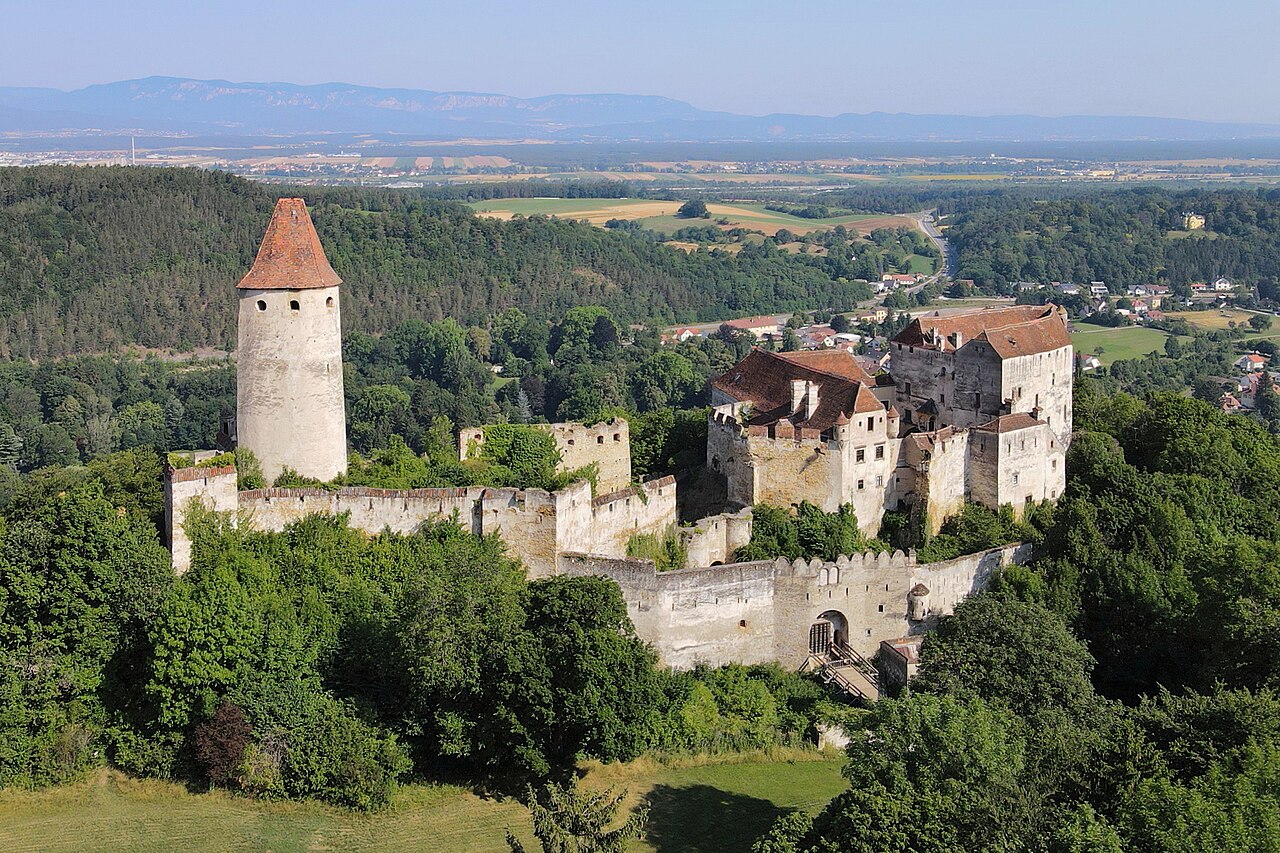
Burg Grimmenstein
Burg Grimmenstein is a remarkable medieval hill castle located in the Pittental on the south-eastern slope of the Kulmriegels in the market town of Grimmenstein, Lower Austria, at an altitude of approximately 660 meters above sea level. This fortress is perched about 100 meters below the summit of Kulmriegel on a rocky outcrop, commanding a strategic vantage point over the surrounding valley. As one of three historic fortifications on the Kulmriegel ridge, Burg Grimmenstein played a crucial role in regional defense, overseeing the Pittental and guarding against eastern incursions.
The castle’s origins trace back to the 12th century, with archaeological and architectural evidence suggesting that parts of its foundations and masonry may be much older, potentially dating to Roman times. Some historians propose that elements of the preserved keep could be remnants of a Roman watchtower nearly 2,000 years old, highlighting the site's long-standing military significance. Over the centuries, the castle has witnessed a complex history of construction, decay, and restoration, reflecting the evolving political and military landscape of medieval Austria.
Historical significance and ownership
The earliest documented owner of Burg Grimmenstein was Albert von Grimmenstein, a vassal under Count Ekbert III von Formbach-Pitten, mentioned between 1144 and 1158. The von Grimmenstein family was influential in the region, with Albert’s son participating in the Fifth Crusade in 1218. The castle’s initial stone fortifications were likely constructed in the 13th century, enhancing its defensive capabilities.
Following the probable extinction of the von Grimmenstein lineage around 1309, the castle passed to Hadmar von Falkenberg and later to ducal authorities. During the 14th and 15th centuries, Burg Grimmenstein was administered by burgraves and occasionally served as collateral in regional power dynamics. Its strategic importance was tied to a network of fortresses and monasteries guarding against Hungarian advances.
The castle’s military role declined over time, culminating in its sale by Emperor Frederick III in 1444. Due to its difficult access and limited residential comfort, the fortress gradually fell into disuse. Ownership transferred to the Order of Saint George after 1470, who undertook restoration efforts to maintain the stone fortifications. In 1522, the castle was handed to the Diocese of Wiener Neustadt but reverted to imperial control a decade later. The last known castellan was Hans Leroch.
Throughout the 17th and 18th centuries, Burg Grimmenstein passed through several noble families, including Baron Kasimir von Petrovich and the Counts Stella-Caracciolo, none of whom established permanent residence. By the early 19th century, the castle had fallen into ruin and was used by local peasants for building materials and storage. The nearby village, originally called Am Treitl, adopted the name Grimmenstein in the 20th century, reflecting the castle’s enduring cultural impact.
Architectural features and layout
Burg Grimmenstein is characterized by its compact rectangular layout, measuring approximately 25 by 30 meters. The fortress is built primarily of stone, with walls that are notably thick—around 2.7 meters at the base, tapering to 1.3 meters at the top. These walls curve slightly outward, conforming to the natural contours of the rocky hill, enhancing the castle’s defensive strength.
A significant defensive feature was a deep moat carved directly into the rock on the more accessible side of the castle, historically spanned by a drawbridge. Although the original drawbridge no longer exists, it has been replaced by a permanent bridge in modern restorations. The most fortified wall, known as the Mantelmauer, reinforced the side facing the gentler terrain.
The castle’s natural defenses were augmented by dense surrounding forest, providing an additional barrier against attackers. The northern wall retains portions of the original 13th-century masonry, which served as a foundation for later construction phases. This layering of masonry visually illustrates the castle’s architectural evolution.
Modern restoration efforts have respected the 13th-century building traditions, incorporating characteristic elements such as projecting oriel windows (erkers), battlemented walls, and specialized niches. Contemporary materials like concrete were used discreetly to ensure structural stability while preserving the medieval floor plan and aesthetic.
Residential and museum spaces
Today, Burg Grimmenstein comprises a three-story residential building that includes living quarters and a knight’s hall. The castle also houses a museum area displaying medieval coats of arms, armor, and other artifacts, offering visitors insight into the fortress’s martial and noble heritage.
Restoration and public access
After decades of neglect and partial ruin, significant restoration began in the 1960s with neo-romantic style repairs using the remaining walls. However, further deterioration occurred until 2014, when Markus Albero Grimmenstein, a descendant of the original owners, undertook extensive restoration work without public funding. By 2016, the castle was restored to approximately 90% of its former structure and opened to the public.
The castle is accessible from the Asfinag parking lot in the valley, with a slow train service operating hourly during opening hours. Visitors can enjoy panoramic views of the Bucklige Welt from the castle terrace, complemented by refreshments and homemade pastries. Burg Grimmenstein is also a popular venue for children’s birthday parties and private events, with heating facilities allowing year-round use.
Cultural and heritage significance
Burg Grimmenstein stands as a protected historic monument and a testament to the region’s medieval military architecture. Its location, architectural features, and layered history make it a valuable cultural landmark in Lower Austria. The castle’s ongoing preservation efforts highlight the importance of maintaining such sites to connect present and future generations with their heritage.
Visitors to Burg Grimmenstein can explore not only the fortress’s structural ingenuity but also the rich tapestry of history embodied in its stones—from possible Roman origins through medieval strategic importance to modern restoration and cultural revival.
Frequently asked questions (FAQ)
- How do I get to Burg Grimmenstein?
- Burg Grimmenstein can be reached via the Asfinag parking lot in the valley. From there, a slow train departs every hour during opening hours, providing convenient access to the castle.
- What is the historical significance of Burg Grimmenstein?
- Burg Grimmenstein dates back to the 12th century and possibly earlier, serving as a strategic hill castle protecting the region from eastern invasions, particularly from Hungarian forces. It was owned by notable medieval families and played a role in regional defense networks.
- Can I visit the castle year-round?
- Yes, Burg Grimmenstein is heated and can be used for events throughout the year, making it accessible to visitors regardless of the season.
- What architectural features can I expect to see at Burg Grimmenstein?
- Visitors can observe thick stone walls with battlements, a deep rock-cut moat, a reconstructed drawbridge replaced by a permanent bridge, projecting oriel windows (erkers), and a three-story residential building including a knight’s hall.
- Are there guided tours available at Burg Grimmenstein?
- Guided tours are offered regularly, allowing visitors to learn about the castle’s rich history, architectural evolution, and the families who lived there. Check the castle’s official website or contact the owner for the current schedule.
Information
Opening hours
Hourly slow train service during opening hours; open to public since 2016
Current owner
Private owner
Website
Visit websiteSources & official resources
Verify the information above using these authoritative references.
Loading map...
Visitor reviews
No reviews yet. Been here? Write the first review and help other travelers!
Write the first reviewVisited this castle? Share your experience
Your review helps other travelers and adds first-hand knowledge to our encyclopedia.